From the free course AP United States Government and Politics on Lykke
4.10 Ideology and Social Policy
Key concepts: First Amendment speech protections · Social media · Information sharing · Voter access to information · Public policy information · Candidate agendas · News stations · Live news updates · Citizen awareness
Social media has transformed the First Amendment’s protection of speech into a daily political contest: citizens, candidates, parties, interest groups, and news organizations can communicate with large audiences almost instantly.
4.10 Ideology and Social Policy
Social media has transformed the First Amendment’s protection of speech into a daily political contest: citizens, candidates, parties, interest groups, and news organizations can communicate with large audiences almost instantly. The constitutional question is not simply who can speak, but how information changes voters’ understanding of social policy and candidate agendas.
LO 4.10.A — Explain how political ideologies influence social policy.
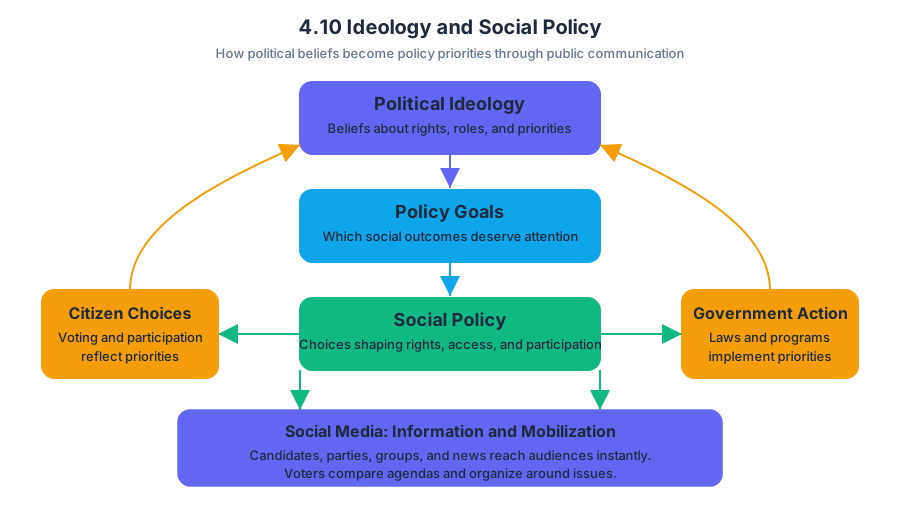
Social policy consists of government choices affecting social relationships, rights, access, and participation. Political ideology helps citizens and policymakers decide which goals deserve priority. Social media connects those ideological preferences to policy information: voters may compare candidates’ positions, parties may promote agendas, and interest groups may organize supporters around particular issues.
Speech protections meet social media
The First Amendment protects freedom of speech from government censorship. In the digital era, people may use social media to share information about topics with audiences interested in those topics. A voter might encounter a candidate’s explanation of an education proposal, an interest group’s argument about voting access, or a news station’s live update about a public event.
This communication can strengthen participatory democracy, a system in which citizens do more than select leaders periodically; they also develop opinions, exchange information, discuss policy, and act politically. News organizations can post live information, keeping citizens updated on current events. Candidates and political parties can communicate directly with voters rather than relying entirely on traditional news coverage.
Important constitutional distinction
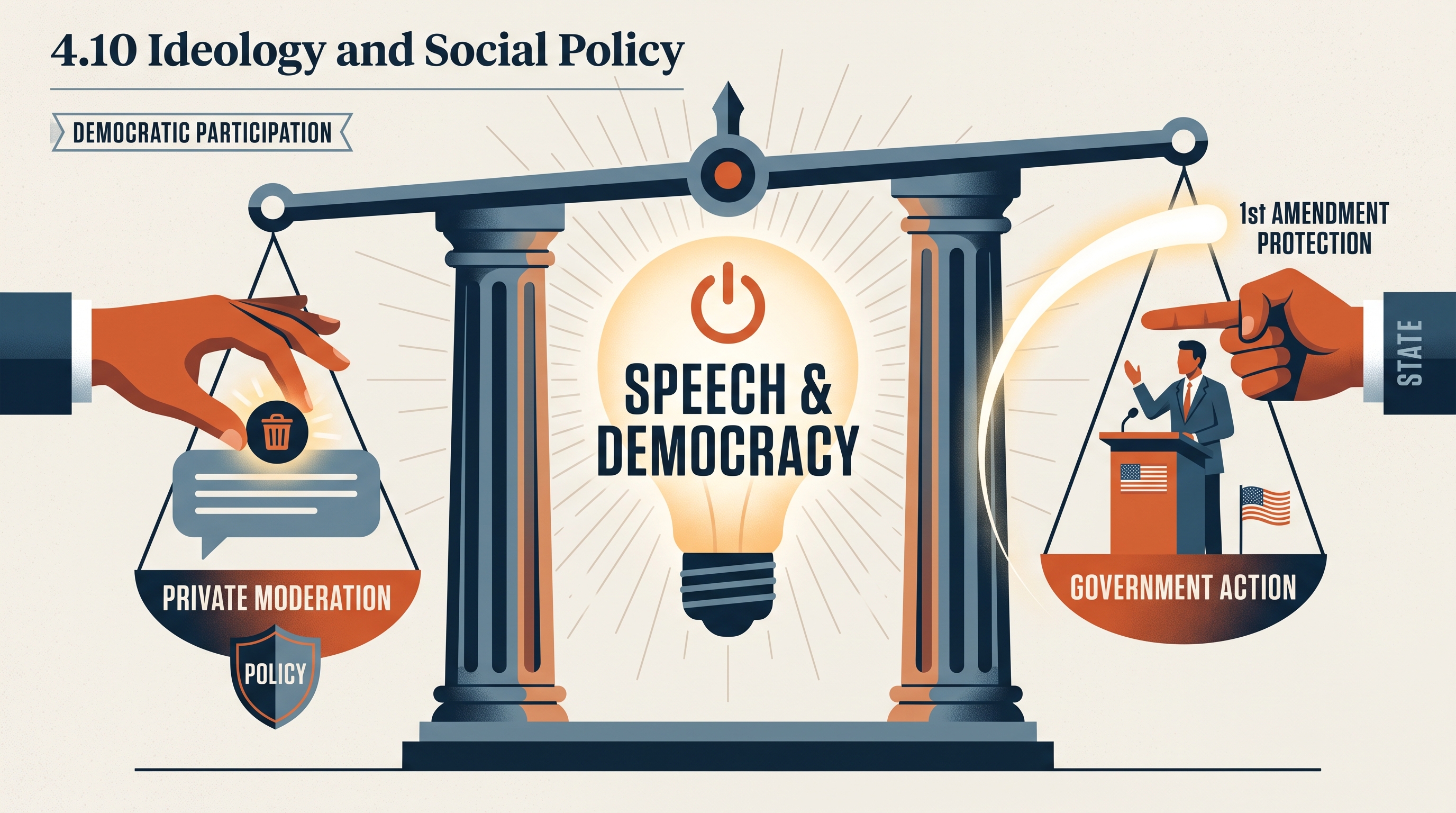
The First Amendment generally restricts government from abridging speech. It does not require a private social-media company to publish every post, preserve every account, or provide every speaker with an unlimited audience. Therefore, “speech is protected” does not mean “every online post must remain available.” The relevant constitutional issue is whether the government is suppressing protected expression, not whether a private platform moderates content under its own rules.
Misconception check: The First Amendment does not guarantee equal reach, guaranteed publication, or freedom from criticism. It protects expression against unjustified government interference.
From information to social-policy choices
Social media can make voters more informed about public policy information—information about what government is doing or what candidates propose to do. A voter can compare candidate agendas, examine party positions, follow interest groups, and observe how competing factions frame the same issue. This comparison matters because voters may be more likely to vote based on issues rather than choosing only the candidate who seems to represent their general ideology.
The process is not automatically beneficial. Information can be incomplete, misleading, or presented only to people who already agree with it. A person who follows only one political party may receive a steady stream of arguments supporting that party’s social-policy agenda while rarely encountering opposing evidence. Thus, social media expands access to political information while also making source evaluation essential.
Worked example: a social-policy campaign
Imagine that a city is debating whether to expand access to early voting. A local news station posts live updates from the city council meeting. One candidate posts a plan supporting expanded access; another argues that existing procedures are sufficient. An interest group shares statistics and asks supporters to contact representatives.
A voter who encounters these messages can identify the policy, compare candidate agendas, connect each position to a broader ideology, and decide whether to vote or participate in the debate. The causal chain is:
First Amendment speech protection → online information sharing → greater awareness of policy and candidates → more informed participation → possible issue-based voting.
This example also reflects the logic of Federalist No. 10: factions—groups pursuing shared political interests—are unavoidable in a free society. Social media gives factions new tools to organize, persuade, and compete for influence. Competition can expose citizens to multiple viewpoints, although it does not guarantee that every viewpoint receives equal attention.
AP skills in action
This topic most directly develops Concept Application (1.A) by applying ideology, social policy, participatory democracy, and First Amendment principles to a contemporary communication setting. It also develops Source Analysis (4.A) when evaluating a candidate post, news update, or interest-group message for its perspective and purpose, and Argumentation (5.A) when defending whether social media strengthens or weakens democratic participation with a claim, evidence, and reasoning.
Retrieval check: A news station posts live election information, while a private platform removes a candidate’s post under its moderation policy. Which action raises the clearest First Amendment question, and why? A strong answer identifies the government-action distinction and then explains how access to reliable information can affect voter awareness and participation.
Source Materials
- AP U.S. Government and Politics Course and Exam Description
- Learn More (.pdf)
- AP U.S. Government and Politics Course Overview
- AP U.S. Government and Politics Course at a Glance
- AP United States Government and Politics Course at a Glance Poster
- AP United States Government and Politics
- AP United States Government and Politics
- United States Government and Politics Sample Syllabus 1