From the free course AP United States Government and Politics on Lykke
4.5 Measuring Public Opinion
A poll is not a crystal ball; it is a carefully designed measurement instrument that uses a smaller group of people to estimate what a larger population thinks.
4.5 Measuring Public Opinion
A poll is not a crystal ball; it is a carefully designed measurement instrument that uses a smaller group of people to estimate what a larger population thinks. Its usefulness depends less on the number of questions asked than on how the sample was selected, how the questions were worded, and how the results were reported.
Learning Objective 4.5.A: Explain how scientific polling can be used to measure public opinion.
From a population to a sample
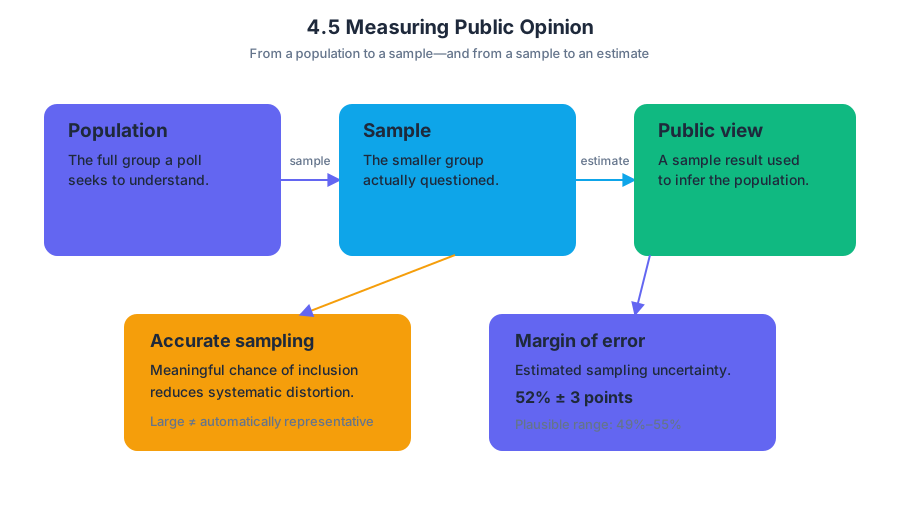
The population is the full group a poll seeks to understand—for example, all likely voters in a state. A sample is the smaller group actually questioned. Because polling every member of the population is usually impractical, pollsters use sampling methods designed to produce a sample that resembles the population in politically important ways.
A strong sample is not simply a large one. If a poll asks only people who attend a particular political rally, it may receive thousands of responses but still fail to represent the broader electorate. Accurate sampling methods give different members of the target population a meaningful chance of being included and reduce systematic distortion.
A poll also commonly reports a margin of error, an estimate of how much the sample result may differ from the actual population view because the poll questioned a sample rather than everyone. If Candidate Rivera receives $52%$ support in a poll with a margin of error of $\pm 3$ percentage points, the poll estimates that support could plausibly fall within a range from $49%$ to $55%$, assuming the poll was properly designed.
Three campaign-related polls
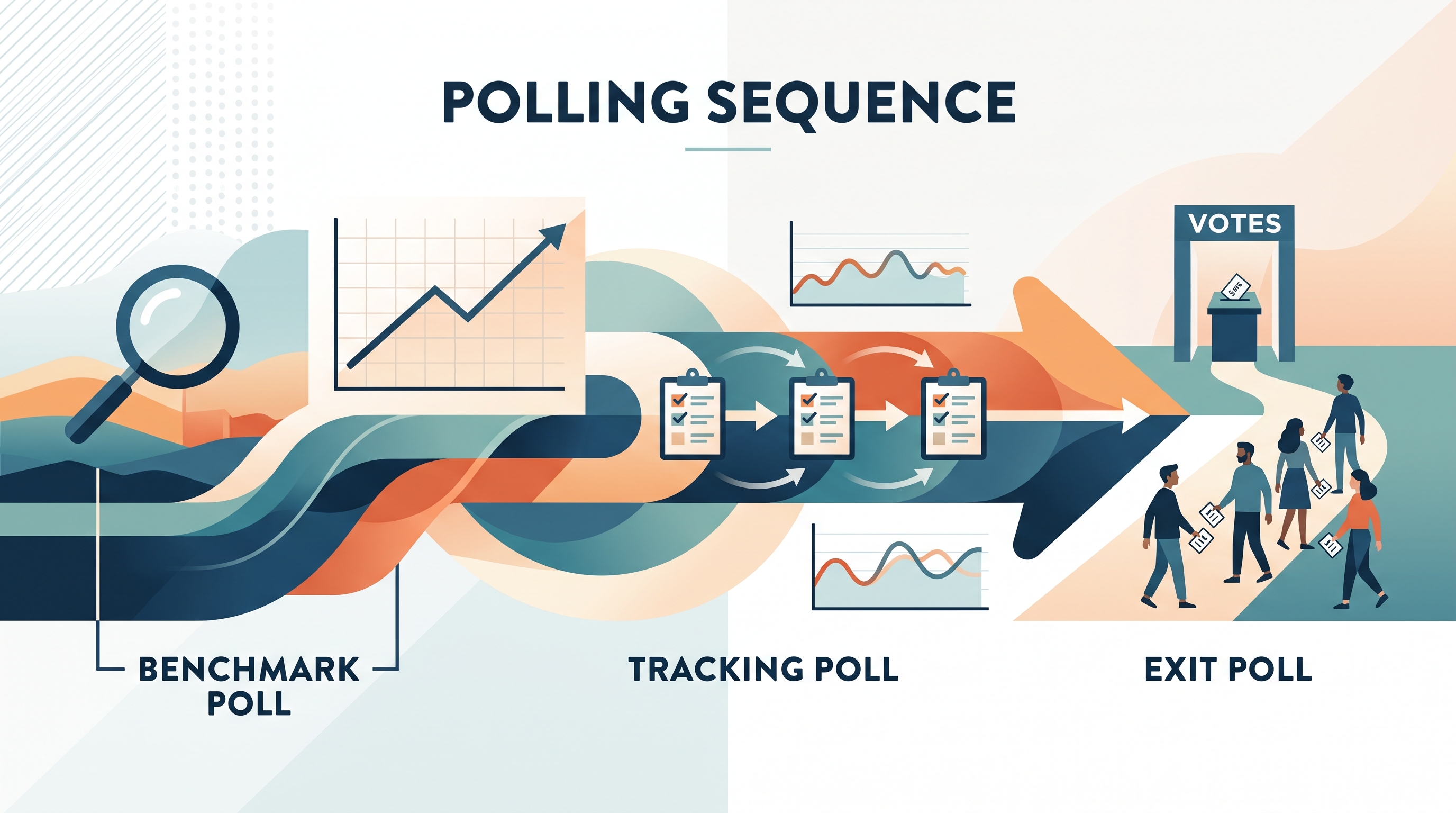
Different polls answer different questions about political opinion. Their timing and purpose matter:
| Poll type | Main purpose | What it establishes |
|---|---|---|
| Benchmark poll | Creates an initial baseline view of a candidate | Where candidate support begins |
| Tracking poll | Follows changes in candidate views during a campaign | Whether support appears to shift over time |
| Exit poll | Questions voters after they vote | Why voters say they voted as they did |
A campaign might begin with a benchmark poll showing Rivera at $38%$ support. After several weeks of advertising and debates, tracking polls can record how reported opinions change. On Election Day, an exit poll may ask voters which issue mattered most and why they selected a particular candidate. The three polls do not serve interchangeable purposes: the first establishes a baseline, the second monitors movement, and the third gathers explanations from people who have already voted.
Why wording changes measurement
Neutral framing of questions means using specific, unbiased wording that does not push respondents toward a preferred answer. Compare these original examples:
- “Do you support the mayor’s reckless spending plan?”
- “Do you support the mayor’s proposal to increase funding for public transit?”
Both questions address the same policy proposal, but the first embeds a negative judgment in the word reckless. A respondent’s answer may therefore reflect the poll’s wording rather than an independently held opinion. Precise polling avoids loaded language, clarifies what policy is being described, and provides response choices that do not conceal important alternatives.
Why reporting matters
Accurate reporting requires clear presentation of what the data actually show and conclusions that the data can support. A poll should identify the population surveyed, the sample, the timing of interviews, and the margin of error when appropriate. Without that information, readers cannot tell whether a result describes registered voters, likely voters, adults generally, or some narrower group.
Suppose a statewide poll reports Rivera with $52%$ support and opponent Chen with $49%$ support, with a margin of error of $\pm 3$ percentage points. Reporting Rivera as “leading by exactly $3$ points” creates false precision: the reported difference is smaller than the possible uncertainty around each estimate. The responsible description is that the candidates are separated by a small reported difference and that the poll does not establish a certain outcome.
Named misconception check
Misconception: “A poll is reliable because it surveyed a lot of people.” A large sample can still be biased if its participants were selected poorly or if the questions were slanted. Conversely, a carefully selected smaller sample can provide useful information. Sample quality, question neutrality, and transparent reporting work together.
Retrieval check
A poll begins by asking a politically neutral question of a properly selected sample of likely voters. It is conducted before any campaign advertising, repeated during the campaign, and administered to voters leaving polling places. Identify the sequence of poll types.
Answer: The sequence is benchmark poll, tracking poll, and exit poll. The sampling, wording, and reporting criteria introduced here provide the basis for evaluating public-opinion data in the next topic.
Source Materials
- AP U.S. Government and Politics Course and Exam Description
- Learn More (.pdf)
- AP U.S. Government and Politics Course Overview
- AP U.S. Government and Politics Course at a Glance
- AP United States Government and Politics Course at a Glance Poster
- AP United States Government and Politics
- AP United States Government and Politics
- United States Government and Politics Sample Syllabus 1