From the free course AP United States Government and Politics on Lykke
2.10 The Court in Action
Key concepts: Supreme Court decision-making and legal holdings · SCOTUS case comparison · Equal Protection Clause and racial gerrymandering · Commerce Clause · Natural rights and democratic ideals · First Amendment freedom of speech · Clear and present danger doctrine · Congressional power to regulate interstate commerce · Wisconsin v. Yoder and Cantwell v. Connecticut · Concept application using Supreme Court cases
A Supreme Court decision is not merely a vote for “yes” or “no”; it is a holding, the Court’s legally controlling answer to a constitutional question, built from the facts of a case, the relevant constitutional clause, and the Court’s reasoning.
2.10 The Court in Action
A Supreme Court decision is not merely a vote for “yes” or “no”; it is a holding, the Court’s legally controlling answer to a constitutional question, built from the facts of a case, the relevant constitutional clause, and the Court’s reasoning. The same constitutional principle can produce different holdings when the regulated activity changes.
CED alignment: Topic 2.10 The Court in Action; Learning Objective CON-6; Essential Knowledge CON-6.A, CON-6.B, and CON-6.C; AP Skill SCOTUS Application 5.A: Identify the constitutional principles and relevant Supreme Court holdings in a given scenario; 5.B: Compare the reasoning and outcomes of different Supreme Court cases; and 5.C: Explain how Supreme Court decisions affect constitutional principles, government power, and individual rights.
A case reaches the Court as a chain of reasoning
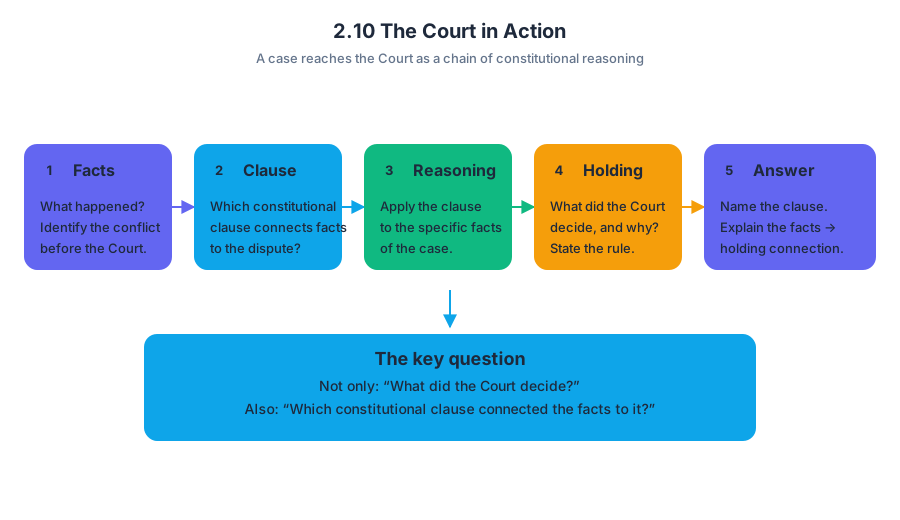
A reliable way to analyze a required case is to follow this chain:
The key question is not only what did the Court decide? It is also: What constitutional clause connected the facts to that decision? AP questions often award a point for naming the clause and additional points for explaining how the facts produced the holding.
Racial gerrymandering: Shaw v. Reno and Bush v. Vera
Racial gerrymandering occurs when race is used as the predominant factor in drawing electoral district boundaries. The constitutional limit comes from the Equal Protection Clause of the Fourteenth Amendment, which requires government to treat people equally under the law.
In Shaw v. Reno (1993), North Carolina created a majority-minority congressional district whose boundaries were unusually shaped. The Court held that voters could challenge a districting plan when race appeared to be the dominant consideration, because racial classifications in redistricting can violate equal protection.
After the 1990 census, Texas received three additional congressional districts. When the state legislature redrew its congressional boundaries, race played a predominant role in shaping several districts. In Bush v. Vera (1996), the Court applied the same Equal Protection Clause principle: districts drawn primarily on the basis of race must satisfy constitutional scrutiny, and the Texas plan was found unconstitutional.
The cases therefore share both a constitutional basis and a constitutional problem:
| Feature | Shaw v. Reno | Bush v. Vera |
|---|---|---|
| Constitutional clause | Equal Protection Clause of the Fourteenth Amendment | Equal Protection Clause of the Fourteenth Amendment |
| Government action | Congressional redistricting | Congressional redistricting after Texas gained three districts |
| Central concern | Race used as the predominant factor | Race used as the predominant factor |
| Holding | Racially driven districting may be challenged | Racially driven districts violated equal protection |
Misconception check — “Majority-minority districts are automatically unconstitutional.” Not exactly. The problem is not simply that a district contains a racial majority. The constitutional issue is whether race was used as the predominant factor in drawing the boundaries without sufficient constitutional justification.
Retrieval check: Which clause connects Shaw and Bush? What fact must a comparison explain to earn more than a simple case description?
Answer: The Equal Protection Clause of the Fourteenth Amendment; the response must explain how race-driven redistricting produced similar holdings.
The Commerce Clause: Katzenbach v. McClung and United States v. Lopez
The Commerce Clause gives Congress authority to regulate interstate commerce—economic activity that crosses state lines or substantially affects the national market. The Court’s interpretation of this clause can either support broad federal power or impose limits on it.
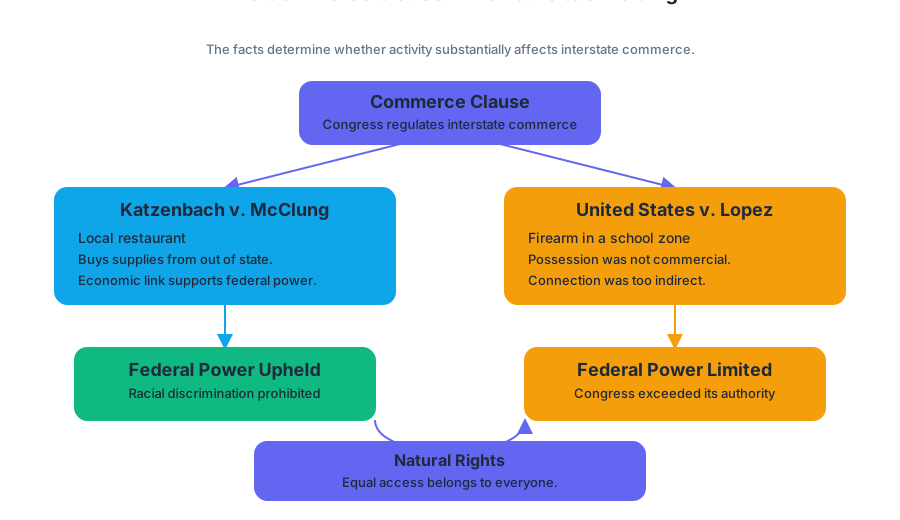
In Katzenbach v. McClung, a restaurant received supplies from out of state. Even though the restaurant itself operated locally, its purchases connected it to interstate commerce. Congress could therefore regulate the restaurant under the Commerce Clause, including prohibiting racial discrimination in public accommodations.
United States v. Lopez reached a different holding. The case concerned possession of a firearm in a school zone. Unlike the restaurant’s commercial purchasing, possessing a firearm in a school zone was not sufficiently commercial or connected to interstate commerce. Congress had exceeded its Commerce Clause power.
The comparison turns on the facts, not on a vague statement that both cases involve federalism:
Katzenbach also reflects the democratic ideal of natural rights—rights understood as inherent in all people rather than gifts from government. By permitting Congress to prohibit racial discrimination in public accommodations, the decision protected equal access and treated discrimination as a threat to rights belonging to everyone.
Speech and danger: Schenck v. United States
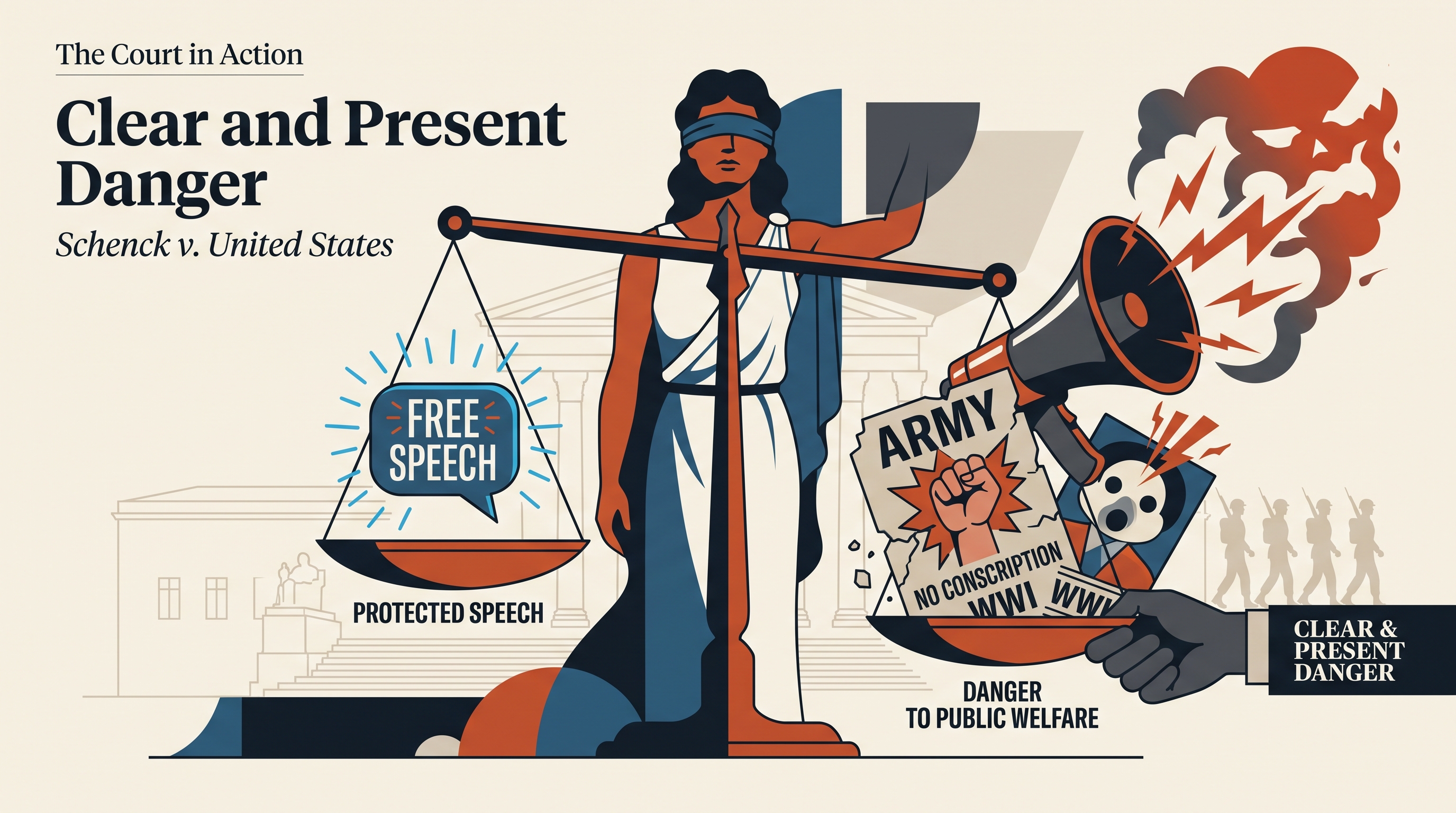
In Schenck v. United States, Charles Schenck distributed antiwar pamphlets urging resistance to the military draft. He was convicted under the Espionage Act, and the Court upheld the conviction under the clear and present danger doctrine: First Amendment protection does not extend to speech that presents a clear and present danger to public welfare.
The distinction is between speech that is merely offensive and speech the government identifies as creating a serious danger connected to unlawful action or public safety. Thus, a constitutional analysis must examine the speech’s context, purpose, and likely consequences rather than treating “free speech” as unlimited protection.
Misconception check — “The First Amendment protects every statement a person makes.” The First Amendment restricts government censorship, but recognized categories and circumstances can permit government regulation. In Schenck, the Court treated draft resistance during wartime as speech presenting a clear and present danger.
Final interpretation check: Why did Katzenbach support federal regulation while Lopez limited it?
Answer: The restaurant’s out-of-state purchases connected its commercial activity to interstate commerce; firearm possession in a school zone lacked a sufficient commercial connection. A strong SCOTUS comparison names the shared clause, identifies the decisive facts, states each holding, and explains the causal link between facts and outcome.
Source Materials
- AP U.S. Government and Politics Course and Exam Description
- Learn More (.pdf)
- AP U.S. Government and Politics Course Overview
- AP U.S. Government and Politics Course at a Glance
- AP United States Government and Politics Course at a Glance Poster
- AP United States Government and Politics
- AP United States Government and Politics
- United States Government and Politics Sample Syllabus 1