From the free course AP United States Government and Politics on Lykke
2.14 Holding the Bureaucracy Accountable
Key concepts: Congressional oversight · Implied powers of Congress · Power of the purse · Joint committees · Budget and Impoundment Control · Bureaucratic accountability · Congressional hearings and investigations · Executive-agency accountability · Bureaucratic discretion in implementing laws · Republican accountability in policymaking
Congress does not need to run every federal agency to control what agencies do; it can investigate, monitor, supervise, and deny or condition funding. This relationship is congressional oversight: Congress’s use of its constitutional and implied powers to determine whether the executive branch is carrying out laws…
2.14 Holding the Bureaucracy Accountable
Congress does not need to run every federal agency to control what agencies do; it can investigate, monitor, supervise, and deny or condition funding. This relationship is congressional oversight: Congress’s use of its constitutional and implied powers to determine whether the executive branch is carrying out laws as intended.
LO 2.14.A: Explain how Congress uses its oversight power in its relationship with the executive branch.
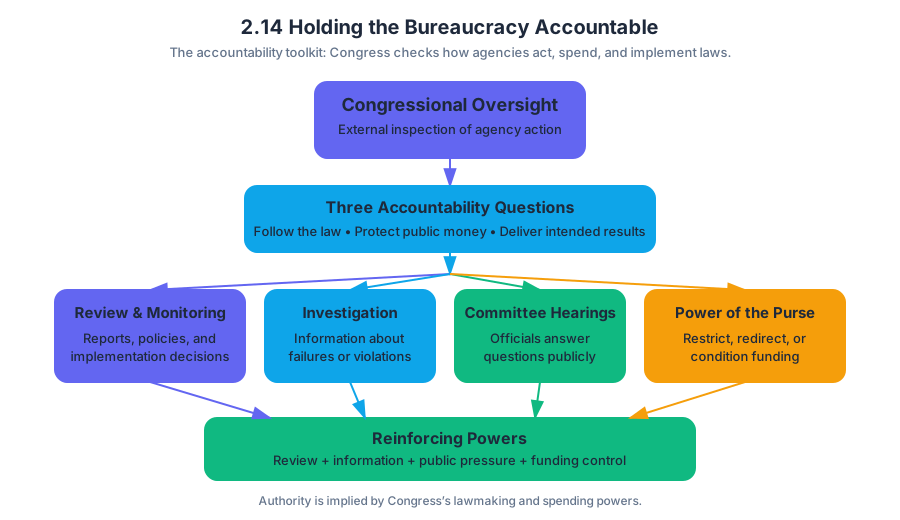
EK 2.14.A.1: Congressional oversight of the bureaucracy to ensure that legislation is implemented as intended includes review, monitoring, and supervision of bureaucratic agencies; investigation and committee hearings of bureaucratic activity; and the power of the purse, or Congress’s authority to control funding.
The accountability toolkit
Congressional oversight works like an external inspection system. Agencies possess expertise and operate continuously, while Congress writes laws and controls resources. Oversight allows legislators to ask: Did the agency follow the law? Did it use public money properly? Did its implementation produce the result Congress intended?
The tools reinforce one another rather than functioning as isolated powers:
- Review, monitoring, and supervision: Congress examines agency reports, policies, performance, and implementation decisions.
- Investigation: Committees gather information about possible mismanagement, failures, or violations.
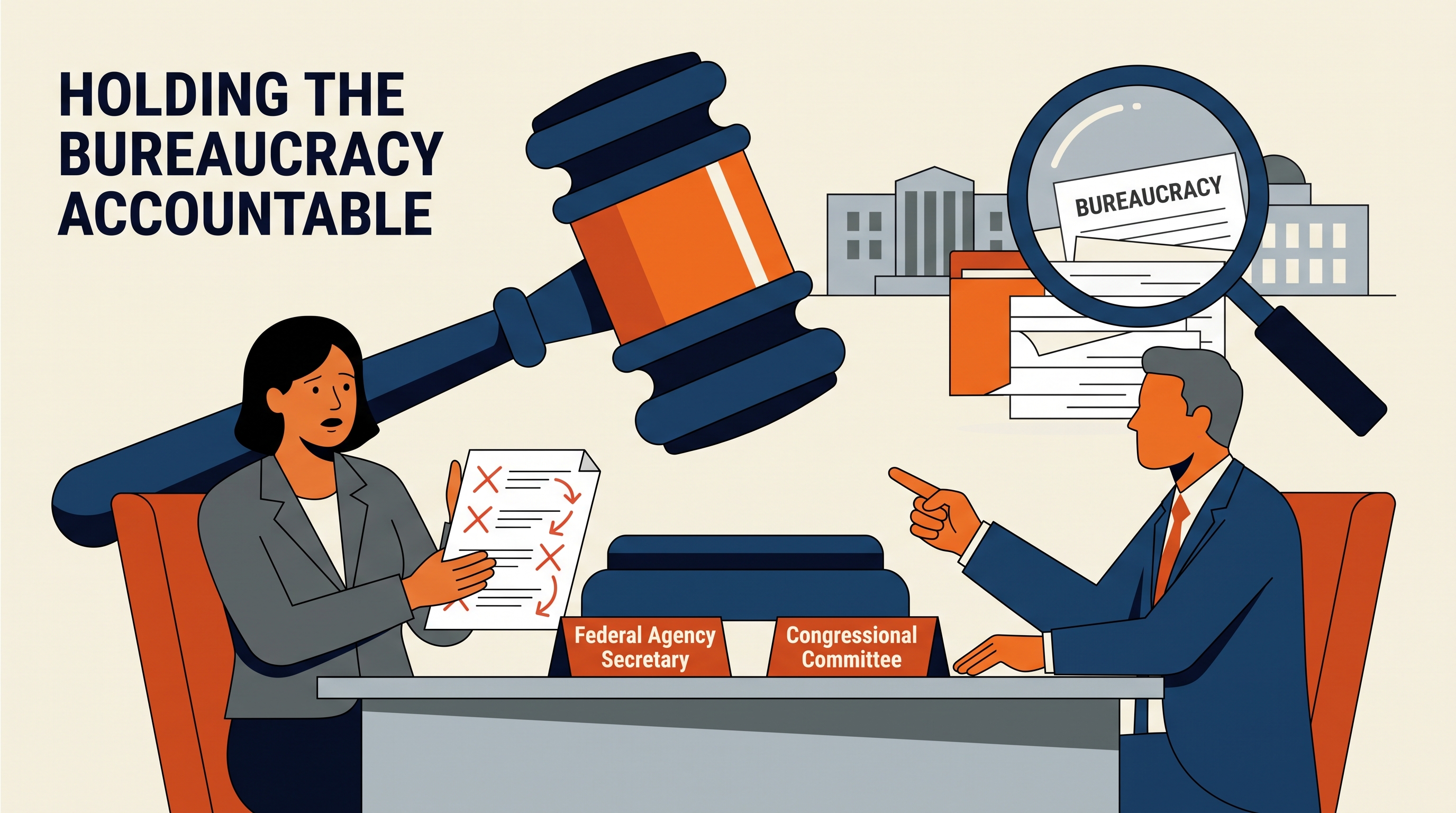
- Committee hearings: Agency officials may be questioned publicly and required to explain their actions.
- Power of the purse: Congress appropriates funds and can restrict, redirect, or condition money.
- Implied oversight power: Although the Constitution does not present one single sentence labeled “oversight,” Congress derives oversight authority from its legislative, investigative, appropriations, and necessary-and-proper powers.
Oversight in action: the 2020 census
The 2020 census provides a clear example of accountability in a policymaking context. The House Committee on Oversight and Reform, led by Chairperson Maloney, investigated Secretary of Commerce Wilbur Ross after concerns arose that he had failed to disclose problems affecting census execution.
The reasoning chain is specific:
- The bureaucratic problem was poor execution and inadequate disclosure in the census process.
- The congressional response was investigation and committee oversight.
- The official held accountable was Secretary Ross, who led the department responsible for the census.
- The constitutional connection was Congress’s implied power to oversee executive agencies and ensure that legislation is implemented as intended.
A strong response would therefore say that the House committee used congressional oversight—through investigation and a hearing—to require the secretary to explain the census problems and to examine whether the executive branch was administering the law properly. Merely writing “checks and balances” is incomplete: it names a broad principle but does not identify the oversight method or connect it to the census facts.
Exam precision: Identify the tool, identify the agency or official, and connect the tool to the bureaucratic failure described in the scenario.
The power of the purse
Congressional control over money is one of its most practical checks on the bureaucracy. Through appropriations, Congress decides how much funding an agency receives and may attach conditions to that funding. An agency may have discretion in carrying out a law, but it cannot spend money Congress has not authorized or appropriated.
The Budget and Impoundment Control Act (1974) is relevant because it strengthened Congress’s role in the federal budget process and addressed presidential attempts to withhold, or impound, funds that Congress had provided. The larger principle is institutional: executive officials cannot simply nullify congressional priorities by refusing to spend appropriated money.
Committees and continuing supervision
Congress often conducts oversight through committees because committees specialize in policy areas and can hold hearings, request documents, question officials, and examine agency performance. Joint committees, which include members of both the House and Senate, provide one mechanism for coordinating congressional attention across the two chambers, although not every joint committee has the same legislative authority as a standing committee.
Oversight can also respond to national crises. After the 9/11 terrorist attacks, Congress examined the performance and coordination of intelligence and security agencies. Such investigations sought to identify failures and improve implementation, demonstrating that bureaucratic accountability is not limited to ordinary budget disputes.
Administration changes, implementation changes
The EPA Superfund example under the Reagan administration illustrates how the implementation of environmental laws can change when a new administration changes agency priorities and management practices. The statute may remain in force while the bureaucracy alters enforcement emphasis, administrative choices, or the pace of implementation.
This does not mean that agencies may ignore law. It means that bureaucratic accountability matters precisely because agencies possess room to interpret and administer broad congressional instructions. Congress can respond through hearings, investigations, statutory revisions, reporting requirements, or funding decisions.
Common misconception — “Oversight means Congress directly commands every agency decision.”
Oversight is monitoring and accountability, not day-to-day administration. Agencies implement policy, while Congress uses its legislative and budgetary powers to check whether implementation follows congressional intent.
AP skill: Data Analysis (3.C)
Data Analysis (3.C): Explain patterns and trends in data to draw conclusions. A bureaucracy question may include performance data, funding figures, inspection results, or implementation trends. Do not merely identify that one number is higher or lower. Explain what the pattern suggests about agency performance and then connect that conclusion to an oversight tool.
For example, if an agency’s inspection completion rate falls while its appropriation rises, the pattern may support congressional investigation or a hearing about management. If funding is repeatedly withheld from a program, the trend may indicate that Congress is using the power of the purse to pressure the agency.
Retrieval check
A committee discovers that a federal agency mishandled a major program and summons the agency’s secretary to explain the failure. Which oversight method is most directly being used, and why is calling it only “checks and balances” insufficient?
Answer: The method is congressional investigation and a committee hearing, an exercise of Congress’s implied oversight power. “Checks and balances” is too general because it does not identify the concrete mechanism or explain how it addresses the agency’s failure.
Source Materials
- AP U.S. Government and Politics Course and Exam Description
- Learn More (.pdf)
- AP U.S. Government and Politics Course Overview
- AP U.S. Government and Politics Course at a Glance
- AP United States Government and Politics Course at a Glance Poster
- AP United States Government and Politics
- AP United States Government and Politics
- United States Government and Politics Sample Syllabus 1