From the free course AP United States Government and Politics on Lykke
4.2 Political Socialization
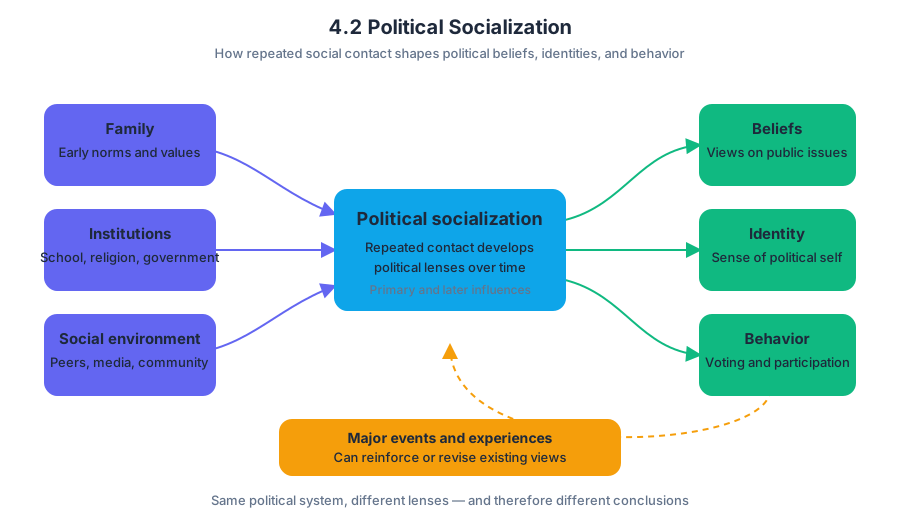
Political socialization is the process through which people develop political beliefs, values, identities, and patterns of political behavior. A child does not begin with an opinion about climate policy, voting, or the proper size of government; those views develop through repeated contact with people,…
4.2 Political Socialization
Political socialization is the process through which people develop political beliefs, values, identities, and patterns of political behavior. A child does not begin with an opinion about climate policy, voting, or the proper size of government; those views develop through repeated contact with people, institutions, media, and major events.
CED Learning Objective 4.2.A: Explain how political socialization affects political beliefs and behaviors.
Political socialization helps explain why people exposed to the same political system can reach different conclusions. Two citizens may receive the same news about climate change but interpret it differently because their families, communities, religious traditions, peer groups, schools, and personal experiences have supplied different political lenses.
The agents that shape political attitudes
An agent of political socialization is a person, group, institution, or experience that influences political learning. The major agents include family, schools, religion, peers, the media, and major political events.
| Agent | How it can shape political beliefs or behavior |
|---|---|
| Family | Introduces early opinions about government, parties, public issues, and civic participation |
| Schools | Teach constitutional principles, political institutions, citizenship, and participation |
| Religion | Provides moral or ethical perspectives that may influence views on social and economic policy |
| Peer groups | Reinforce, challenge, or modify political opinions through discussion and social pressure |
| Media | Supplies political information and frames which issues appear important or urgent |
| Major political events | Create lasting impressions that may shape an entire generation or alter existing beliefs |
Family often has an especially early influence because political ideas are learned before individuals can independently evaluate competing arguments. However, early influence is not permanent. Schools, friends, media environments, employment, community conditions, and major events can reinforce or change political attitudes over time.
Worked example: climate-change opinion
Imagine a line graph showing the percentage of Americans who believed that climate change would pose a serious threat in their lifetime. The graph reports that 32% of Americans held that belief in 2010 and shows an overall increase from 1997 to 2015.
To interpret the political-socialization connection, proceed in three steps:
- Identify the political attitude: concern about climate change.
- Describe the change: the percentage believing climate change posed a serious lifetime threat increased overall between 1997 and 2015.
- Explain the mechanism: repeated exposure to scientific information, media coverage, school instruction, political debate, and experiences with severe weather could socialize citizens into viewing climate change as a more serious public issue.
That change in public opinion can affect political behavior. An environmental interest group could use the upward trend to argue that more citizens support environmentally friendly policies and could pressure Congress through lobbying, public campaigns, or constituent mobilization. The key reasoning is not merely that people changed their minds; it is that socializing influences helped shape an attitude, and that attitude could motivate participation and policymaking pressure.
Political socialization and political generations
People who experience the same major event during their formative years may develop a shared political outlook. A generation that comes of age during an economic crisis, war, civil-rights movement, terrorist attack, pandemic, or major environmental disaster may remember the event as evidence about what government can do, what threats matter, or whether political institutions deserve trust.
This does not mean every member of a generation thinks alike. Political socialization interacts with race, socioeconomic status, geography, religion, education, family experience, and personal interests. A major event may therefore produce a broad generational tendency without creating uniform political beliefs.
Essential Knowledge 4.2.A.1: Political socialization is the process by which individuals develop political beliefs and values.
Essential Knowledge 4.2.A.2: Family, schools, religion, peer groups, the media, and major political events influence political socialization.
Named misconception check
Misconception: Political socialization means political indoctrination. Socialization does not necessarily involve deliberate propaganda or forced agreement. It describes the broader process of learning political ideas, including ordinary conversations at home, classroom experiences, media exposure, community traditions, and firsthand encounters with government.
Misconception: One agent determines a person’s political ideology. No single influence mechanically produces a political position. Political beliefs emerge from the interaction of multiple agents, and later experiences can modify earlier views.
AP skills in action
This topic most directly develops Skill 1.B: Explain how political concepts and processes relate to political institutions, government policies, political behaviors, and outcomes. For example, connect political socialization to an interest group’s decision to pressure Congress or to a citizen’s decision to vote, protest, or contact a representative.
It also uses Skill 3.A: Identify and describe the data presented in a table, chart, or graph, Skill 3.B: Describe the patterns and trends in quantitative data, and Skill 3.C: Draw conclusions from quantitative data. A strong response identifies the relevant value, accurately describes the overall trend, and then draws a supported conclusion about political behavior or policymaking.
Retrieval check
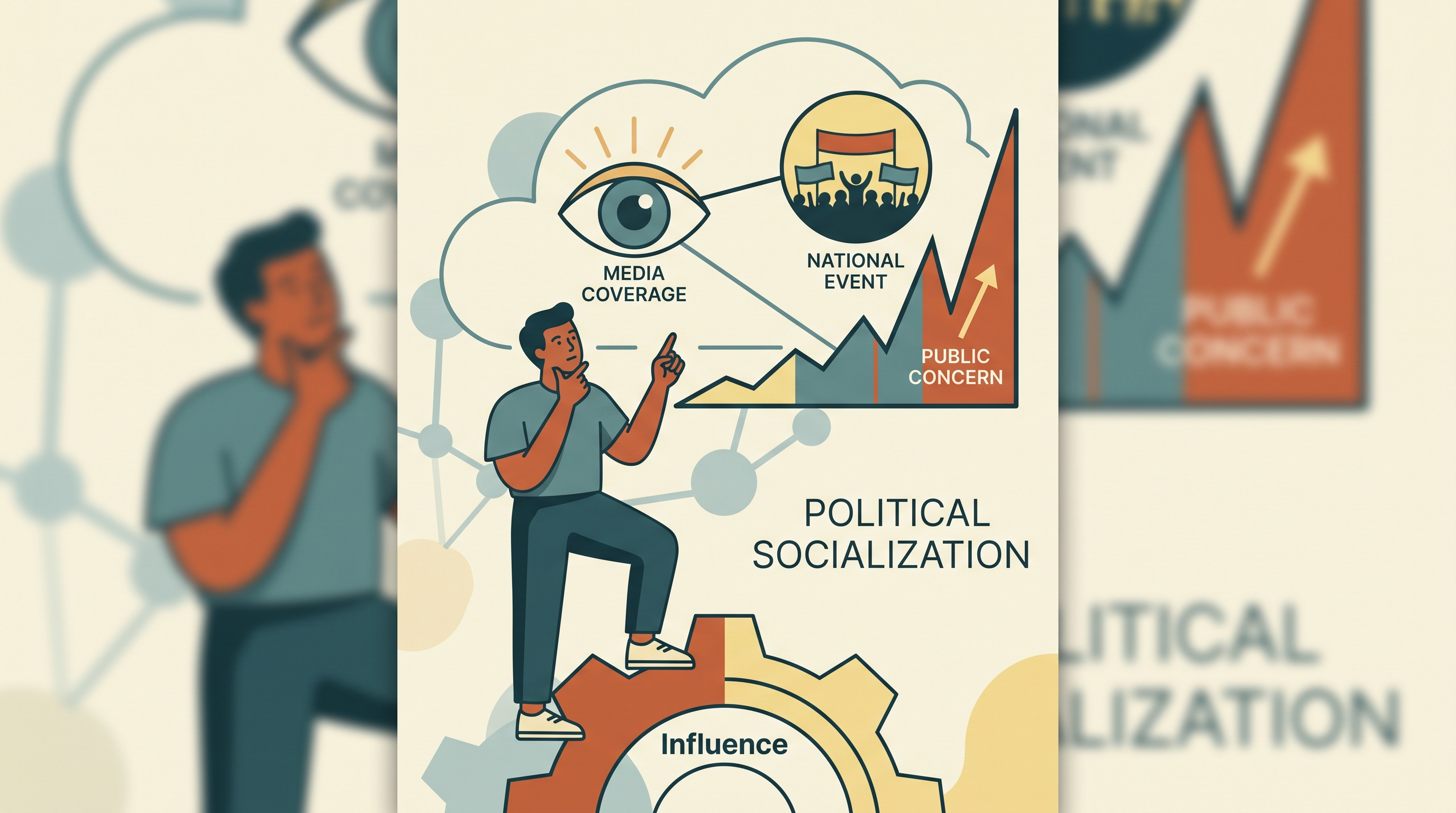
A survey shows that concern about an issue rises sharply after sustained media coverage and a major national event. Name two agents of political socialization, describe one trend the survey might show, and explain how the trend could influence political participation or public policy. A complete answer must connect the influence to a specific political behavior or outcome—not merely state that public opinion changed.
Source Materials
- AP U.S. Government and Politics Course and Exam Description
- Learn More (.pdf)
- AP U.S. Government and Politics Course Overview
- AP U.S. Government and Politics Course at a Glance
- AP United States Government and Politics Course at a Glance Poster
- AP United States Government and Politics
- AP United States Government and Politics
- United States Government and Politics Sample Syllabus 1