From the free course AP United States Government and Politics on Lykke
3.1 The Bill of Rights
Key concepts: Bill of Rights · Individual liberties · Civil rights · Protection from arbitrary government interference · Constitutional rights · Rights of citizens · Rights involving opinions and property · Judicial interpretation · Supreme Court cases · Liberty and order
A government can become dangerous not only when it is too weak to keep order, but also when it is powerful enough to silence opinions, search homes, punish dissent, or take property without fair procedures.
3.1 The Bill of Rights
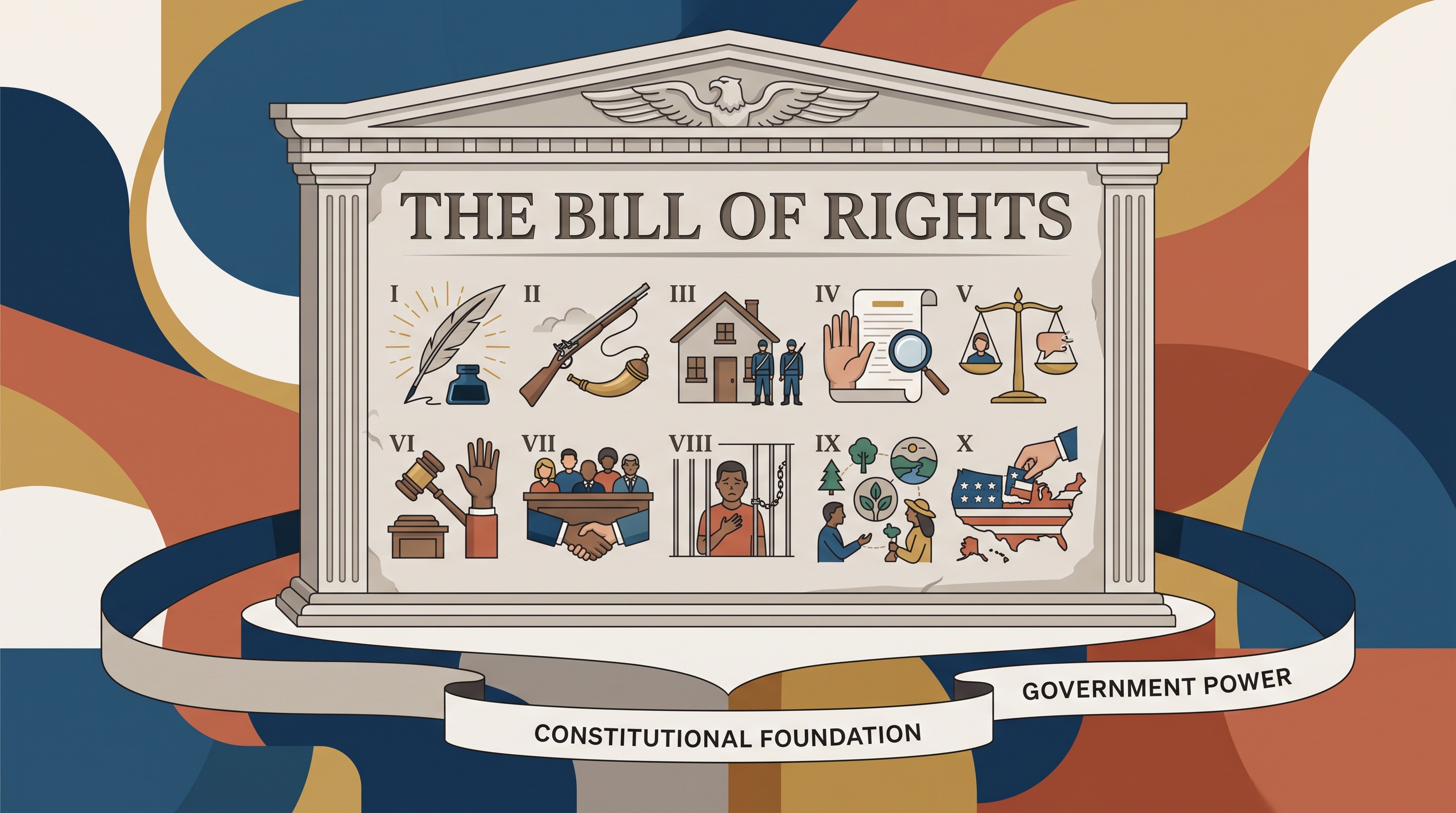
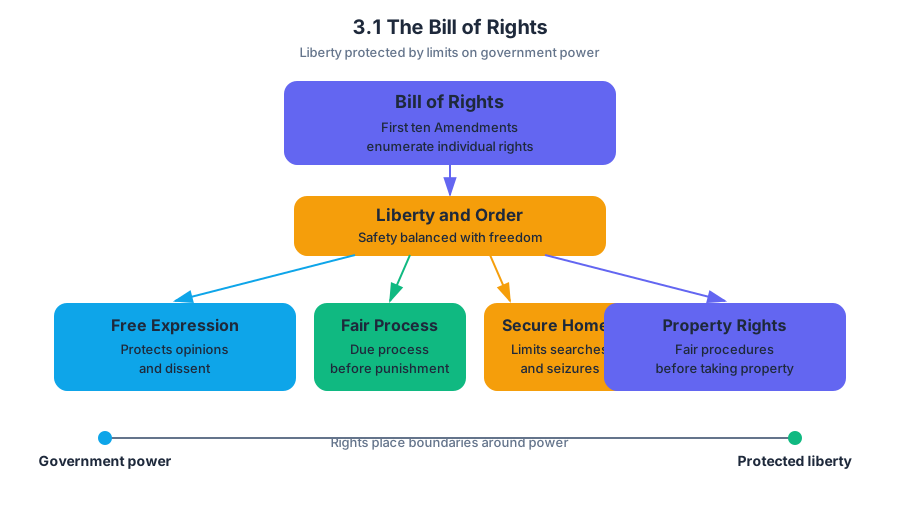
A government can become dangerous not only when it is too weak to keep order, but also when it is powerful enough to silence opinions, search homes, punish dissent, or take property without fair procedures. The Bill of Rights is the Constitution’s explicit answer to that danger: the first ten Amendments establish protections against arbitrary government interference.
Bill of Rights: The first ten Amendments to the Constitution, which enumerate the liberties and rights of individuals.
The central tension is liberty and order. Government must maintain public safety and administer laws, but constitutional rights limit the methods it may use. The Bill of Rights therefore does not eliminate government power; it places boundaries around that power.
Constitutional liberties versus civil rights
Civil liberties are constitutionally established guarantees and freedoms that protect citizens, their opinions, and their property against arbitrary government interference. Examples include freedom of speech, protection against unreasonable searches, religious liberty, and the right to a fair criminal trial.
Civil rights concern protection from unequal treatment and the guarantee of equal protection under the law. The distinction is useful but not absolute: a dispute may involve both liberty and equality. For example, a government rule could restrict expression, while its selective enforcement against one racial or religious group could raise a civil-rights issue as well.
| Concept | Core question | Typical constitutional concern |
|---|---|---|
| Civil liberties | What may government not do to an individual? | Can officials search, censor, or punish without sufficient justification? |
| Civil rights | Is government treating people equally under the law? | Is a law or policy discriminating against a protected group? |
Misconception check — “The Bill of Rights protects people from every unfair action.” Not exactly. Its primary function is to restrict government action. A private employer, website, or neighbor may create serious problems, but the constitutional question is usually whether a government actor is responsible and whether a specific constitutional protection applies.
What the first ten Amendments protect
EK 3.1.B.1: The Bill of Rights consists of the first ten Amendments to the Constitution, which enumerate the liberties and rights of individuals. Their protections include:
- First Amendment: religion, speech, press, assembly, and petition.
- Second Amendment: the right to keep and bear arms.
- Third Amendment: protection against the quartering of soldiers in private homes.
- Fourth Amendment: protection against unreasonable searches and seizures, including requirements related to warrants.
- Fifth Amendment: protections involving grand juries, double jeopardy, self-incrimination, due process, and property taken for public use.
- Sixth Amendment: rights of criminal defendants, including a speedy and public trial, an impartial jury, notice of charges, confrontation of witnesses, and assistance of counsel.
- Seventh Amendment: jury trials in certain civil cases.
- Eighth Amendment: limits on excessive bail, excessive fines, and cruel and unusual punishments.
- Ninth Amendment: recognition that listing certain rights does not mean people possess no other rights.
- Tenth Amendment: reservation to the states or the people of powers not delegated to the United States by the Constitution.
This list is not a menu that government may selectively ignore. Each protection must be interpreted in context. The meaning of an “unreasonable” search, an “excessive” punishment, or a sufficient form of due process may depend on the facts of a case and on how courts understand constitutional principles.
Courts make the protections operational
EK 3.1.A.3: The application of the Bill of Rights is continuously interpreted by the courts. Courts examine the facts, identify the constitutional issue, interpret the relevant text and precedent, and announce a holding—the legal rule that resolves the dispute.
A useful case-analysis chain is:
Facts → constitutional issue → holding → reasoning → effect on government power
For instance, imagine police officers enter a person’s home without a warrant because they believe evidence might be inside. The constitutional issue is not simply whether the officers were trying to solve a crime. The analysis asks whether the search was reasonable under the Fourth Amendment, whether an exception to the warrant requirement applies, and what remedy or limitation follows if the search was unconstitutional.
Worked application: liberty and order
A city adopts a rule allowing officials to inspect every home without individualized suspicion during a period of heightened security. Supporters argue that universal inspections improve public safety. A constitutional analysis begins by identifying the affected liberty—security against government searches—then asks whether the city’s broad method is reasonable, whether less intrusive alternatives exist, and whether the rule gives officials uncontrolled discretion.
A strong response does not merely write “the Fourth Amendment applies.” It explains the conflict: the city pursues order, while the Amendment protects liberty by limiting suspicionless government searches. The court’s interpretation determines how those values are balanced in practice.
AP skill connection
LEARNING OBJECTIVE LO 3.1.A: Explain how the U.S. Constitution protects individual liberties and rights. EK 3.1.A.1 identifies the Constitution’s Bill of Rights as specifically designed to protect individual liberties and rights. EK 3.1.A.2 defines civil liberties as constitutional guarantees against arbitrary government interference.
This topic is assessed through Suggested Skill: Concept Application — Describe political principles and through Supreme Court reasoning. Skill 2.A: Describe the facts, issue, holding, reasoning, decision, and majority opinion of required Supreme Court cases. Skill 2.C requires applying constitutional principles and reasoning to a political situation. In case comparisons, 5.A and 5.B emphasize using evidence and explaining how it supports a conclusion rather than merely naming similarities or differences.
Retrieval check: A state bans a peaceful public demonstration criticizing the governor. Is the strongest initial classification a civil liberty or a civil-rights issue? Identify the relevant amendment and explain, in one sentence, how the policy creates a liberty-and-order conflict.
Source Materials
- AP U.S. Government and Politics Course and Exam Description
- Learn More (.pdf)
- AP U.S. Government and Politics Course Overview
- AP U.S. Government and Politics Course at a Glance
- AP United States Government and Politics Course at a Glance Poster
- AP United States Government and Politics
- AP United States Government and Politics
- United States Government and Politics Sample Syllabus 1
- AP US Gov Past Exam Questions — AP Central
- Khan Academy — AP US Government and Politics
- YouTube — Heimler's History
- YouTube — Jocz Productions