From the free course AP United States Government and Politics on Lykke
2.2 Structures, Powers, and Functions of Congress
Key concepts: Bicameral structure of Congress · Senate · House of Representatives · Differences in the structures, powers, and functions of the two houses · Design-based differences between the Senate and House · Filibuster · Cloture · Congressional behavior and partisanship · Entitlement spending · Discretionary spending and tax revenues
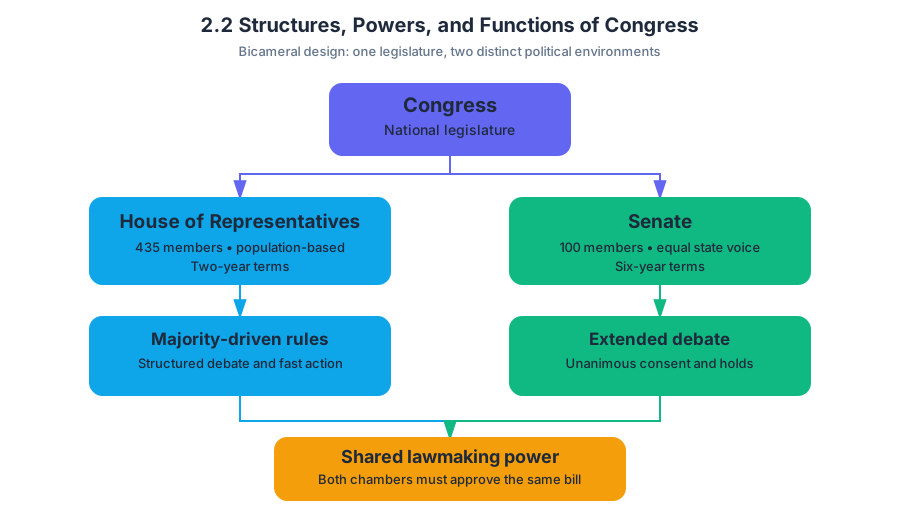
Congress is bicameral by design: the House of Representatives and the Senate share lawmaking power, but their different rules force legislation through two different political environments.
2.2 Structures, Powers, and Functions of Congress
Congress is bicameral by design: the House of Representatives and the Senate share lawmaking power, but their different rules force legislation through two different political environments.
One legislature, two institutional designs
The House of Representatives is larger and more tightly organized. Its members serve two-year terms and represent smaller districts, so the chamber is built for speed, party coordination, and responsiveness to shifting public opinion. The Senate is smaller and more individualistic: each state has two senators serving six-year terms, regardless of population. Longer terms and statewide constituencies encourage a broader time horizon and give individual senators greater procedural influence.
| Feature | House of Representatives | Senate |
|---|---|---|
| Membership | 435 voting representatives, apportioned by state population | 100 senators, two per state |
| Term length | Two years | Six years, staggered |
| Constituency | Smaller geographic district | Entire state |
| Presiding officer | Speaker of the House | Vice president; president pro tempore when the vice president is absent |
| Debate | More structured and time-limited | More open-ended |
| Agenda control | Majority party strongly controls scheduling and debate rules | Leaders must negotiate with individual senators and often the minority |
| Special constitutional powers | Revenue bills originate here; impeaches federal officials | Confirms appointments, ratifies treaties, and conducts impeachment trials |
Structure becomes procedure
The House’s size makes unlimited debate impractical. House leaders and the Rules Committee therefore help determine when a bill reaches the floor, how long members may debate it, and whether amendments may be offered. A majority-controlled House can often move its party’s priorities forward if its members remain sufficiently united.
The Senate’s smaller membership permits extended debate and greater individual influence. Senators may use unanimous-consent agreements, holds, amendments, and negotiations to shape or delay legislation. Because the Senate’s rules give the minority more opportunities to slow action, major legislation often requires broader support than a simple majority of the majority party.
Powers and functions
Both chambers legislate by introducing, debating, amending, and voting on bills. They also represent constituents, conduct oversight of executive agencies, authorize programs, appropriate funds, and investigate public problems. These shared functions create a system of checks within Congress itself: neither chamber can ordinarily send a bill to the president without the other chamber passing identical wording.
The Constitution assigns distinct powers to each house. The House must originate bills raising revenue and has the sole power to impeach federal officials. The Senate confirms presidential appointments, approves treaties by a supermajority, and conducts impeachment trials. These differences reflect competing constitutional goals: the House is closely tied to popular representation, while the Senate provides state-based representation and continuity.
When the chambers pass bills on the same subject with different wording, a conference committee may meet to reconcile the differences. The House and Senate must then approve the identical compromise before it can go to the president. This procedure illustrates how bicameralism can slow policymaking but also require broader agreement.
Filibuster and cloture
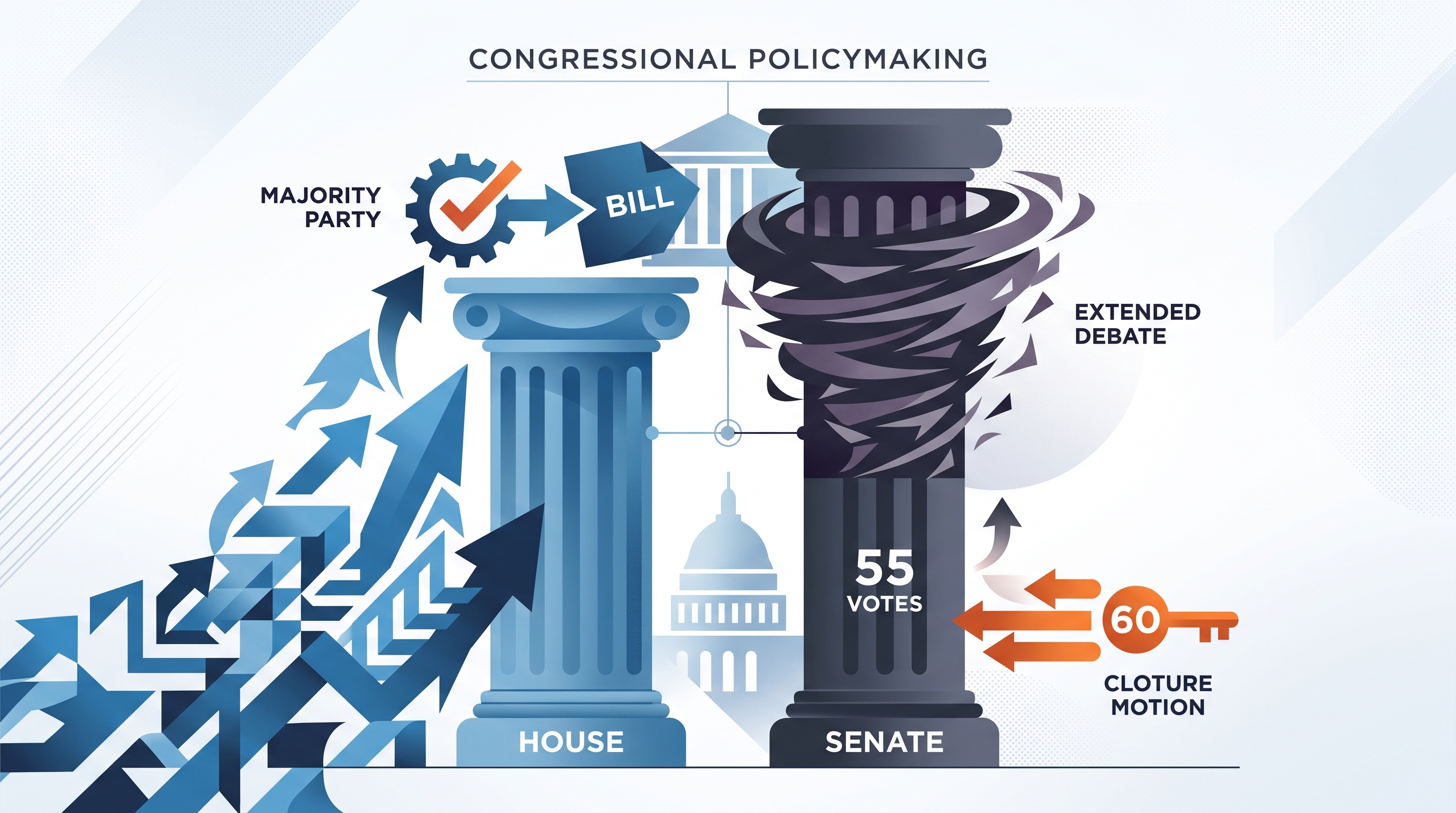
A filibuster is a Senate tactic in which debate is prolonged to delay or prevent a final vote. Under modern Senate practice, ending debate on most legislation generally requires cloture, a motion supported by at least 60 senators. Cloture does not pass the bill; it limits further debate so the Senate can proceed toward a vote.
Worked example: Suppose 52 senators support a bill and 48 oppose it. In the House, the majority party might schedule the bill, restrict debate, and pass it with 218 votes. In the Senate, however, the 48 opponents could use extended debate or threaten a filibuster. Unless at least 60 senators support cloture, the bill may never reach a final vote—even though a majority favors it.
The filibuster therefore makes Senate legislation more difficult to pass than House legislation. The House generally imposes stricter limits on debate time and relevance, while the Senate permits more delay and individual bargaining.
Procedure shapes congressional behavior
Institutional design does not determine every vote, but it changes the strategies legislators use. In the House, the majority party controls much of the agenda, party leaders organize members, and representatives often vote along party lines when leadership links a bill to the party’s program. In the Senate, party leaders still coordinate action, but they frequently need coalition-building, bipartisan bargaining, or agreements with individual senators to obtain enough support for debate and passage.
This is the key boundary with Topic 2.3 Congressional Behavior: Topic 2.2 explains how chamber rules and powers create incentives for party-line voting, coalition-building, and bargaining; Topic 2.3 examines legislators’ behavior and motivations in greater depth.
Congress and the budget
Under EK 2.2.A.4, Congress must produce a budget addressing both mandatory spending and discretionary spending. Mandatory spending is required by law for entitlement programs such as Social Security, Medicare, and Medicaid. Discretionary spending is approved annually for areas such as defense, education, and infrastructure.
As entitlement costs grow, fewer budget dollars remain available for discretionary priorities unless tax revenues increase or the budget deficit increases. Congress’s spending choices therefore involve trade-offs rather than an unlimited pool of money.
$$\text{Available discretionary room} \approx \text{Tax revenues} - \text{Mandatory spending}$$
Under EK 2.2.A.5, pork-barrel legislation places funding for a local project inside a larger appropriation bill. Logrolling is the exchange of political support—such as trading votes—to build enough support for legislation. Both practices can help legislators assemble coalitions in either chamber.
Misconception check
Misconception: “A Senate majority can always pass a bill.”
Correction: A majority may be enough for a final vote in many circumstances, but opponents can use Senate debate rules to block that vote unless cloture receives the required supermajority support.
AP skill and retrieval check
LO 2.2.A asks you to explain how the structures, powers, and functions of both houses affect policymaking. The relevant Concept Application, 1.C: Compare political principles, institutions, processes, policies, and behaviors, is demonstrated by identifying a specific House–Senate difference and explaining its policymaking consequence.
A bill has House support from a unified majority party but only 55 Senate supporters. Which institutional feature most directly explains why the bill may stall, and what procedural action could address the obstacle? Answer: Senate extended debate or a filibuster may prevent a final vote; a cloture motion supported by at least 60 senators could end debate and allow the Senate to proceed.
Source Materials
- AP U.S. Government and Politics Course and Exam Description
- Learn More (.pdf)
- AP U.S. Government and Politics Course Overview
- AP U.S. Government and Politics Course at a Glance
- AP United States Government and Politics Course at a Glance Poster
- AP United States Government and Politics
- AP United States Government and Politics
- United States Government and Politics Sample Syllabus 1