From the free course AP United States Government and Politics on Lykke
2.5 Checks on the Presidency
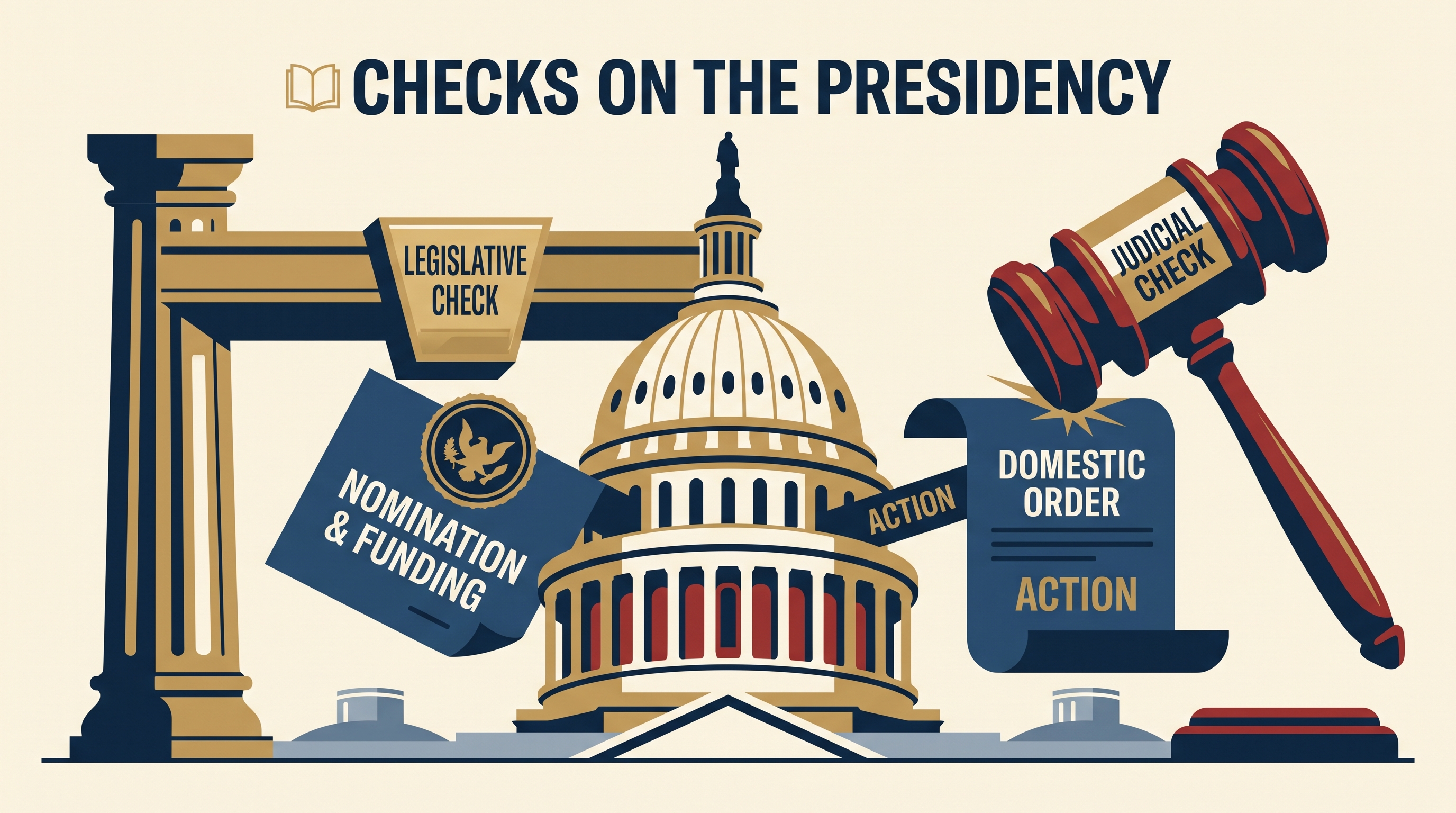
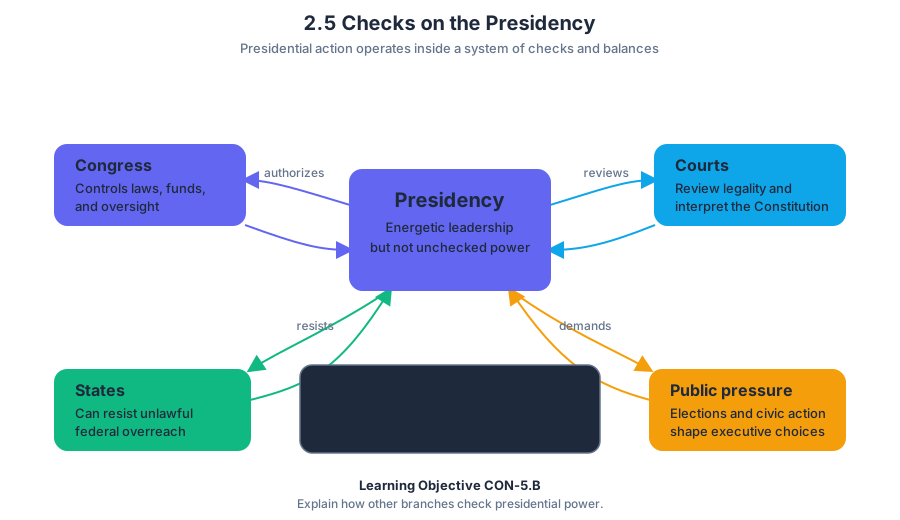
A president may act quickly, but cannot lawfully govern alone. The constitutional design places presidential power inside a system of checks and balances, in which Congress, the courts, and sometimes public and state resistance can limit, redirect, or review presidential action.
Learning Objective CON-5.B: Explain how other branches in the government can check the powers of the presidency.
The central tension is straightforward: energetic leadership can make government effective, but unchecked executive power can threaten liberty and states’ rights. Federalist No. 70 defends an energetic executive because one president can respond more quickly and decisively than a large legislature. The constitutional system answers with a second principle: speed does not eliminate accountability.
The constitutional “brakes” on presidential power
Congressional checks operate through several powers granted primarily in Article I. Congress can pass laws that shape or restrict executive action, refuse to fund an initiative through its control of appropriations, investigate executive agencies through oversight, approve or reject major appointments, and impeach and remove officials under the constitutional process.
The Senate’s confirmation power is especially important for presidential appointments. A president may nominate a justice, cabinet secretary, or agency leader, but the Senate must consent before many of those officials take office. Sandra Day O’Connor and Thurgood Marshall illustrate successful judicial appointments; Robert Bork illustrates a nomination that failed to receive Senate confirmation. The president selects the nominee, but the Senate controls the second constitutional step.
Congress also checks the president through legislation. Suppose a president proposes a nationwide education program. The president may recommend the policy and direct executive officials to administer it, but Congress must authorize the program and provide funding. The No Child Left Behind Act illustrates how national policy can emerge through legislation rather than presidential command alone.
Worked example: a military action
Imagine that a president orders a long military operation without a clear, continuing authorization from Congress. The president can act as commander in chief, but Congress retains powers connected to declaring war, appropriating funds, and conducting oversight. Congress could hold hearings, limit or refuse funding, require reports, or pass legislation governing the operation.
The Vietnam and Iraq conflicts demonstrate why this check matters. Presidential control over military operations can produce rapid decisions, while congressional involvement supplies deliberation, representation, and a possible limit on executive action. The conflict is not simply “president versus Congress”; it is a constitutional disagreement over which branch has authority at a particular stage of policymaking.
Judicial checks
The federal courts can check the presidency through judicial review, the power to determine whether government action violates the Constitution. If a presidential action conflicts with a statute, exceeds constitutional authority, or violates individual rights, a court may block or invalidate that action.
Judicial review does not mean that courts manage the executive branch day by day. Courts generally decide concrete cases brought by parties with a legal injury. Their check is therefore usually indirect: a dispute reaches court, the court interprets the relevant constitutional or statutory rule, and the resulting decision constrains presidential officials.
A visual decision path
When analyzing a presidential-checks scenario, trace the policy through this sequence:
- Presidential action: What did the president order, nominate, veto, or direct?
- Congressional response: Can Congress legislate, control funding, investigate, confirm, or impeach?
- Judicial response: Is there a justiciable dispute involving constitutional or statutory limits?
- Institutional consequence: Which branch gains authority, and which presidential action is limited?
Misconception check
Misconception: “Checks and balances mean the president has no real power.”
The opposite is closer to the constitutional design. The president possesses substantial independent authority, especially in execution, administration, foreign affairs, and military command. Checks do not erase presidential power; they require that power to operate within a structure where another institution can resist or review it.
Misconception: “The president can avoid checks by claiming that quick action is necessary.”
Urgency may strengthen the argument for executive action, but it does not automatically cancel congressional or judicial authority. A strong AP response distinguishes between an argument for energetic leadership and the constitutional question of whether the action remains subject to proper checks.
AP skills and reasoning processes
This topic is most directly assessed through Skill 1.B: Explain political concepts and processes, especially by explaining how oversight, appropriations, confirmation, impeachment, legislation, and judicial review constrain presidential action. It also develops Skill 2.B: Explain how a Supreme Court decision relates to a political issue, when a court’s interpretation limits executive authority.
For source-based questions, use Skill 4.B: Explain the author’s argument, perspective, or reasoning. For example, Federalist No. 70 supports energetic executive leadership, while an opposing argument warns that access to federal resources can threaten liberty without proper checks. Argument questions draw on Skill 5.A: Develop a claim or thesis, and Skill 5.C: Use refutation, concession, or rebuttal, by acknowledging the value of quick presidential action and then explaining why institutional limits remain necessary.
Retrieval check
A president nominates a Supreme Court justice, orders a new domestic program, and requests funding for it. Name one congressional check and one judicial check that could limit presidential power. Then explain why Federalist No. 70’s defense of an energetic executive does not eliminate checks and balances.
Source Materials
- AP U.S. Government and Politics Course and Exam Description
- Learn More (.pdf)
- AP U.S. Government and Politics Course Overview
- AP U.S. Government and Politics Course at a Glance
- AP United States Government and Politics Course at a Glance Poster
- AP United States Government and Politics
- AP United States Government and Politics
- United States Government and Politics Sample Syllabus 1