From the free course AP United States Government and Politics on Lykke
1.8 Constitutional Interpretations of Federalism
Federalism is not a fixed boundary between “national” and “state” government; it is a constitutional relationship whose meaning has been shaped by interpretation, especially by the Supreme Court.
1.8 Constitutional Interpretations of Federalism
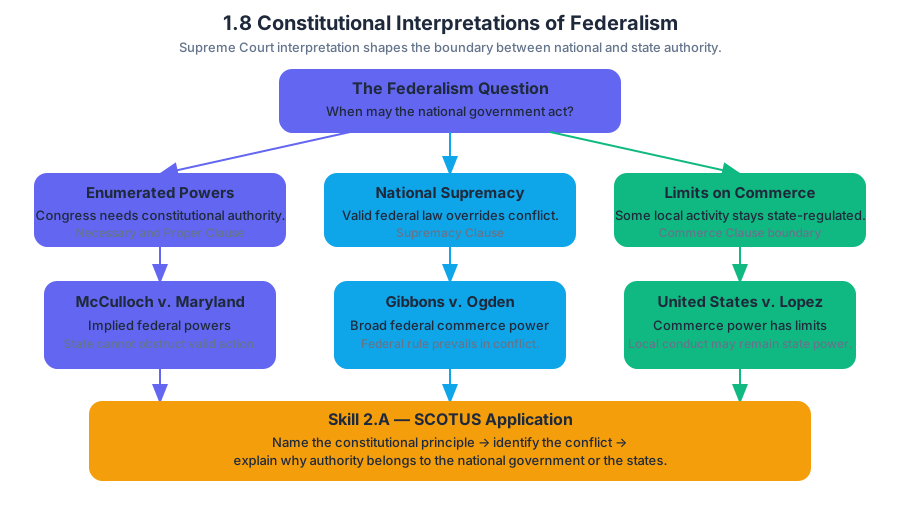
Federalism is not a fixed boundary between “national” and “state” government; it is a constitutional relationship whose meaning has been shaped by interpretation, especially by the Supreme Court. The central question is practical and powerful: When may the national government act, and when must power remain with the states?
Learning Objective 1.8.A: Explain how the Supreme Court has interpreted the Constitution’s provisions regarding federalism.
Skill 2.A — SCOTUS Application is the essential reasoning tool for this topic: use a Supreme Court decision to explain how constitutional principles apply to a specific governmental conflict. A strong response does not merely name McCulloch v. Maryland or United States v. Lopez; it identifies the constitutional principle in the case and connects that principle to the distribution of governmental authority.
The constitutional tension: national power versus state power
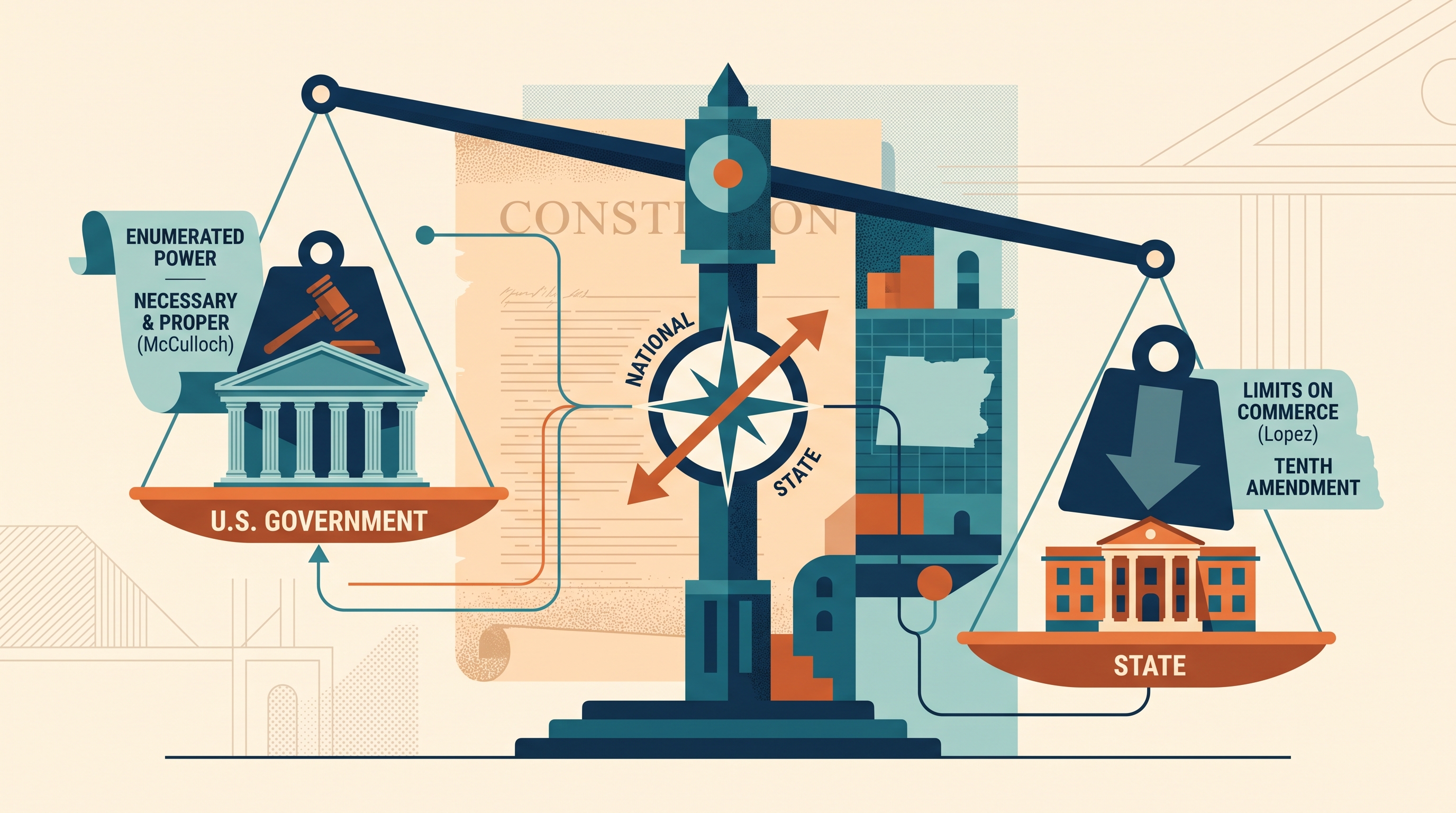
The Constitution gives Congress enumerated powers, meaning powers listed directly in the constitutional text. Article I, Section 8 includes powers such as taxing, spending, regulating interstate commerce, and establishing a national currency. But Congress also receives authority through the Necessary and Proper Clause, which permits it to make laws needed to carry out its listed responsibilities.
The Tenth Amendment supplies the opposing presumption: powers not delegated to the national government, and not prohibited to the states, are reserved to the states or the people. The result is a constitutional design with both an expanding mechanism—national powers that may be implied from enumerated powers—and a limiting principle—authority that remains outside the national government’s lawful reach.
Essential Knowledge 1.8.A: The Constitution establishes a federal system by dividing power between the national government and the states, while constitutional clauses and judicial interpretation determine how that division operates.
McCulloch v. Maryland (1819): implied powers and national supremacy
In McCulloch v. Maryland, Maryland attempted to tax the Second Bank of the United States. The dispute created two constitutional questions: Could Congress establish a national bank even though the Constitution does not expressly say “create a bank”? And could a state tax a legitimate institution of the national government?
The Supreme Court, led by Chief Justice John Marshall, answered both questions in favor of national authority. Congress could establish the bank under the Necessary and Proper Clause because the bank was a useful means of carrying out enumerated powers such as taxing, borrowing, and managing national finances. The Court also held that Maryland could not tax the bank because “the power to tax involves the power to destroy,” and state taxation could undermine constitutional national functions.
The decision established two linked principles:
- Implied powers: Congress may use reasonable means not expressly listed when those means help execute an enumerated power.
- Federal supremacy: Valid national laws and institutions take priority over conflicting state action, reflecting the Supremacy Clause.
Worked application: Suppose Congress creates a federal agency to administer a national borrowing program. A state argues that the agency is unconstitutional because no clause expressly names that agency. Under McCulloch, the question is not whether the agency is named word-for-word. The question is whether it is a reasonable instrument for carrying out an enumerated national power. If it is, the state may not obstruct it through taxation or similar measures.
United States v. Lopez (1995): a limit on the Commerce Clause
More than a century later, United States v. Lopez demonstrated that federalism can also restrict national power. Congress had enacted the Gun-Free School Zones Act, making it a federal crime to possess a gun near a school. The Supreme Court struck down the law because possessing a gun near a school was not sufficiently connected to interstate commerce.
The Commerce Clause allows Congress to regulate interstate economic activity and activities substantially related to it. The Court reasoned that accepting an unlimited chain of effects—guns near schools might affect education, education might affect the economy, and therefore Congress may regulate gun possession—would allow Congress to control nearly anything. Lopez therefore preserved a constitutional sphere for state authority.
Reading the two cases together
These cases are not contradictory. McCulloch asks whether Congress may select an appropriate means for implementing an enumerated power; Lopez asks whether Congress has identified a sufficient constitutional connection to an enumerated power in the first place.
| Case | Constitutional issue | Holding | Federalism effect |
|---|---|---|---|
| McCulloch v. Maryland | Necessary and Proper Clause; state interference | Congress may use implied powers, and states may not obstruct valid national action | Expanded national authority |
| United States v. Lopez | Commerce Clause | Congress may not regulate an activity with only a remote connection to interstate commerce | Limited national authority and protected state power |
Named misconception — “The Necessary and Proper Clause lets Congress do anything useful.” It does not. The implied power must connect to an enumerated power, and the chosen means must be appropriate for carrying out that power. Conversely, “the Tenth Amendment makes states sovereign whenever they disagree with Congress” is also incorrect: valid federal law remains supreme under the Constitution.
Retrieval check
A state challenges a federal regulation of an activity occurring entirely within one state. Which case provides the stronger analogy, McCulloch or Lopez, and what constitutional question should be asked first? A defensible answer should identify the relevant enumerated power, explain the constitutional connection, and use the case to show why national authority is either supported or limited.
Source Materials
- AP U.S. Government and Politics Course and Exam Description
- Learn More (.pdf)
- AP U.S. Government and Politics Course Overview
- AP U.S. Government and Politics Course at a Glance
- AP United States Government and Politics Course at a Glance Poster
- AP United States Government and Politics
- AP United States Government and Politics
- United States Government and Politics Sample Syllabus 1