From the free course AP United States Government and Politics on Lykke
5.12 The Media
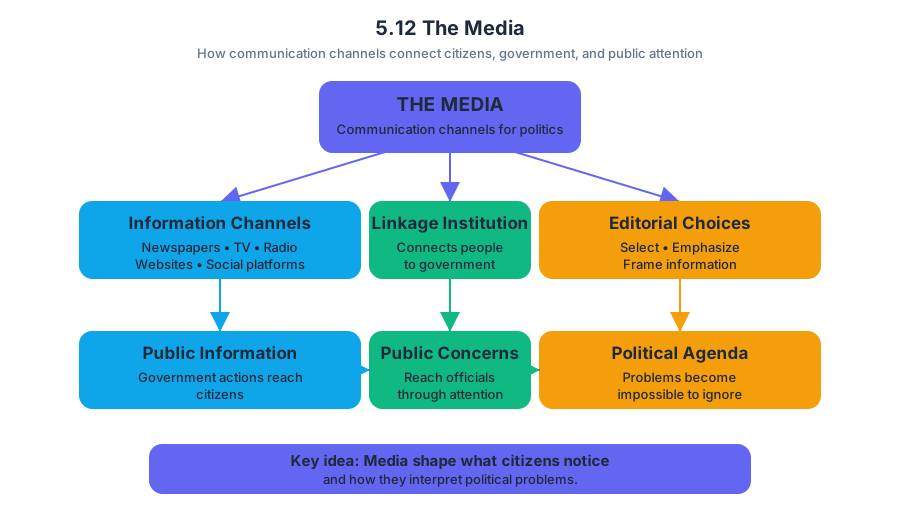
A news story can change an election without telling anyone how to vote: by deciding which problem becomes impossible to ignore. The media are communication channels—such as newspapers, television, radio, websites, and social-media platforms—that distribute political information and connect citizens to government.
In American politics, the media function as a linkage institution, an organization that connects people to government by communicating public concerns to officials and reporting government actions back to the public. This makes the media important to participatory democracy, but it also creates risks when citizens receive incomplete, partisan, or unreliable information.
Key idea: The media do not merely report politics; by selecting, emphasizing, and framing information, they influence which political problems citizens notice and how citizens interpret them.
What the media do in the political process
Media influence operates through several connected mechanisms. Agenda setting occurs when media attention increases the public visibility of an issue. Framing occurs when coverage presents an issue through a particular interpretation—for example, describing a budget dispute as government waste, a tax burden, or a failure of public services. Gatekeeping occurs when editors, journalists, producers, or platform systems decide which events receive attention and which do not.
The media also provide a watchdog function by investigating public officials and exposing possible misconduct. In addition, media coverage can serve a political socialization function: repeated exposure to political arguments, symbols, and information can shape citizens’ beliefs about government, parties, and public policy.
These functions can strengthen democracy when they help citizens make informed decisions. They can also weaken participation when people encounter ideological “echo chambers,” misinformation, or such a large volume of competing claims that they become less confident in distinguishing reliable information from unsupported opinion.
Worked example: the 2003 California recall
In California’s 2003 recall election, voters removed Governor Gray Davis and elected Arnold Schwarzenegger. A strong explanation does not stop at saying that Schwarzenegger was famous or that the media covered the election. It identifies the mechanism connecting media coverage to voter behavior.
The media gave widespread attention to California’s budget shortfall and energy crisis. That coverage highlighted failures associated with Davis’s time in office, giving voters information they could use in a retrospective voting model—a model in which citizens evaluate a leader’s past performance when deciding whether to keep that leader in office.
Causal chain
Media attention to policy failures $\rightarrow$ greater public awareness of Davis’s record $\rightarrow$ retrospective evaluation $\rightarrow$ votes to recall Davis
The celebrity-focused explanation is incomplete. Schwarzenegger’s fame may have helped attract attention, but the politically relevant explanation is that media coverage connected voters’ awareness of budget and energy problems to their judgment about Davis’s past performance.
Benefits and risks of contemporary media
The media can widen political participation by allowing more people to encounter political information and express opinions to large audiences. Social media may improve the relationship between citizens and government by strengthening linkage institutions: citizens can publicize grievances, organize supporters, and communicate directly with elected officials.
The same tools can produce harmful effects. Ideologically driven programming may encourage people to consume only information that confirms their existing beliefs. This can reduce political knowledge across ideological groups, increase polarization, and make citizens less willing to trust sources that present opposing perspectives.
A further problem is credibility. When unreliable claims circulate alongside professional reporting, citizens may treat all news as equally untrustworthy. More opportunities to speak do not automatically produce better democratic deliberation; participation is more valuable when citizens can evaluate evidence and distinguish assertion from verified information.
| Media effect | Democratic possibility | Democratic risk |
|---|---|---|
| Agenda setting | Brings neglected problems to public attention | Makes some issues appear more important than others |
| Framing | Helps citizens understand complicated policy disputes | Encourages one-sided interpretations |
| Watchdog reporting | Exposes misconduct and increases accountability | Can emphasize conflict or scandal over policy substance |
| Political expression | Gives citizens a larger public voice | Produces misinformation, overload, or harassment |
| Ideological programming | Offers specialized perspectives | Reinforces partisan divisions and selective exposure |
Misconception check
Misconception: “Media bias means every report is false.” Bias can instead refer to choices about which stories receive attention, which facts appear first, what language describes an event, or which voices are treated as authoritative. A report may contain accurate facts while still presenting a selective frame.
Misconception: “More media participation always improves democracy.” Increased participation can improve representation, but it can also damage public deliberation if credibility declines or if citizens receive politically isolated streams of information.
AP skill connection
This topic is assessed especially through Concept Application (CON): apply the media’s linkage-institution, agenda-setting, framing, watchdog, and political-socialization roles to a new political situation. It also uses Source Analysis (SOU) when interpreting a news excerpt or political communication, Data Analysis (DAT) when connecting media-use patterns to participation or partisanship, and Argumentation (ARG) when weighing whether media effects strengthen or weaken participatory democracy.
Retrieval check
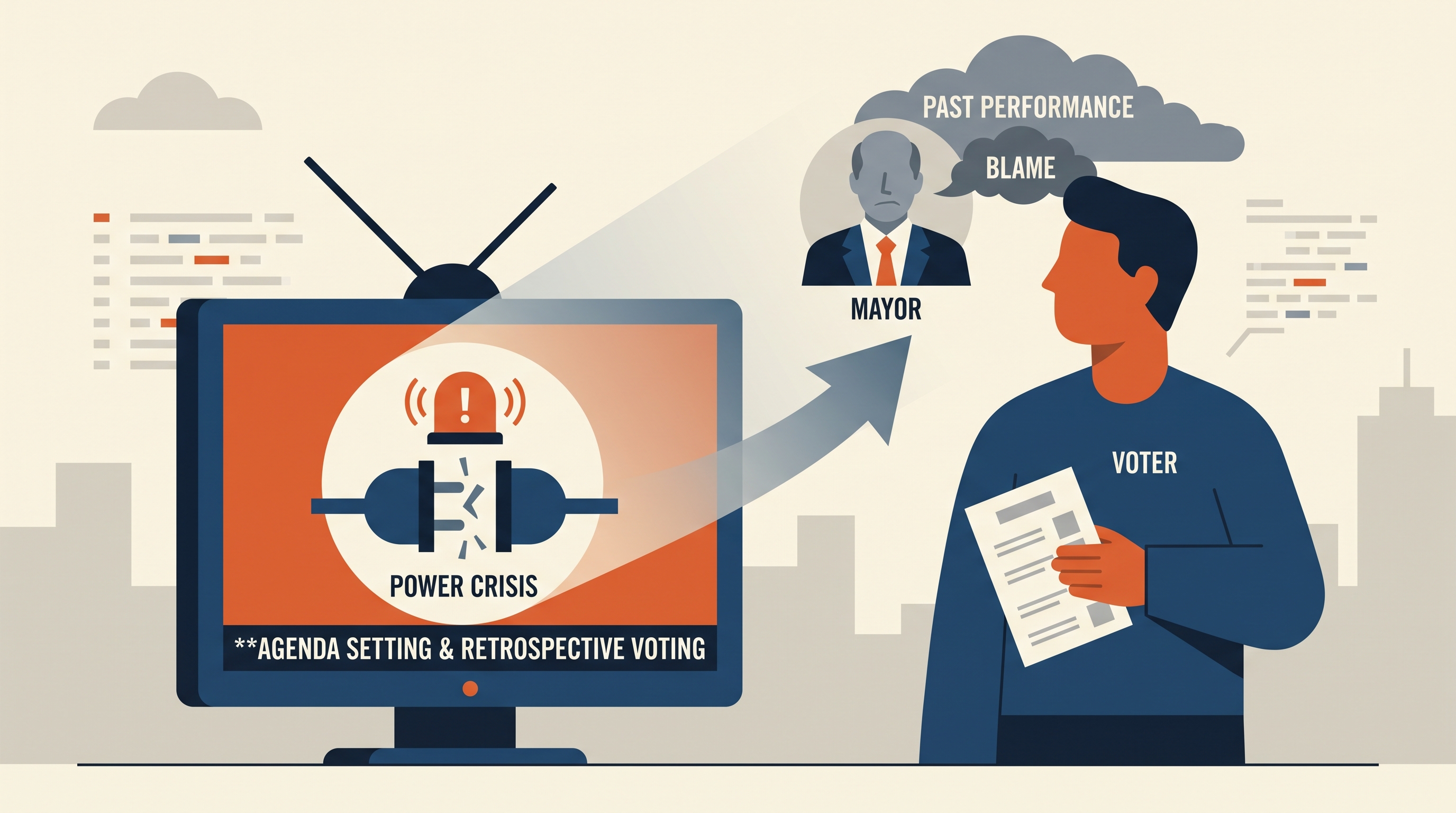
A city’s power crisis receives sustained television coverage, and voters subsequently blame the mayor for failing to address it. Which media mechanism and voting model are operating? The strongest answer identifies agenda setting as the mechanism that increased issue visibility and retrospective voting as the model voters used to judge the mayor’s past performance.
Source Materials
- AP U.S. Government and Politics Course and Exam Description
- Learn More (.pdf)
- AP U.S. Government and Politics Course Overview
- AP U.S. Government and Politics Course at a Glance
- AP United States Government and Politics Course at a Glance Poster
- AP United States Government and Politics
- AP United States Government and Politics
- United States Government and Politics Sample Syllabus 1