From the free course AP United States Government and Politics on Lykke
2.12 The Bureaucracy
Key concepts: The expansion of the bureaucracy over time · Causes and effects of bureaucratic expansion · The impact of events such as 9/11 on the bureaucracy · How bureaucratic interpretations, policies, and behaviors apply to policymaking · Connections between group activism and policymakers or the policymaking process · Prospective voting · The distinction between political appointees and career bureaucrats · Secretary Ross as a political appointee
The federal bureaucracy is the government’s permanent operating machinery: departments, agencies, bureaus, offices, and commissions that turn broad laws into everyday public action. Congress may pass a law about aviation safety, disaster relief, or national security, but bureaucratic organizations determine how…
2.12 The Bureaucracy
The federal bureaucracy is the government’s permanent operating machinery: departments, agencies, bureaus, offices, and commissions that turn broad laws into everyday public action. Congress may pass a law about aviation safety, disaster relief, or national security, but bureaucratic organizations determine how that law is administered in practice.
Learning Objective CON-5.A: Explain how the bureaucracy carries out the responsibilities of the federal government.
Essential Knowledge CON-5.A.1: The federal bureaucracy is a complex system of departments, agencies, bureaus, offices, and other organizations.
Why the bureaucracy expands
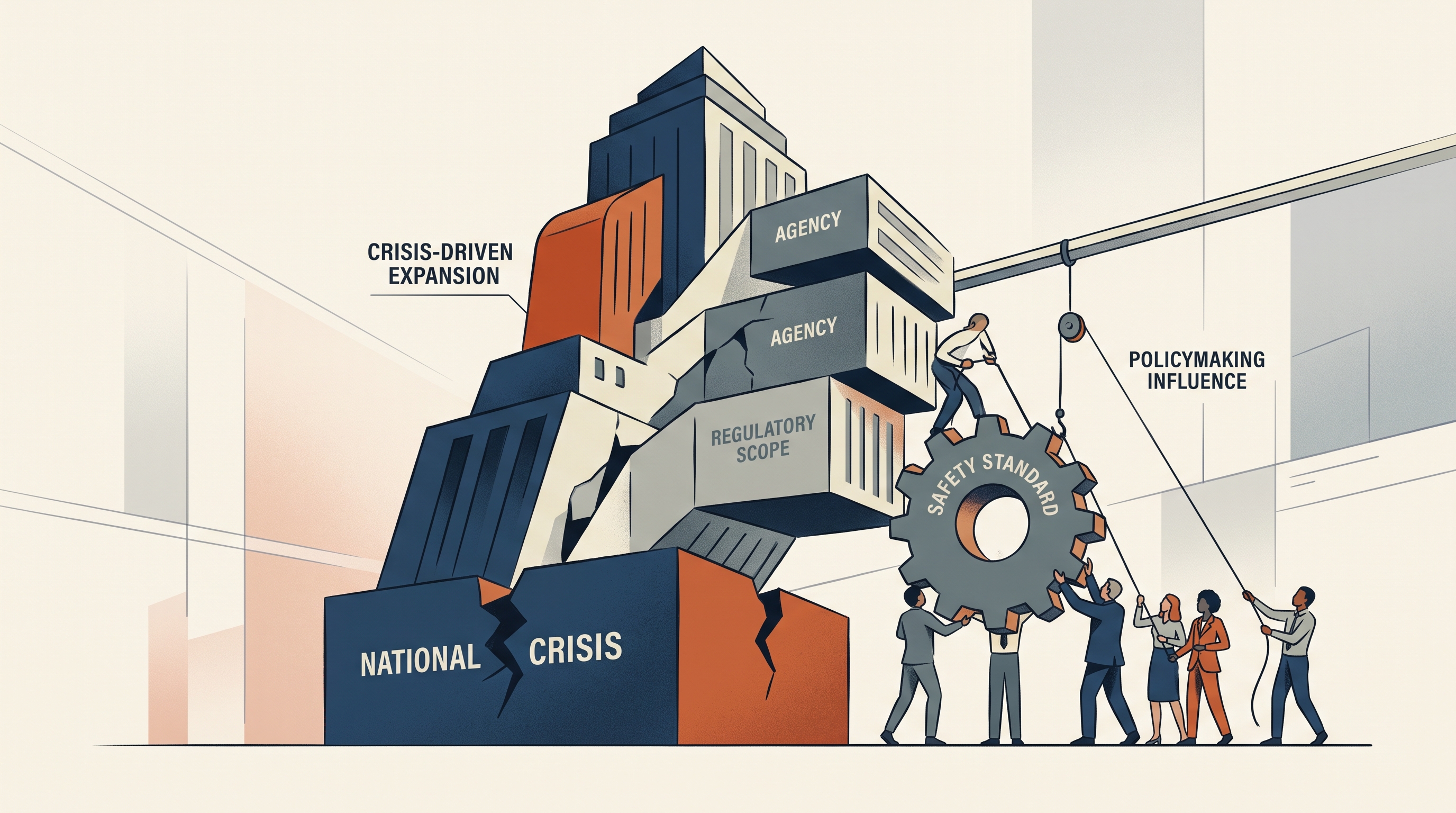
Bureaucratic expansion usually follows a combination of new public demands, national crises, technological change, and congressional delegation. As the responsibilities of the federal government grow, policymakers create or enlarge administrative organizations with the expertise and personnel needed to carry out those responsibilities.
The expansion is visible across American history:
- The growth of industrial production created demands for economic regulation.
- Economic crisis led to new administrative responsibilities for relief, recovery, and financial supervision.
- Social programs required permanent agencies to deliver benefits and enforce standards.
- Advances in transportation, communication, science, and technology created policy problems that legislators could not manage through one-time statutes alone.
- National-security threats produced new intelligence, defense, and emergency-management responsibilities.
The attacks of September 11, 2001, illustrate how a crisis can rapidly reorganize bureaucracy. The federal government expanded its capacity to coordinate intelligence, transportation security, emergency preparedness, and homeland protection. The creation of the Department of Homeland Security consolidated several existing offices and agencies into a larger organizational structure.
The effect was not simply “more government” in the abstract. Expansion produced specialization and coordination: agencies developed expertise in particular tasks, while the government also needed new systems for sharing information across organizational boundaries. The trade-off was that larger bureaucracies could become more difficult to supervise, coordinate, and hold accountable.
Causes and effects of bureaucratic change
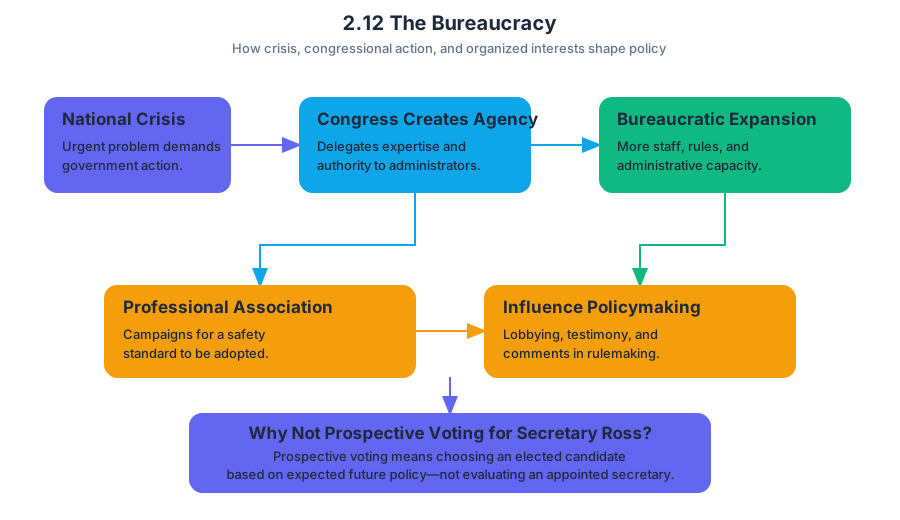
A useful causal chain is:
Public problem or crisis $\rightarrow$ legislative response $\rightarrow$ new or expanded agency authority $\rightarrow$ administrative implementation $\rightarrow$ new oversight and accountability demands
For example, if repeated infrastructure failures create public pressure, Congress may enact safety legislation and assign implementation to an agency. The agency then interprets the law, establishes procedures, inspects facilities, and imposes penalties. Its decisions affect citizens and organizations directly, even though voters did not elect the agency’s administrators.
Bureaucratic change can therefore produce both benefits and problems:
| Change | Potential benefit | Potential problem |
|---|---|---|
| More specialized agencies | Greater expertise | Fragmentation and duplication |
| More administrative staff | Capacity to deliver programs | Higher cost and complexity |
| Broader agency responsibilities | Faster, more practical implementation | More discretion and less direct control |
| Consolidation after a crisis | Improved coordination | Concentration of authority and bureaucratic delay |
A common misconception is that bureaucrats merely “follow orders.” Congress often writes broad laws because technical details change quickly or because legislators lack the expertise to specify every procedure. Bureaucratic interpretations, policies, and behaviors consequently become part of policymaking: implementation choices determine how a policy works on the ground.
Bureaucracy, groups, and policymaking
Group activism connects citizens to bureaucratic policymaking as well as to elected officials. Advocacy organizations may provide technical information, testify at hearings, submit comments, organize affected constituents, publicize agency decisions, or pressure Congress to alter an agency’s funding and authority.
Consider an environmental organization campaigning for stricter pollution controls. Its activism may influence legislators to authorize regulation, agency officials to prioritize enforcement, and the broader public to view the issue as urgent. Industry groups may respond with their own research, lobbying, and mobilization. This is a pluralist process: multiple organized interests compete to shape policy outcomes.
Exam-quality connection: Do not stop at “the group protested” or “the group lobbied.” Explain how the activism reaches a policymaker or policymaking process and what decision it could change.
This distinction addresses a frequent response error: repeating what an agency did without identifying the bureaucratic power involved or connecting group activism to policymakers. A complete explanation names the actor, the action, the target of influence, and the policy consequence.
Prospective voting—and the Secretary Ross trap
Prospective voting is voting based on a candidate’s expected future performance and proposed policies. A voter asks, “What will this candidate do if elected?” This differs from retrospective voting, which evaluates an officeholder’s past performance, and from party-line voting, which relies primarily on party identification.
Prospective voting applies most directly to candidates seeking elected office. It was therefore incorrect to apply the concept to Secretary Ross, who was a political appointee rather than an elected candidate. A strong answer would identify the category error: evaluating what Ross might do as an appointed administrator is not the same as choosing among candidates based on their promised future actions.
Misconception check: “Anyone who makes policy can be evaluated through prospective voting.” Not quite. Prospective voting describes a voter’s choice among candidates for office, not simply a prediction about the future behavior of an appointed bureaucrat.
Skill focus: applying bureaucracy to a scenario
This topic most directly exercises Skill 1: Concept Application, especially 1.A Define and describe political concepts and processes and 1.B Explain how political concepts or processes apply in a given context. On an exam, naming “bureaucratic expansion” earns less than showing the mechanism: identify the event, explain why government responsibilities changed, and trace the effect on agency structure or policy implementation.
It also develops Skill 5: Argumentation, particularly when weighing whether bureaucratic growth improves effective governance or creates accountability problems. The strongest reasoning acknowledges both sides, then uses a specific example—such as post-9/11 reorganization—to support a defensible conclusion.
Retrieval check
A national crisis leads Congress to create a new agency, while a professional association campaigns for the agency to adopt a particular safety standard. Identify one cause of bureaucratic expansion, one effect of expansion, and one way the association could influence policymaking. Finally, explain why applying prospective voting to Secretary Ross would be incorrect.
Source Materials
- AP U.S. Government and Politics Course and Exam Description
- Learn More (.pdf)
- AP U.S. Government and Politics Course Overview
- AP U.S. Government and Politics Course at a Glance
- AP United States Government and Politics Course at a Glance Poster
- AP United States Government and Politics
- AP United States Government and Politics
- United States Government and Politics Sample Syllabus 1