From the free course AP United States Government and Politics on Lykke
AP Practice 4
A strong AP Government argument is not a list of facts; it is a defensible claim supported by constitutional evidence and connected through explicit reasoning.
AP Practice 4
A strong AP Government argument is not a list of facts; it is a defensible claim supported by constitutional evidence and connected through explicit reasoning. The argument task asks you to decide how far a political principle applies, then prove that judgment with required foundational documents and relevant political knowledge.
The task: build a constitutional argument
Original practice prompt — unofficial
Develop an argument that evaluates the extent to which dividing governmental power among multiple institutions protects individual liberty in the United States. In your response, use at least two required foundational documents as evidence, including Federalist No. 51. You may also use relevant knowledge from the course.
A useful structure is:
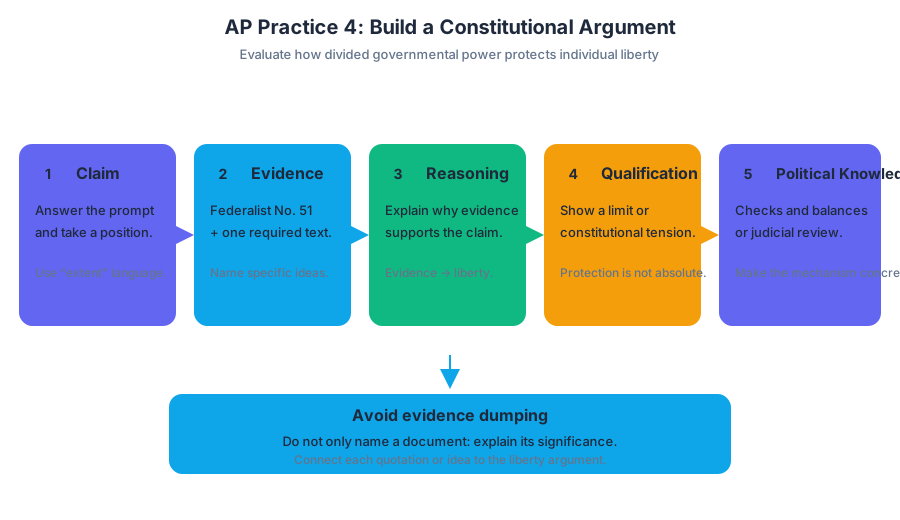
| Argument move | What it must do |
|---|---|
| Claim or thesis | Answer the prompt directly and establish a defensible position. |
| Evidence | Use specific evidence from at least two required foundational documents. |
| Reasoning | Explain why each piece of evidence proves or supports the claim. |
| Qualification | Show a limit, tension, or condition affecting the argument. |
| Political knowledge | Connect the documents to a concrete constitutional mechanism, institution, case, or policy. |
The most common failure is evidence dumping: naming a document without explaining its significance. Writing “Federalist No. 51 supports checks and balances” is not yet an argument. The reader must see the chain: document principle → constitutional mechanism → effect on liberty.
Step 1: Turn the prompt into a position
The prompt asks about the extent to which divided power protects liberty. That wording invites a qualified claim rather than an absolute one. A defensible thesis might be:
Dividing governmental power generally protects individual liberty because separate branches can restrain one another, but this protection is incomplete when institutional conflict produces inaction or when a determined majority controls several institutions at once.
This thesis earns argumentative strength because it does three things: it answers the question, identifies a primary reason, and acknowledges a limitation. It does not merely restate that the Constitution divides power.
Step 2: Select and connect foundational documents
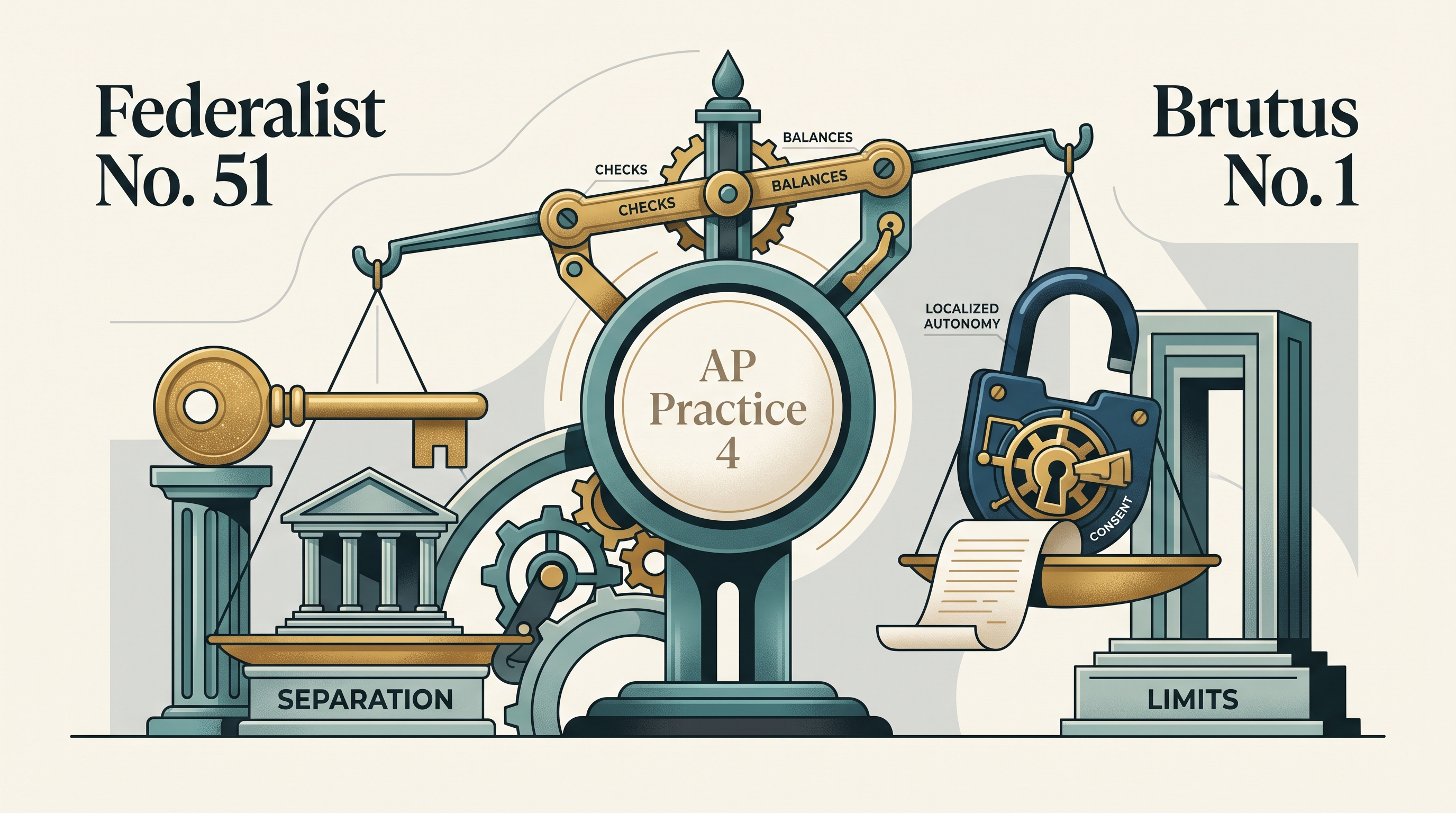
Federalist No. 51 argues that the constitutional structure should make “ambition” counteract ambition. Its logic is institutional: because officials possess different powers and incentives, each branch can resist encroachment by another branch. This supports the claim that liberty does not depend entirely on officials’ personal virtue.
A second document can provide a contrasting concern. Brutus No. 1 warns that a powerful national government may gradually absorb authority and threaten the people’s liberty. Used carefully, Brutus does not disprove Federalist No. 51. Instead, it supplies the qualification: divided institutions may restrain one another, but national power can still expand unless federal authority remains limited and accountable.
Worked argument
Dividing governmental power generally protects individual liberty because it prevents any single institution from exercising unlimited authority. In Federalist No. 51, James Madison explains that government must be arranged so that “ambition” counteracts ambition. This principle appears in the Constitution’s separation of powers: Congress writes laws, the president executes them, and the judiciary interprets them. For example, Congress may refuse to fund an executive initiative, while the president may veto legislation and courts may invalidate actions that violate the Constitution. Because each branch has tools that affect the others, a branch seeking to threaten individual rights faces institutional resistance.
However, divided power does not automatically protect liberty. Brutus No. 1 argues that a strong national government could become distant from the people and eventually endanger their freedom. This concern is visible when Congress delegates broad authority to executive agencies or when political polarization prevents Congress from effectively overseeing the executive branch. In such circumstances, separation of powers may produce gridlock without guaranteeing rights. Therefore, divided power is most protective when constitutional checks are actively used and when citizens, courts, Congress, and state governments hold officials accountable.
The response earns value through its reasoning, not its length. It identifies a claim, uses Federalist No. 51 and Brutus No. 1 specifically, explains constitutional mechanisms, and qualifies the argument with delegation, oversight, and gridlock.
Timing and error review
For a timed argument essay, reserve approximately 5 minutes to identify the task and plan, 30 minutes to write, and 5 minutes to revise. Before writing, sketch three lines: claim, document one plus explanation, and document two plus qualification.
Afterward, perform an error review:
- Thesis check: Does the first paragraph answer the exact question?
- Document check: Did you use at least two required foundational documents accurately?
- Explanation check: Does every document reference explain how it supports the claim?
- Reasoning check: Did you connect evidence to a constitutional mechanism or political outcome?
- Qualification check: Did you address a limit rather than contradict your own thesis?
Named misconception — “More branches always mean more liberty.” Divided power creates opportunities for restraint; it does not guarantee effective restraint. Checks and balances can protect rights, but they can also create delay, encourage evasion of responsibility, or fail when officials share the same goal. The strongest argument recognizes both the constitutional design and the conditions required for that design to work.
Retrieval check
In one sentence, explain why Federalist No. 51 supports separation of powers, and in a second sentence explain how Brutus No. 1 can qualify rather than simply reject that argument.
Source Materials
- AP U.S. Government and Politics Course and Exam Description
- Learn More (.pdf)
- AP U.S. Government and Politics Course Overview
- AP U.S. Government and Politics Course at a Glance
- AP United States Government and Politics Course at a Glance Poster
- AP United States Government and Politics
- AP United States Government and Politics
- United States Government and Politics Sample Syllabus 1
- AP US Gov Past Exam Questions — AP Central
- Khan Academy — AP US Government and Politics
- YouTube — Heimler's History
- YouTube — Jocz Productions