From the free course AP United States Government and Politics on Lykke
AP Practice 5
A federal law can be constitutional in one case and unconstitutional in another even when both cases involve Congress regulating activity inside a state. The decisive question is not simply whether Congress acted, but whether the Constitution gives Congress the power it used and whether the law is a valid means of…
AP Practice 5
A federal law can be constitutional in one case and unconstitutional in another even when both cases involve Congress regulating activity inside a state. The decisive question is not simply whether Congress acted, but whether the Constitution gives Congress the power it used and whether the law is a valid means of carrying out that power.
Task type: Supreme Court Comparison FRQ
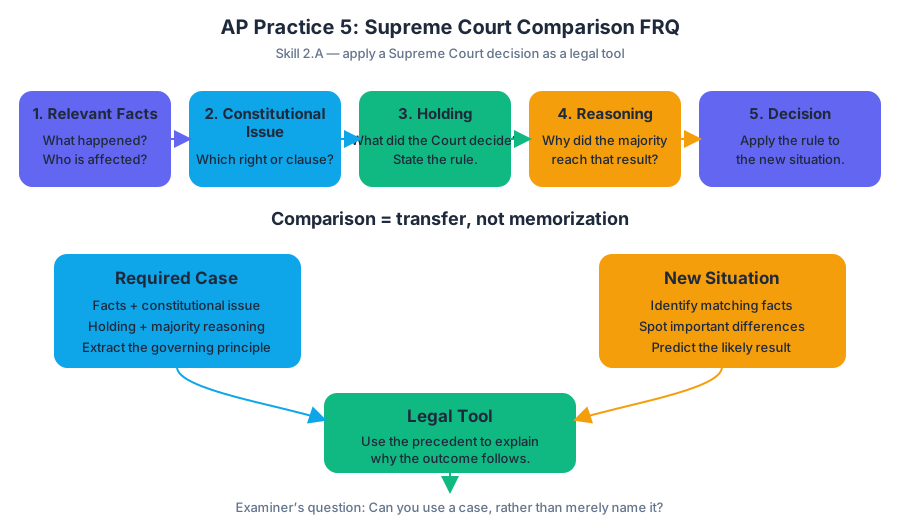
This practice targets Skill 2: SCOTUS Application, especially Skill 2.A, which requires applying Supreme Court decisions by identifying the relevant facts, constitutional issue, holding, reasoning, and decision of a majority opinion. The task also requires transferring a constitutional principle from one required case to a new situation.
Examiner’s central question: Can you use a Supreme Court case as a legal tool, rather than merely naming it?
Original practice prompt
In McCulloch v. Maryland (1819), the Supreme Court considered whether Congress had constitutional authority to establish a national bank and whether Maryland could impose a tax on that bank.
In United States v. Lopez (1995), the Supreme Court considered whether Congress could prohibit possession of a firearm near a school by relying on its power to regulate interstate commerce.
Answer the following.
(a) Identify the constitutional clause that provided the primary basis for the decision in McCulloch v. Maryland.
(b) Describe the holding in McCulloch v. Maryland and explain the reasoning the Court used to reach that holding.
(c) Explain how the reasoning in United States v. Lopez differs from the reasoning in McCulloch v. Maryland.
Timing target
Spend approximately $20–25 minutes: about 3 minutes reading and planning, 14–17 minutes writing, and 3–5 minutes checking. Because this is a short free-response task, each paragraph should perform a visible job: identify, describe, or explain.
Worked response and scoring logic
(a) Constitutional clause
Creditworthy answer: The Necessary and Proper Clause, also called the Elastic Clause, provided the primary basis for the decision.
The clause permits Congress to enact laws that are appropriate means of carrying out its enumerated powers. A response that names only the Commerce Clause is not the best answer for this part because McCulloch centered on Congress’s implied powers and the constitutionality of creating the bank.
Rewarded reasoning: Correctly identify the constitutional provision that supplied the legal authority at issue.
(b) Holding and reasoning
Creditworthy answer: The Court held that Congress had the implied power to establish a national bank, even though the Constitution did not expressly list “creating a bank” as a congressional power. The Court reasoned that Congress may choose appropriate means to execute its enumerated powers, including collecting taxes, borrowing money, and regulating commerce. The Necessary and Proper Clause therefore allowed the bank as a useful instrument for carrying out those legitimate powers. The Court also held that Maryland could not tax the national bank because the power to tax could be used to destroy or control a constitutional federal instrument.
This answer earns the relevant credit because it contains all three required pieces:
- Holding: Congress could establish the bank.
- Constitutional reasoning: The Necessary and Proper Clause supports implied powers connected to enumerated powers.
- Federalism consequence: Maryland’s tax was invalid because state action could not undermine a lawful federal institution.
A vague statement such as “the Court expanded federal power” is incomplete. It identifies an effect but does not explain the constitutional mechanism that produced it.
(c) Comparison with United States v. Lopez
Creditworthy answer: The reasoning in Lopez placed a limit on congressional power under the Commerce Clause, whereas the reasoning in McCulloch broadly recognized implied congressional powers under the Necessary and Proper Clause. In McCulloch, the national bank was sufficiently connected to enumerated federal powers, so Congress could use it as an appropriate means of carrying out those powers. In Lopez, possessing a gun near a school was not sufficiently connected to interstate commerce because the law regulated a noneconomic local activity without requiring a demonstrated connection to interstate commercial activity. Therefore, the Court rejected Congress’s asserted Commerce Clause authority in Lopez.
The comparison must identify a meaningful similarity or difference in constitutional reasoning, not merely summarize two outcomes. The strongest response explains why the cases point in different directions: McCulloch permits implied means that help Congress execute legitimate powers, while Lopez prevents Congress from converting the Commerce Clause into a general power over every local activity.
Named misconception check
Misconception: “The Necessary and Proper Clause gives Congress unlimited power.” It does not. The clause supports means that are appropriate and connected to an enumerated power; it does not create an independent general authority. McCulloch expanded implied powers, but Lopez demonstrates that the Court still polices the boundaries of federal authority.
Error-review routine
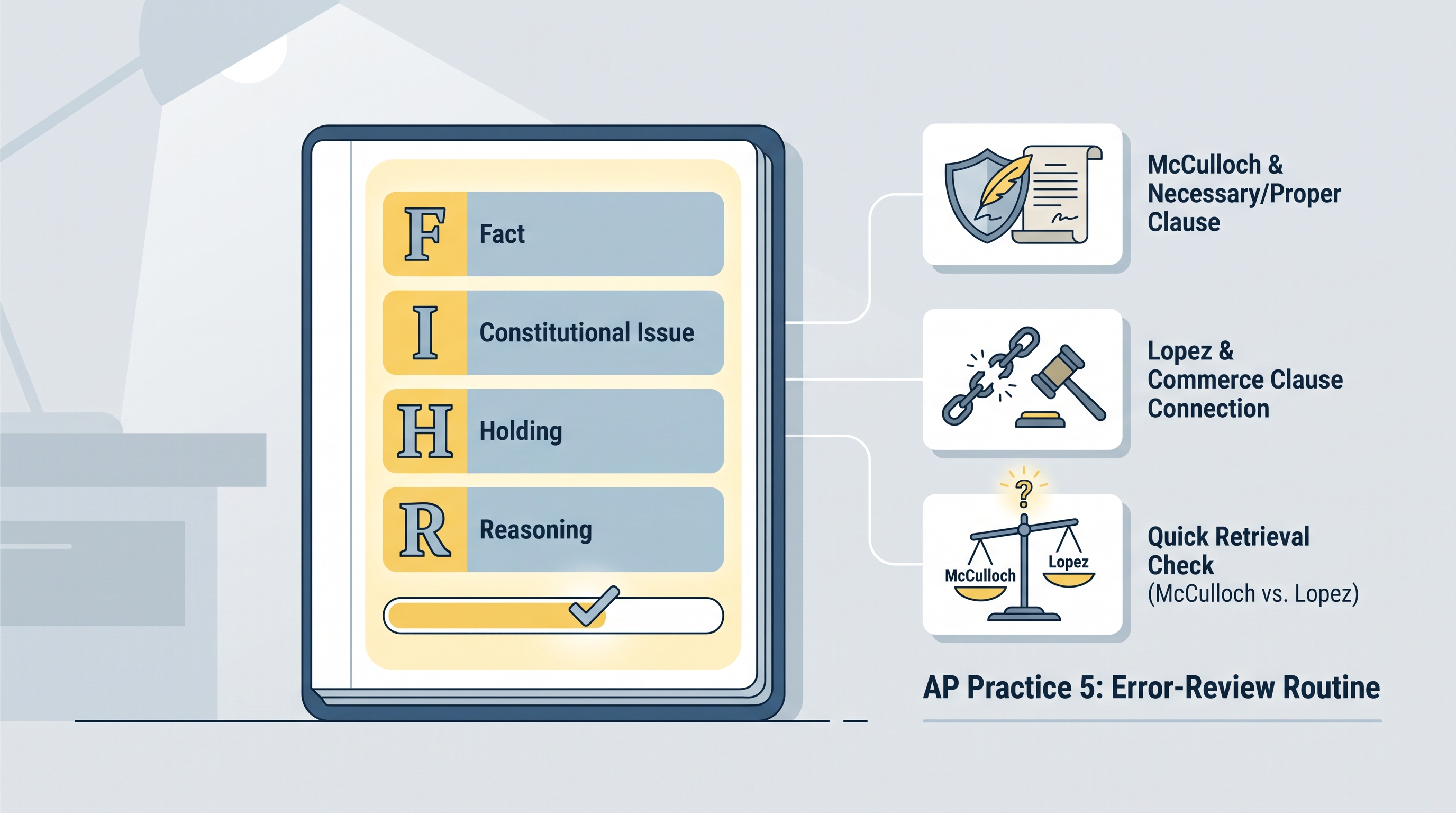
After writing, label each sentence F for fact, I for constitutional issue, H for holding, or R for reasoning. If you have facts and holdings but very few R sentences, your response is probably describing cases rather than applying them.
Then check three precision points:
- Did you name the Necessary and Proper Clause for McCulloch?
- Did you explain the connection between implied powers and enumerated powers?
- Did you explain why the activity in Lopez lacked a sufficient Commerce Clause connection?
Quick retrieval check: Which case is more protective of congressional authority, and which constitutional principle explains that result? A defensible answer should identify McCulloch and connect it to implied powers under the Necessary and Proper Clause.
Source Materials
- AP U.S. Government and Politics Course and Exam Description
- Learn More (.pdf)
- AP U.S. Government and Politics Course Overview
- AP U.S. Government and Politics Course at a Glance
- AP United States Government and Politics Course at a Glance Poster
- AP United States Government and Politics
- AP United States Government and Politics
- United States Government and Politics Sample Syllabus 1
- AP US Gov Past Exam Questions — AP Central
- Khan Academy — AP US Government and Politics
- YouTube — Heimler's History
- YouTube — Jocz Productions