From the free course AP United States Government and Politics on Lykke
3.11 Government Responses to Social Movements
Key concepts: Government responses to social movements · Explaining implications of an argument or perspective · Political principles, institutions, processes, and policies · Qualitative inference from quantitative evidence · Partisanship · Political news acquisition · Social media and questionable information · Defensible thesis · Line of reasoning · Responding to an alternative perspective
Social movements can change government without holding office: organized citizens may alter public opinion, pressure institutions, reshape political agendas, and produce new laws or administrative practices.
3.11 Government Responses to Social Movements
Social movements can change government without holding office: organized citizens may alter public opinion, pressure institutions, reshape political agendas, and produce new laws or administrative practices. The central question is not simply whether protest “works,” but how a public argument travels through political principles, institutions, processes, policies, and behaviors.
Learning Objective 3.11.A: Explain how an argument or perspective can affect political principles, institutions, processes, policies, and behaviors.
Essential Knowledge 3.11.A.1: Social movements and other forms of political participation can influence government action by shaping public opinion, putting issues on the political agenda, and pressuring elected officials and institutions.
From public argument to government action
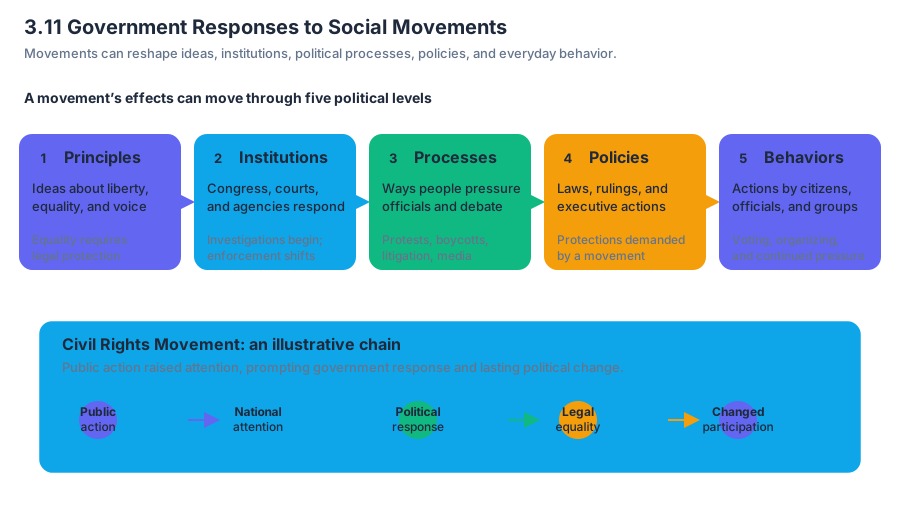
An argument is a position supported by reasoning and evidence. A social movement’s argument may challenge an existing practice, reinterpret a constitutional principle, or demand a policy change. Its effects can appear at several levels:
| Political level | What changes? | Illustrative effect |
|---|---|---|
| Principles | Ideas about liberty, equality, participation, or representation | Equality becomes understood as requiring legal protection against discrimination |
| Institutions | Behavior of Congress, the presidency, courts, or bureaucracy | Congress investigates an issue or an agency changes enforcement priorities |
| Processes | How citizens and officials participate in politics | Protests, boycotts, litigation, and media campaigns increase political pressure |
| Policies | Laws, regulations, court rulings, or executive actions | A government adopts protections demanded by a movement |
| Behaviors | Actions by voters, officials, organizations, and citizens | More people vote, contact officials, join organizations, or change party support |
The Civil Rights Movement illustrates the chain. Public demonstrations and arguments about constitutional equality increased national attention; political institutions responded through legislation and executive enforcement; policies changed; and political behavior changed as citizens organized, voted, litigated, and continued pressing government to enforce legal equality in practice.
Building an argument that earns credit
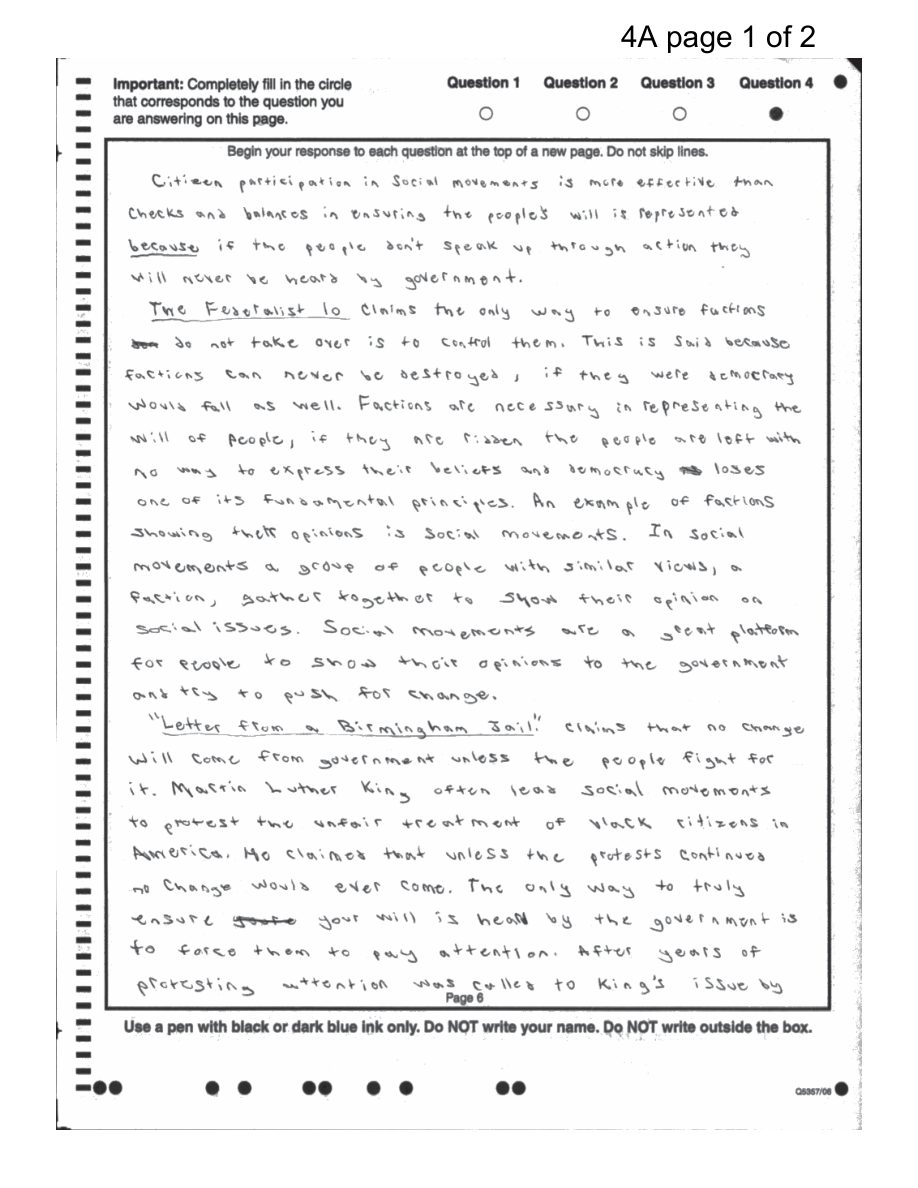
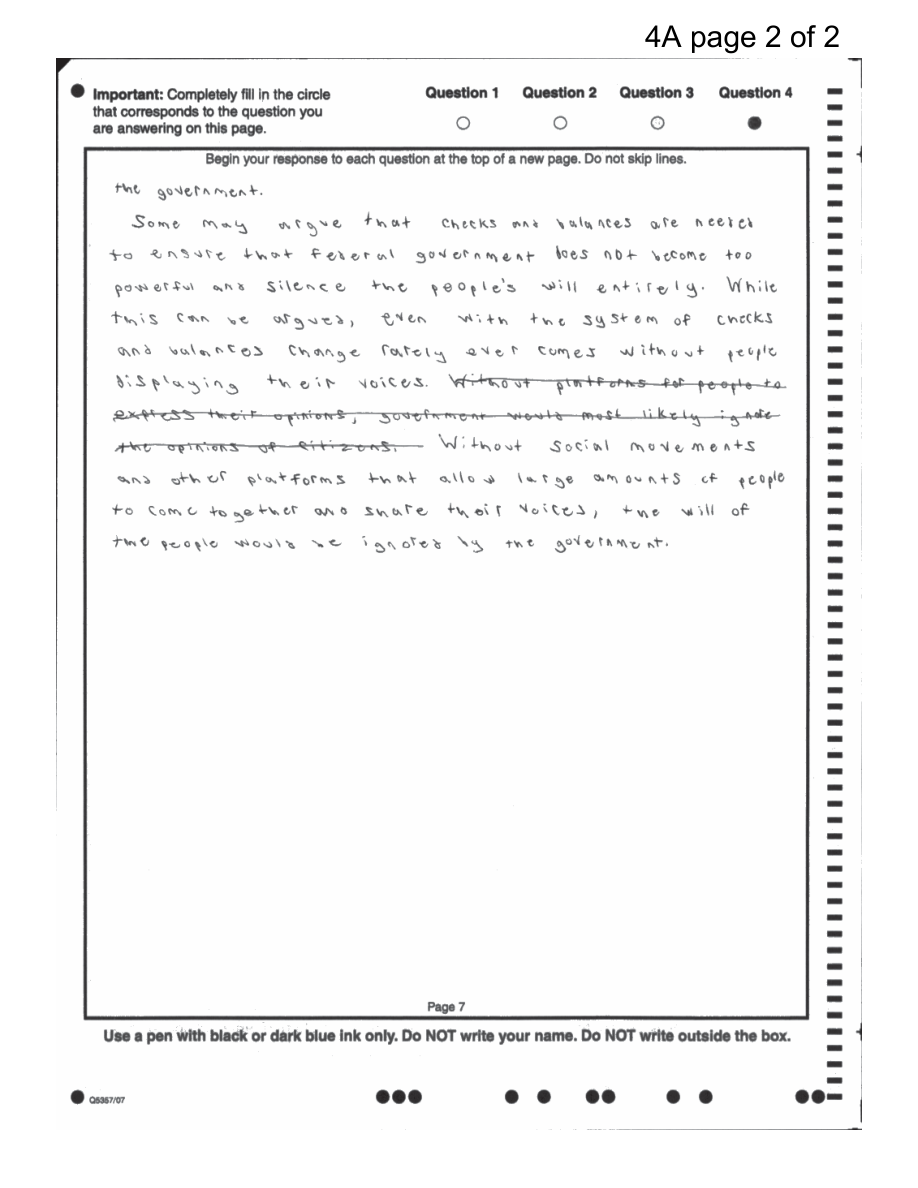
A strong argumentative response begins with a thesis, meaning a clear, defensible side on an issue. “Social movements matter” is too broad to establish a position. A stronger thesis takes a side and gives a reason: Social movements are more effective than institutional checks at making government respond to public demands because sustained public action can place neglected issues on the policy agenda.
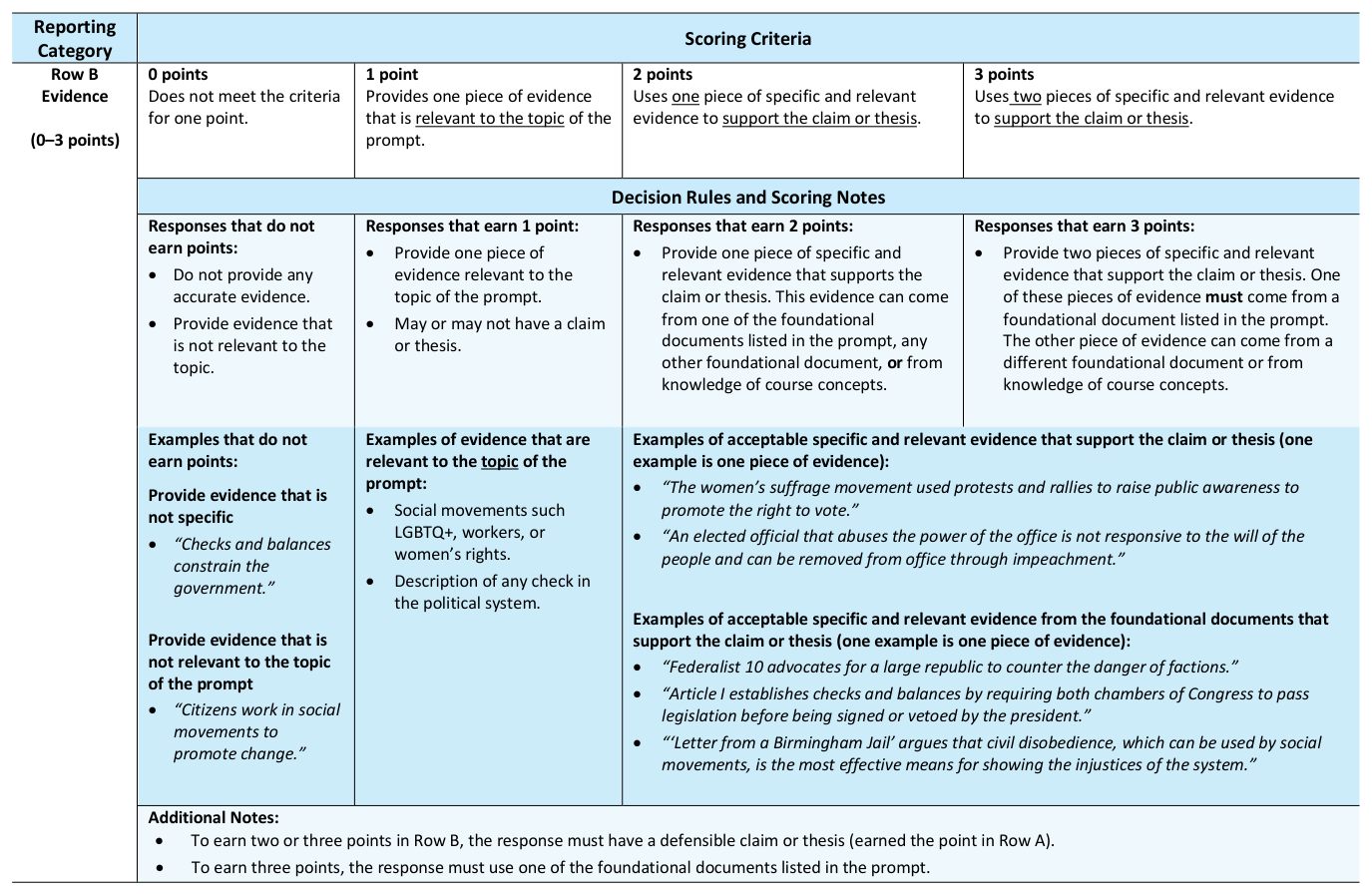
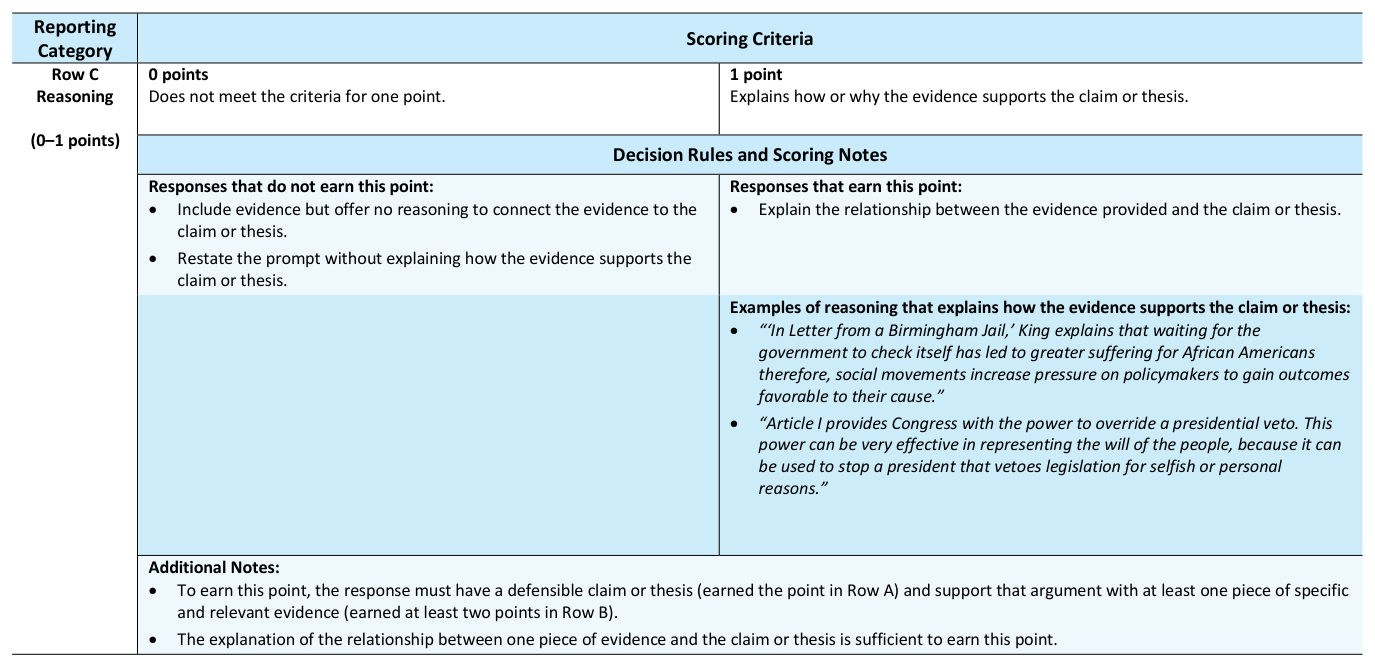
A claim should include reasoning that connects it to evidence, often through words such as because, by, or when. Evidence alone does not earn the reasoning point. The writer must explain the political relationship:
- Evidence: Federalist No. 10 argues that factions can be controlled by setting them against one another.
- Reasoning: This supports the claim that institutional checks can protect the public from one faction because divided institutions make it harder for a temporary majority to impose its will.
- Additional evidence: “Letter from a Birmingham Jail” argues that direct action can force an issue ignored by government into public attention.
- Reasoning: This supports the competing claim that social movements can produce change by making officials confront demands they might otherwise avoid.
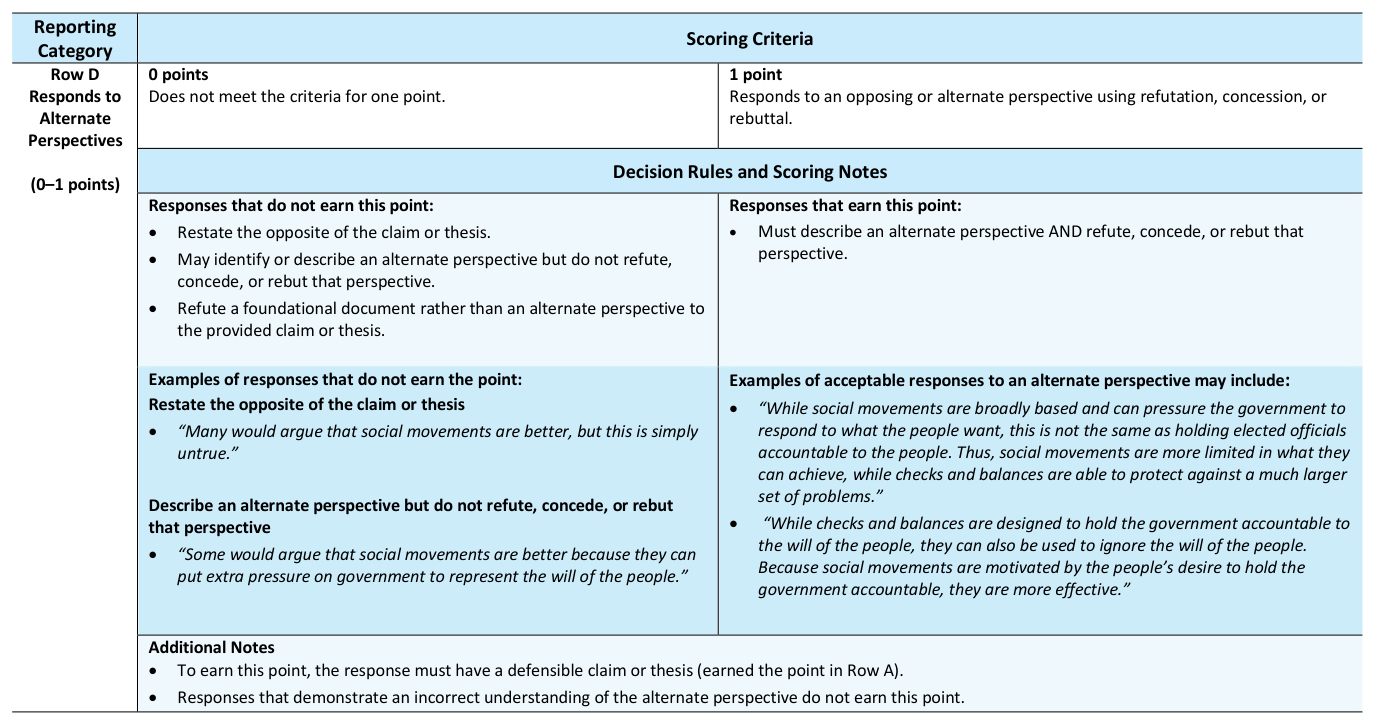
A complete response also addresses an alternative perspective rather than merely restating the opposite claim. For example, a writer may concede that checks and balances prevent government from becoming too powerful, then rebut that point by explaining that constitutional protections do not automatically place an ignored injustice on the government’s agenda. The response must show why its original position remains stronger.
Quantitative evidence and partisanship
The same reasoning pattern applies to data analysis. Suppose a graph shows an increasing trend in the percentage of voters choosing Senate and presidential candidates from the same political party. The correct qualitative inference is that partisanship is increasing: voters are becoming more likely to support candidates using a consistent party label across offices.
The evidence does not prove that every voter is more ideological, nor does it establish why the trend occurred. It supports the narrower inference that straight-ticket or same-party voting increased. To earn the explanation, connect the pattern to a possible political process: increasingly partisan political news may reinforce party identities and make voters more likely to select candidates from one party.
Political news acquisition means how people obtain political information. An overall graph trend may reflect changes from newspapers and broadcast networks toward ideological websites, online platforms, and social media. Social media can broaden participation and introduce people to political issues, but it may also expose them to questionable information, selective framing, or highly partisan content. That perspective must be considered in an argument about whether social media strengthens or weakens democracy.
AP skill application
- Skill 4.C — Explain the implications of an argument or perspective: Trace how a movement’s claim could affect principles, institutions, processes, policies, or behaviors.
- Skill 3.D — Use quantitative analysis to make a qualitative inference: Move from a numerical trend to a defensible political conclusion, such as increasing same-party voting indicating greater partisanship.
- Skill 2.B — Explain how a required Supreme Court case relates to a foundational document or other source: Connect constitutional principles, judicial decisions, and movement arguments rather than naming a case without explanation.
- Skill 5.A — Articulate a defensible claim/thesis: Take a clear side.
- Skill 5.B — Support an argument using evidence: Provide relevant information from foundational documents or course concepts.
- Skill 5.C — Use reasoning to explain why evidence supports a claim: State the causal or logical connection and address an alternative perspective.
Misconception check
Misconception: “If a response names accurate evidence, it has explained the argument.” Correction: evidence identifies what happened; reasoning explains why that evidence supports the claim. Likewise, a graph’s rising line does not automatically prove every possible cause. Identify the trend first, make the limited inference it supports, and then explain a plausible connection to political behavior.
Retrieval check
A graph shows that same-party Senate and presidential voting rises from one election period to the next. What qualitative inference is supported, and how could changing political news acquisition help explain it? A complete answer should identify increasing partisanship and connect the trend to increasingly partisan, ideological, or socially mediated news environments—while recognizing that social media may also spread questionable information.

Source Materials
- AP U.S. Government and Politics Course and Exam Description
- Learn More (.pdf)
- AP U.S. Government and Politics Course Overview
- AP U.S. Government and Politics Course at a Glance
- AP United States Government and Politics Course at a Glance Poster
- AP United States Government and Politics
- AP United States Government and Politics
- United States Government and Politics Sample Syllabus 1
- Figure — Sample Responses Q4 - Set 2 (p. 2)
- Figure — Sample Responses Q4 - Set 2 (p. 3)
- Figure — Sample Responses Q4 - Set 2 (p. 4)
- Figure — Sample Responses Q4 - Set 2 (p. 5)