From the free course AP United States Government and Politics on Lykke
4.8 Ideology and Policymaking
A political ideology becomes politically consequential when it turns a belief about government into a preferred policy choice: What problem deserves attention, what should government do, and who should bear the cost?
4.8 Ideology and Policymaking
A political ideology becomes politically consequential when it turns a belief about government into a preferred policy choice: What problem deserves attention, what should government do, and who should bear the cost? Ideology and policymaking therefore connects abstract values—such as equality, individual liberty, limited government, or collective responsibility—to concrete decisions about laws and public programs.
Essential question: How do political ideology and core values influence government policymaking?
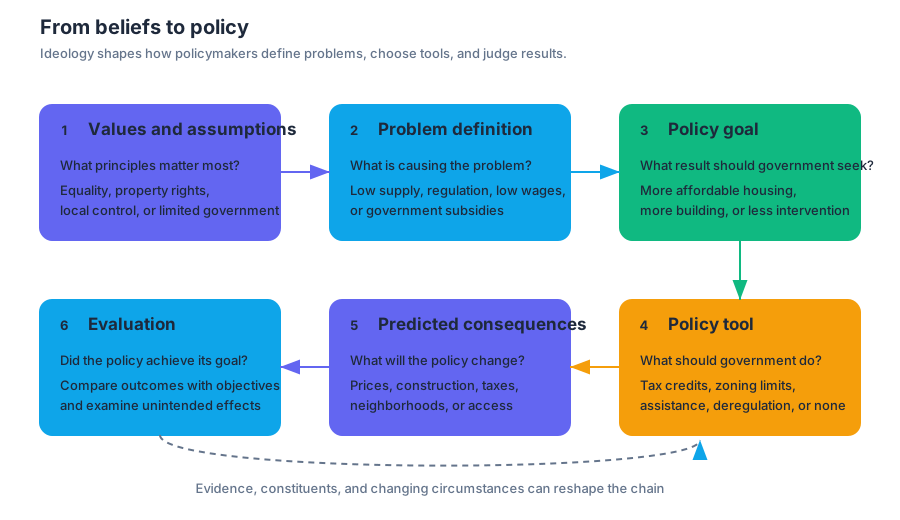
From beliefs to policy
A policymaker does not move directly from “liberal” or “conservative” beliefs to a final law. The reasoning usually passes through several steps. Two people may agree that a problem exists but define it differently, choose different goals, and support different tools.
| Stage | Guiding question | Example: rising housing costs |
|---|---|---|
| Values and assumptions | What principles matter most? | Equality of opportunity, property rights, local control, or limited government |
| Problem definition | What is causing the problem? | Insufficient housing supply, excessive regulation, low wages, or government subsidies |
| Policy goal | What result should government seek? | More affordable housing, greater construction, or less government intervention |
| Policy tool | What should government do? | Tax credits, zoning limits, direct assistance, deregulation, or no new program |
| Predicted consequences | What will the policy change? | Prices, construction, taxes, neighborhood patterns, or access |
| Evaluation | Did the policy achieve its goal? | Compare outcomes with the original objective and examine unintended effects |
This chain explains why ideology influences both the substance of policy and the arguments used to defend it. A liberal perspective may emphasize government action to reduce unequal outcomes; a conservative perspective may emphasize individual responsibility, market incentives, or limiting government power. These are tendencies, not rigid predictions: actual policymakers may combine approaches or change positions in response to evidence, constituents, political pressure, or changing circumstances.
Policy choices are not ideology in isolation
Political ideology is a consistent pattern of ideas about the proper role of government, the distribution of authority, and the best ways to address public problems. In policymaking, ideology interacts with public opinion, party coalitions, interest groups, institutions, constitutional limits, and available evidence.
For example, imagine that a state experiences severe wildfire damage. A policymaker who prioritizes limited government may oppose a large permanent bureaucracy and favor private insurance, local responsibility, or temporary emergency aid. A policymaker who prioritizes collective responsibility may support stronger building standards, public funding for prevention, and a permanent state program. Both may support immediate emergency response; their ideological differences become clearer when deciding who pays, how much authority the state should exercise, and whether the policy should continue after the crisis.
Worked example: interpreting an ideological argument
Suppose a city proposes a public transportation subsidy. One argument says that affordable transit expands access to jobs and reduces inequality. Another says that the subsidy transfers money from taxpayers who may not use transit and that private providers should compete to serve riders.
To analyze the arguments, identify the policy reasoning, not merely the label attached to each speaker:
- The first argument defines transportation as an opportunity problem.
- Its goal is broader access to employment and services.
- Its preferred tool is public funding that lowers fares or expands routes.
- It predicts social benefits that individual consumers may not be able to create alone.
- The second argument defines transportation as a government-efficiency and individual-choice problem.
- Its goal is limited taxation and competitive service.
- Its preferred tool is market provision rather than a broad public subsidy.
An AP response earns stronger analysis by explaining this causal connection: because the first perspective prioritizes equality of opportunity and accepts a larger governmental role, it is more likely to support a subsidy; because the second prioritizes limited government and market choice, it is more likely to oppose or narrow the subsidy. Simply calling one position “liberal” and the other “conservative” does not explain policymaking.
Misconception check
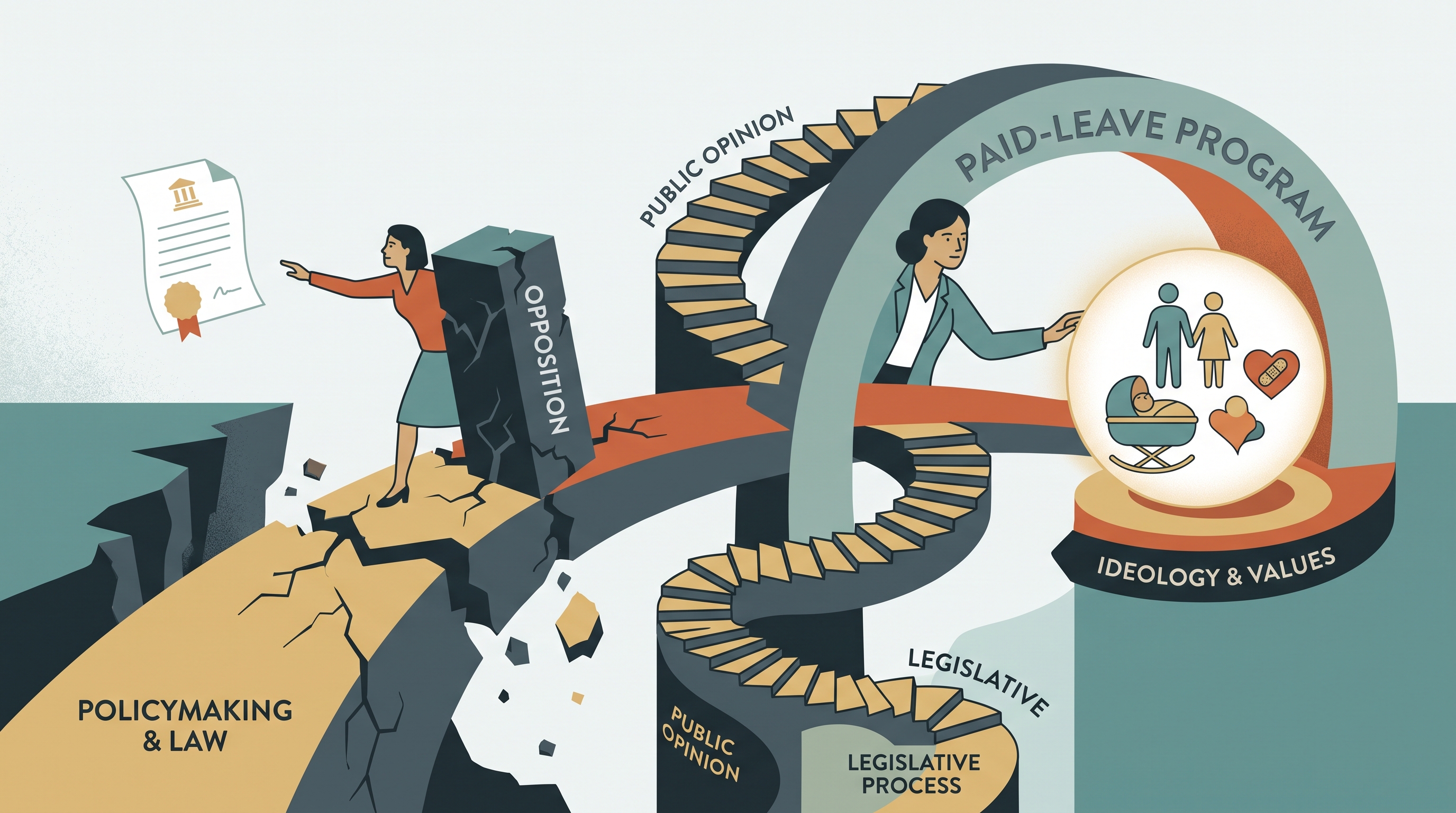
Misconception: ideology determines policy automatically. It does not. Institutional barriers, divided government, federalism, constitutional interpretation, budget constraints, public opinion, and interest-group activity can prevent an ideologically preferred policy from becoming law. A policymaker can also support a policy associated with another ideology when practical circumstances or constituency demands change.
Misconception: one policy always belongs exclusively to one ideology. Policy tools can be supported for different ideological reasons. A tax credit might be defended as social assistance, as a market-based alternative to direct regulation, or as an incentive for private investment. Explain the reasoning and predicted consequences rather than relying on labels.
AP skill connection
Topic 4.8 Ideology and Policymaking is assessed through Skill 4.D: Explain the implications of political processes, institutions, and behaviors. Apply the skill by tracing how an ideological perspective affects a policy goal, a governmental action, or the expected consequences of a policy. The key move is to connect perspective to implication: If policymakers prioritize this value, what decision becomes more likely, and how might that decision affect institutions, policies, or political behavior?
Retrieval check
A legislator supports a national paid-leave program because workers should not lose economic security when caring for a newborn or sick relative. Identify the likely value, policy goal, and policy tool. Then explain one reason why that ideological preference might still fail to become law.
Source Materials
- AP U.S. Government and Politics Course and Exam Description
- Learn More (.pdf)
- AP U.S. Government and Politics Course Overview
- AP U.S. Government and Politics Course at a Glance
- AP United States Government and Politics Course at a Glance Poster
- AP United States Government and Politics
- AP United States Government and Politics
- United States Government and Politics Sample Syllabus 1