From the free course AP United States Government and Politics on Lykke
3.3 First Amendment: Freedom of Speech
Key concepts: First Amendment freedom of speech · Supreme Court interpretation of free speech · Clear and present danger doctrine · Symbolic speech · Time, place, and manner restrictions · Political speech and campaign spending · Corporate, association, and labor-union political spending · Freedom of expression and compelled speech · Equal Protection Clause · Redistricting and political-question doctrine
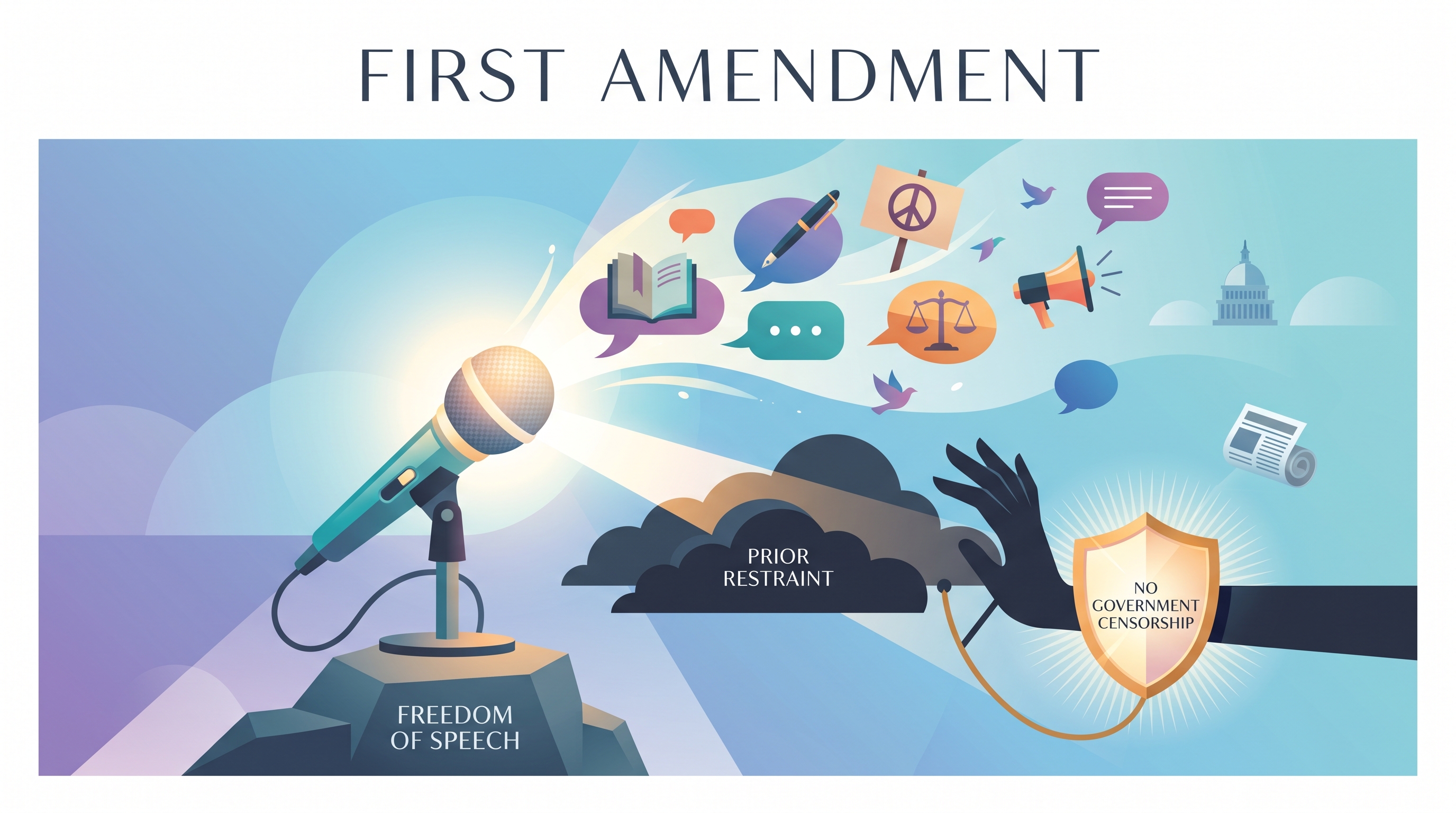
The First Amendment protects political communication because democratic self-government depends on people being able to criticize officials, advocate change, and express unpopular beliefs. The protection is powerful but not unlimited: the Supreme Court has permitted restrictions when speech falls into a legally…
3.3 First Amendment: Freedom of Speech
The First Amendment protects political communication because democratic self-government depends on people being able to criticize officials, advocate change, and express unpopular beliefs. The protection is powerful but not unlimited: the Supreme Court has permitted restrictions when speech falls into a legally unprotected category or when the government regulates the conditions of communication without targeting the message.
LO 3.3.A: Explain the extent to which the Supreme Court’s interpretation of the First Amendment reflects a commitment to free speech.
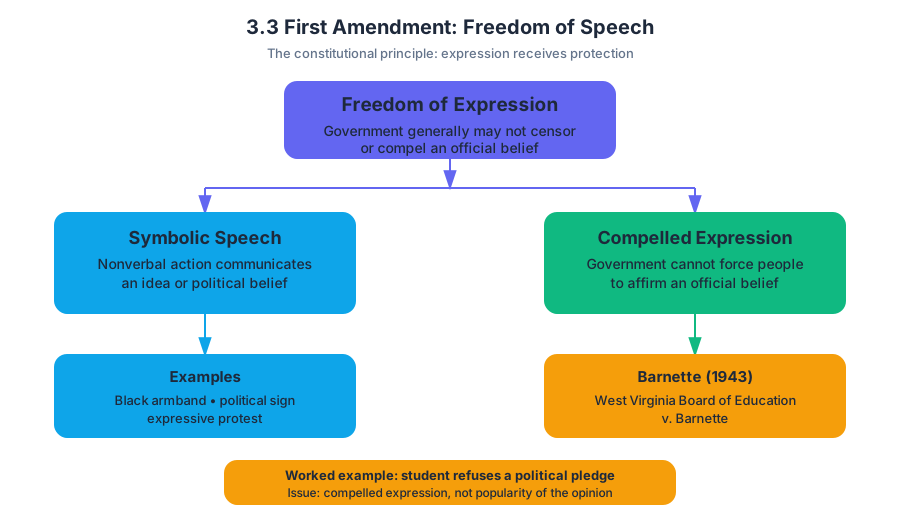
The constitutional principle: expression receives protection
Symbolic speech is nonverbal action that communicates an idea or belief. A protester wearing a black armband, displaying a political sign, or engaging in another expressive act may be communicating a political message even without speaking or writing words.
In West Virginia Board of Education v. Barnette (1943), the Court held that the First Amendment protects freedom of expression, including opposition to compelled expression—being forced by the government to communicate a message. The principle is broader than protection from censorship: government generally may not force individuals to affirm an official belief.
Worked example: A public school requires students to participate in a political pledge. A student refuses because the pledge conflicts with the student’s beliefs. The constitutional issue is not whether the student’s opinion is popular; it is whether the government is compelling expression. Under Barnette, compelled political expression conflicts with the First Amendment’s protection of individual freedom.
When speech may be limited
The Court balances social order and individual freedom. EK 3.3.A.1 identifies symbolic speech as protected expression, while EK 3.3.A.2 identifies categories and circumstances in which speech may be restricted.
The important distinction is between offensive political expression, which is generally protected, and legally defined categories that receive reduced or no protection. These can include legally defined obscenity, defamation, true threats, and fighting words. Defamation is a false statement that unlawfully harms another person’s reputation: libel is written defamation, while slander is spoken defamation. Mere vulgarity or political offensiveness does not automatically make speech regulable.
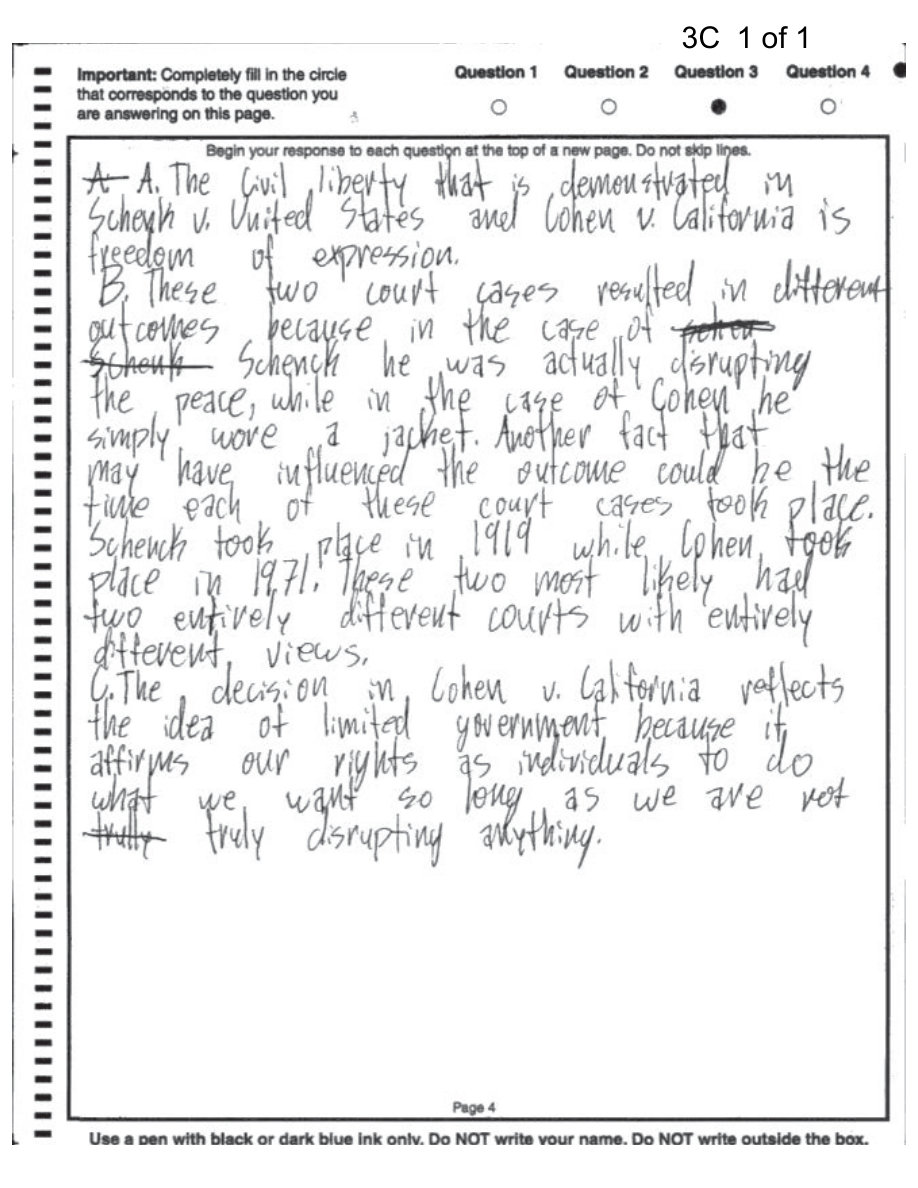
In Schenck v. United States (1919), the Court used the historical clear and present danger doctrine: speech creating a clear and present danger was not protected and could be limited. The doctrine shows that the First Amendment does not protect speech simply because it is labeled political if the circumstances make serious harm sufficiently immediate.
Later decisions narrowed this boundary. In Brandenburg v. Ohio (1969), the modern imminent lawless action standard generally protects advocacy unless it is directed toward producing imminent lawless action and is likely to produce it. Therefore, merely expressing a radical idea, criticizing government, or using offensive political language is ordinarily protected; urging immediate unlawful conduct in circumstances likely to trigger it may not be.
Misconception check: “Schenck means the government can ban any speech it considers dangerous.”
Correction: Schenck supplies a historically important formulation. Later doctrine, especially Brandenburg, requires a much tighter connection to imminent unlawful action.
Time, place, and manner restrictions
The government may impose content-neutral time, place, and manner restrictions—rules governing when, where, or how communication occurs without targeting its message. Examples include limiting the hours of a large public event, designating a location for demonstrations, or enforcing noise limits.
Content neutrality alone is not enough. A valid restriction must serve a significant governmental interest, be narrowly tailored, and leave open adequate alternative channels of communication. A city may control event noise to protect nearby residents, but it cannot disguise viewpoint discrimination as a noise rule or make communication practically impossible.
Worked example: A city permits demonstrations in a public park but requires amplified sound to stop at $10{:}00$ p.m. The rule is more likely constitutional if it applies equally to all viewpoints, protects residents’ ability to sleep, is narrowly tailored to that interest, and leaves demonstrators other ways to communicate—such as signs, daytime events, or nonamplified speech.
Political speech and campaign spending
Political speech includes communication intended to influence public debate and elections. In Citizens United v. Federal Election Commission (2010), the Court held that political spending by corporations, associations, and labor unions is protected speech under the First Amendment. The decision connects campaign participation to constitutional protection for political communication.
A useful analytical distinction is between the identity of the speaker and the content of the message. Supporters of Citizens United emphasize that restricting organizational spending can restrict the spread of political ideas; critics argue that concentrated spending can give wealthy organizations disproportionate influence. For AP analysis, the constitutional holding is the anchor: political spending is treated as protected expression, not merely as an ordinary economic transaction.
Keeping cases in their proper constitutional lane
Brown v. Board of Education (1954) held that race-based school segregation violates the Equal Protection Clause of the Fourteenth Amendment, and Baker v. Carr (1962) held that redistricting claims could be heard by federal courts rather than automatically dismissed as political questions. Both are required Supreme Court precedents, but neither is primarily a First Amendment freedom-of-speech case. Do not use them as evidence for symbolic speech or campaign-spending rules.
AP skill connection and retrieval check
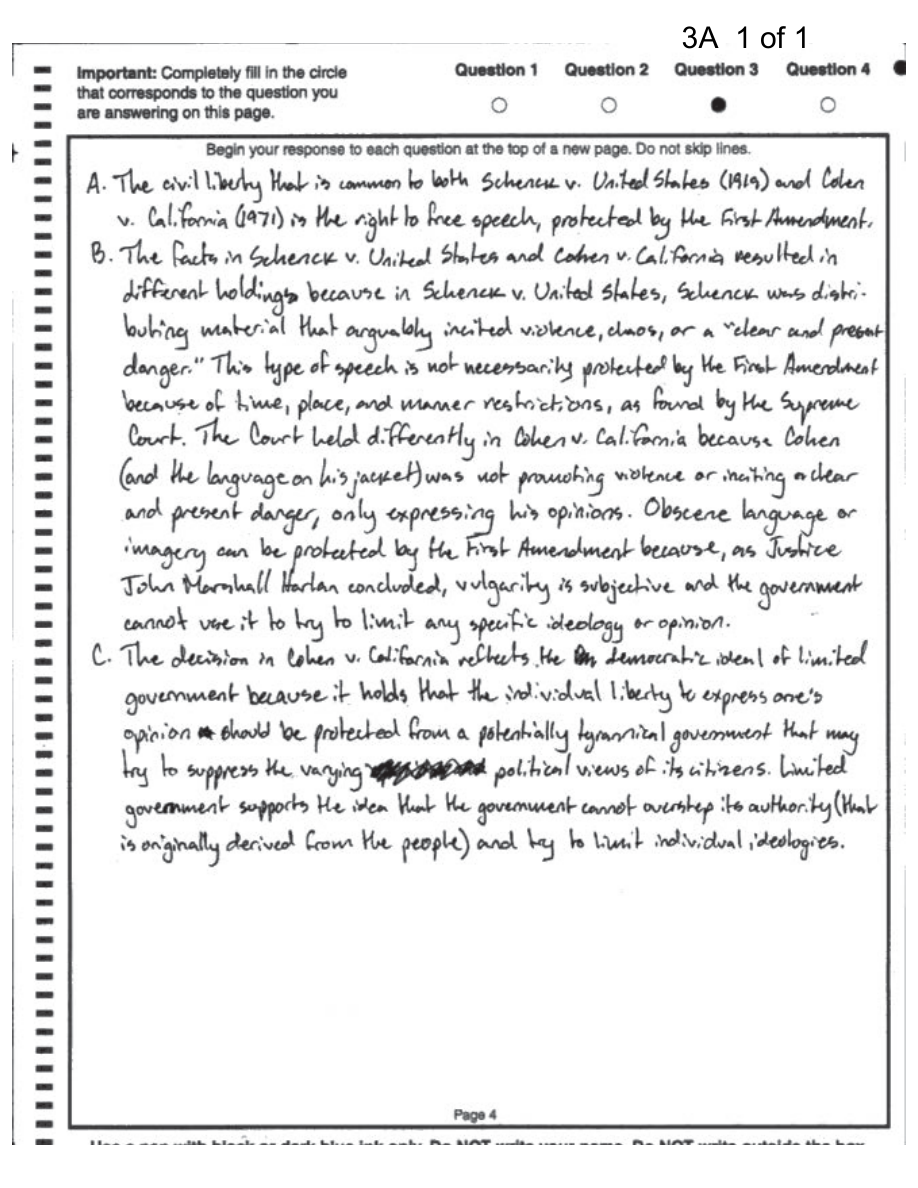
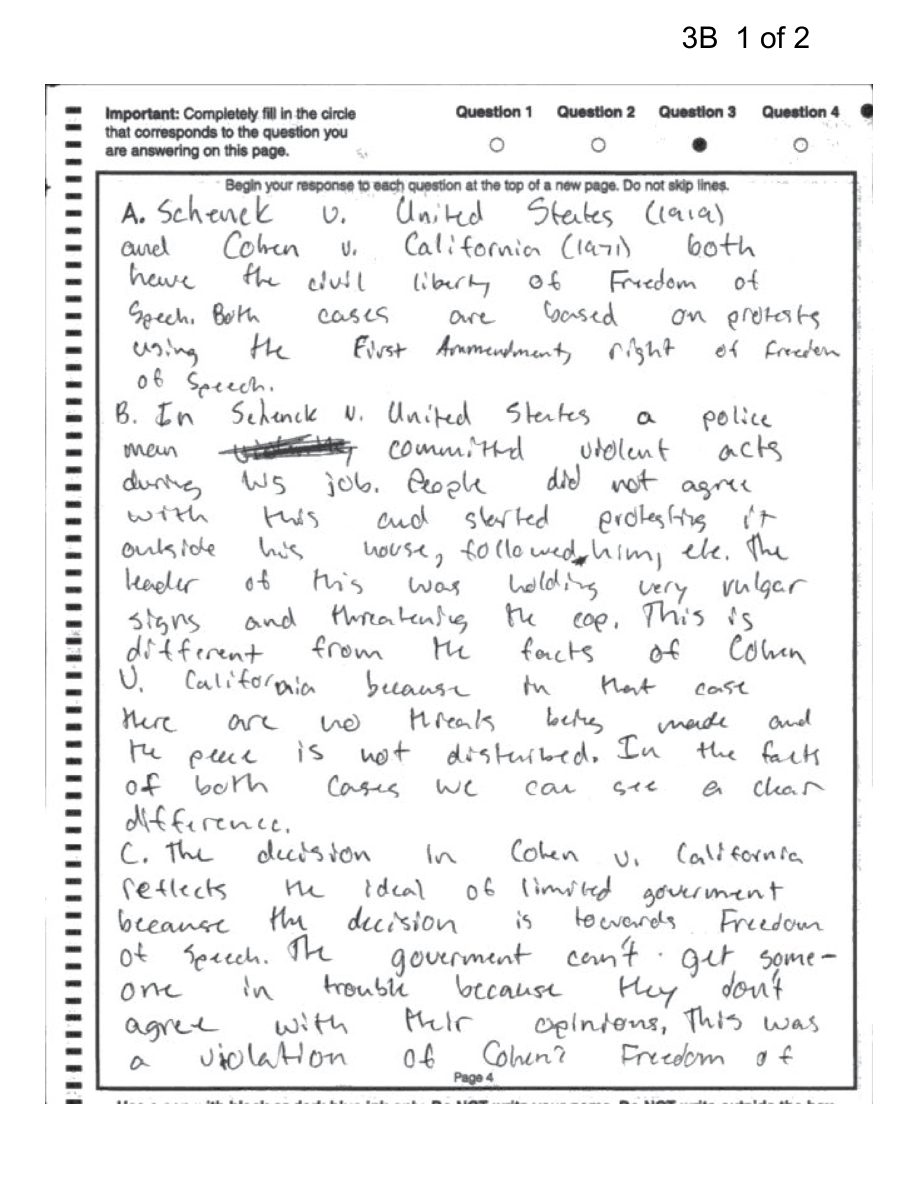
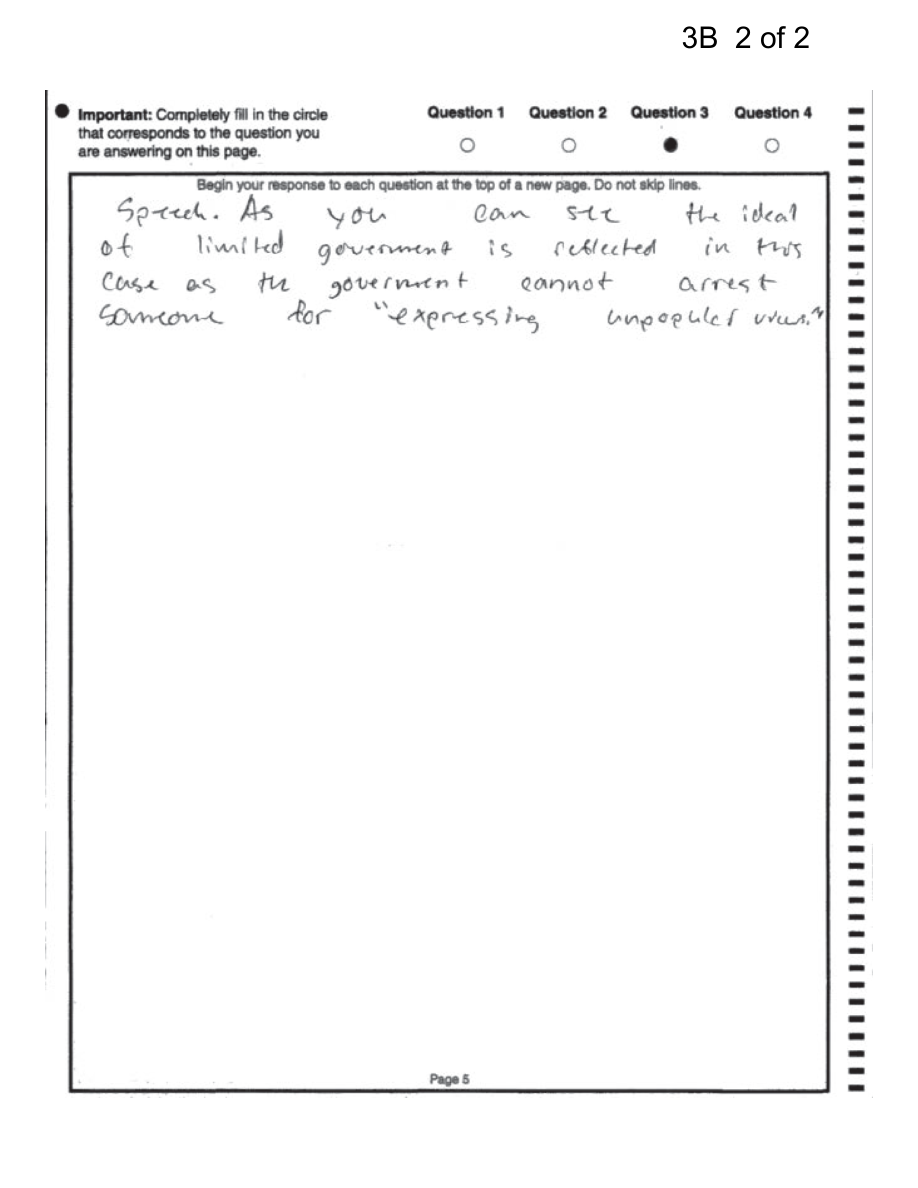
This topic especially exercises Concept Application (1.A): Define and explain political concepts and processes, SCOTUS Application (2.A): Describe the facts, reasoning, and decision in a Supreme Court case, and SCOTUS Application (2.B): Explain how a Supreme Court case relates to a political principle, institution, process, policy, or behavior. A strong comparison identifies the shared constitutional principle, explains the legally important factual difference, and connects the holding to the broader tension between liberty and order.
Retrieval check: A city bans only demonstrations criticizing the mayor, while allowing demonstrations praising the mayor. Is this a content-neutral time, place, and manner restriction? What required element fails first?
Answer: No. It targets viewpoint or content, so it fails content neutrality before the city can rely on the time, place, and manner test.
Source Materials
- AP U.S. Government and Politics Course and Exam Description
- Learn More (.pdf)
- AP U.S. Government and Politics Course Overview
- AP U.S. Government and Politics Course at a Glance
- AP United States Government and Politics Course at a Glance Poster
- AP United States Government and Politics
- AP United States Government and Politics
- United States Government and Politics Sample Syllabus 1
- Figure — Sample Responses Q3 - Set 2 (p. 3)
- Figure — Sample Responses Q3 - Set 2 (p. 4)
- Figure — Sample Responses Q3 - Set 2 (p. 5)
- Figure — Sample Responses Q3 - Set 2 (p. 6)