From the free course AP United States Government and Politics on Lykke
2.3 Congressional Behavior
Key concepts: retrospective voting · voter approval of congressional actions · electoral accountability · chairperson decision-making · voting in the next election
A voter can judge a member of Congress not by campaign promises, but by what that official actually did in office. Retrospective voting is a model of electoral decision-making in which voters look backward at an incumbent’s performance and then decide whether to support that official—or the official’s party—in the…
2.3 Congressional Behavior
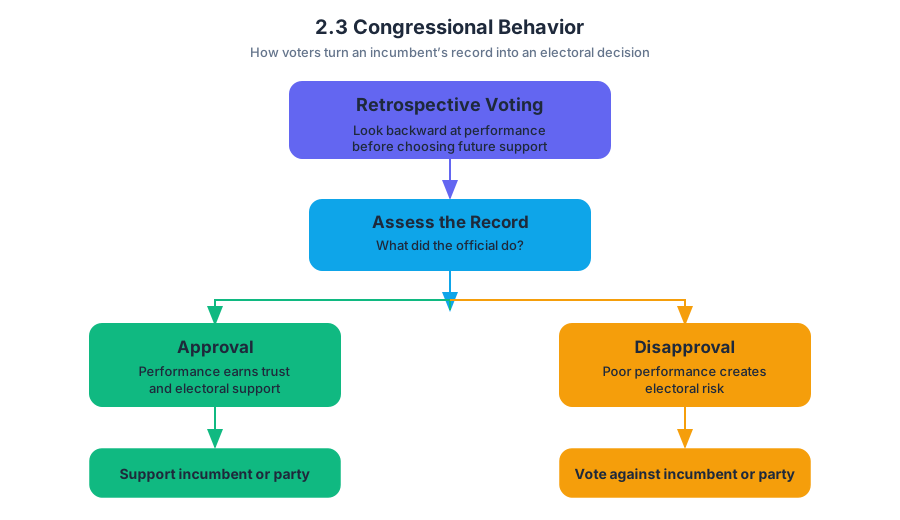
A voter can judge a member of Congress not by campaign promises, but by what that official actually did in office. Retrospective voting is a model of electoral decision-making in which voters look backward at an incumbent’s performance and then decide whether to support that official—or the official’s party—in the next election.
The model is simple: approval creates electoral support; disapproval creates electoral risk. Congressional behavior therefore matters beyond the Capitol because a representative’s decisions can become evidence that voters use to assign responsibility.
The retrospective voter model
Under retrospective voting, citizens ask a practical question: “How did this official perform?” They may evaluate a vote, a public decision, a committee action, or the results of a policy. The voter does not need to agree with every position; the key is whether the official’s observed behavior produces approval or disapproval.
Retrospective voting: Voting based primarily on an official’s past performance rather than on promises about future action.
The basic causal chain is:
| Congressional behavior | Voter evaluation | Electoral consequence |
|---|---|---|
| The member takes an action the voter supports | Approval | The voter is more likely to support the member in the next election |
| The member takes an action the voter opposes | Disapproval | The voter may vote against the member or withhold support |
| The member’s party is associated with the action | Party-level evaluation | The voter may support or oppose the party’s candidate |
This model produces electoral accountability, the idea that elections allow citizens to reward or punish public officials for their performance. Accountability is not automatic: voters must notice the action, connect it to the correct official, and care enough to change their vote.
Worked example: Chairperson Maloney
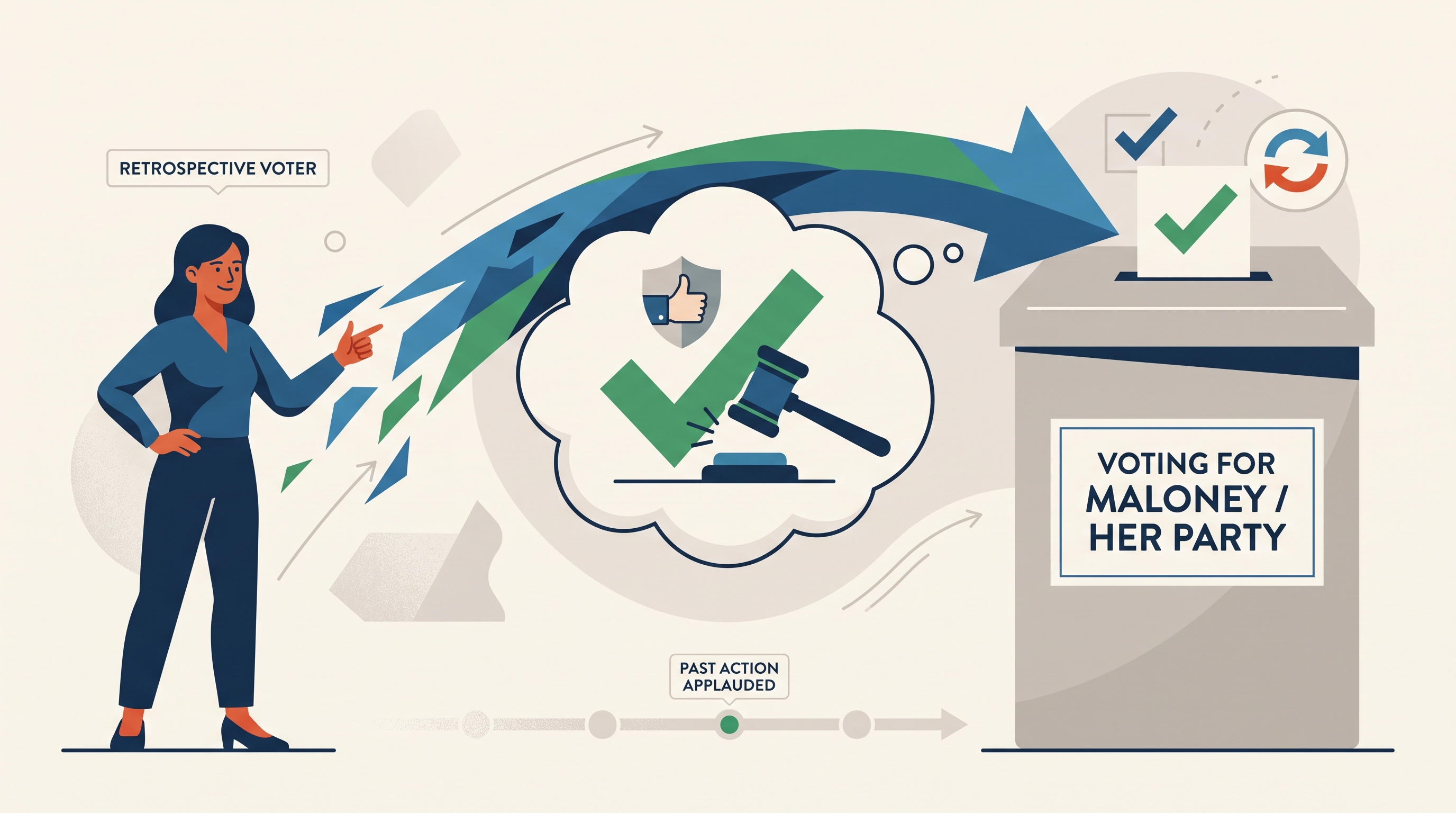
Imagine that Chairperson Maloney leads a congressional committee considering a proposal affecting local manufacturers. She schedules public hearings, rejects a rushed amendment, and supports a compromise that protects some workers while limiting costs for employers.
A voter who believes Maloney’s decision protected the community may approve of her actions. Applying the retrospective voter model, that voter is more likely to vote for Maloney in the next election. The voter may also support Maloney’s party if the party is seen as responsible for the committee’s position.
A different voter may believe Maloney ignored consumer concerns or favored business interests. That voter may evaluate her performance negatively and become less likely to vote for her in the next election. The disagreement does not need to involve a constitutional argument; the voter’s judgment about her conduct is enough to create electoral pressure.
Responsibility can also be attributed at several levels:
- Individual level: “Maloney made the decision, so I will reward or punish her.”
- Committee level: “The chairperson controlled the hearing or agenda, so the committee’s outcome reflects her leadership.”
- Party level: “Maloney’s party supported this position, so I will reward or punish the party’s candidates.”
The chairperson’s actions can therefore influence electoral support by shaping voters’ evaluations of her performance. Even when a chairperson does not act alone, visibility and agenda-setting can make that official appear especially responsible for the result.
Misconception check: voters do not punish every official equally
Common misconception: Retrospective voting means voters always know exactly who caused a policy outcome and punish that person.
In reality, voters may have incomplete information. They may attribute a committee’s decision to the chairperson, the full chamber, the majority party, or Congress as a whole. Party identification can also influence the judgment: a strong partisan may defend an official from the preferred party or blame the opposing party even when responsibility is shared.
A second misconception is that retrospective voting concerns only the individual representative. Voters can use congressional behavior to evaluate the member, the committee leadership, or the party. The crucial reasoning step is to identify which political actor the voter holds responsible.
AP skill connection
This topic most directly develops Skill 1: Concept Application, especially 1.A Describe political concepts and processes and 1.B Explain political concepts and processes. A strong response does more than define retrospective voting: it connects Maloney’s specific action to approval or disapproval and then to the likelihood of voting for or against her.
It also supports Skill 5: Argumentation, particularly when a response makes a defensible claim about electoral accountability and supports it with the scenario’s evidence. The high-value structure is: identify the action → state the voter’s evaluation → explain the likely vote in the next election.
Retrieval check
If a voter approves of Chairperson Maloney’s committee decision, what does the retrospective voter model predict?
Answer: The voter is more likely to vote for Maloney in the next election, or possibly for candidates from her party, because the voter is rewarding an action viewed as good performance.
Source Materials
- AP U.S. Government and Politics Course and Exam Description
- Learn More (.pdf)
- AP U.S. Government and Politics Course Overview
- AP U.S. Government and Politics Course at a Glance
- AP United States Government and Politics Course at a Glance Poster
- AP United States Government and Politics
- AP United States Government and Politics
- United States Government and Politics Sample Syllabus 1
- continued on next page