From the free course AP United States Government and Politics on Lykke
2.4 Roles and Powers of the President
A president can reject a bill, direct federal agencies, negotiate with foreign governments, command the armed forces, and persuade Congress—but these actions do not all come from the same constitutional source.
2.4 Roles and Powers of the President
A president can reject a bill, direct federal agencies, negotiate with foreign governments, command the armed forces, and persuade Congress—but these actions do not all come from the same constitutional source. The central question is: How does the president turn the office’s powers and institutional support into a policy agenda?
The presidency as an agenda-building institution
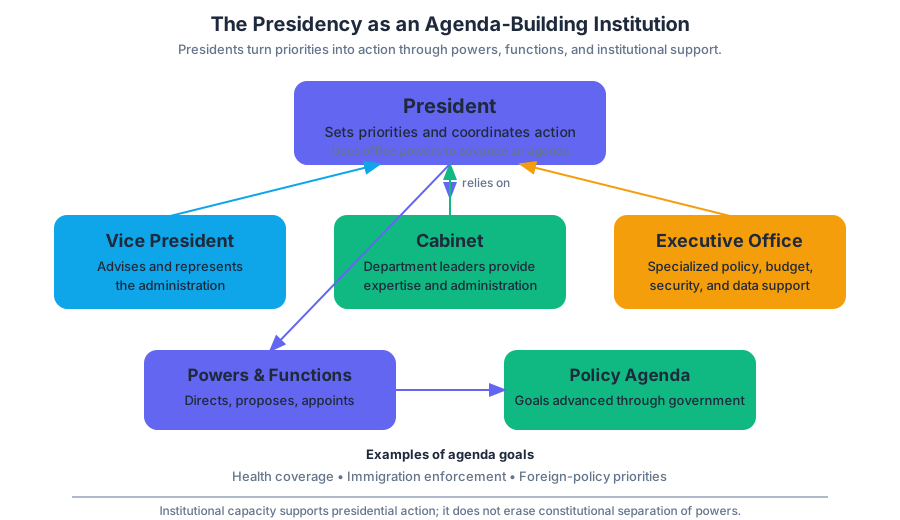
LO 2.4.A — Explain how presidents use powers and perform functions of the office to accomplish a policy agenda. A policy agenda is the set of goals a president seeks to advance, such as expanding health coverage, changing immigration enforcement, or revising foreign-policy priorities. Presidents rarely accomplish those goals through personal action alone; they rely on the Vice President, Cabinet, and Executive Office of the President.
The Cabinet consists of the leaders of executive departments, such as the secretary of state or secretary of defense. The Executive Office of the President (EOP) is a collection of specialized offices and advisers that help the president manage information, budgeting, communications, national security, and policy coordination. Together, these institutions give the president expertise and administrative capacity—but they do not erase the constitutional division between the branches.
EK 2.4.A.1 — Presidents use powers and perform functions of the office, with support from the Vice President, Cabinet, and Executive Office of the President, to accomplish a policy agenda.
Formal and informal presidential powers
EK 2.4.A.2 — The powers of the president include both formal and informal powers. Formal powers are powers explicitly granted by the Constitution or by federal law. Informal powers are tools that presidents use because of political influence, executive practice, or authority implied by the constitutional structure.
| Presidential tool | Type | What it does |
|---|---|---|
| Veto | Formal | Rejects a bill passed by Congress |
| Pocket veto | Formal | Prevents a bill from becoming law when Congress adjourns during the review period |
| Commander-in-chief authority | Formal | Directs the armed forces |
| Treaties | Formal, with Senate role | Establishes international agreements subject to Senate ratification |
| Executive agreements | Informal | Make international commitments without the treaty-ratification process |
| Bargaining and persuasion | Informal | Encourages Congress or other political actors to support presidential goals |
| Executive orders | Implied or delegated authority | Directs the operation of the federal government |
| Signing statements | Informal | Announces the president’s interpretation of a law being signed |
Worked example: stopping a bill
Imagine Congress passes a bill requiring every federal agency to use a new environmental reporting system. The president believes the bill is harmful and issues a veto, a formal power that prevents the bill from becoming law. Congress can still enact it, but only by overriding the veto with a two-thirds vote in both the House and Senate.
A pocket veto works differently. If Congress adjourns during the period in which the president may consider the bill, and the president does not sign it, the bill fails without the president returning it to Congress. Unlike an ordinary veto, a pocket veto cannot be overridden by a two-thirds congressional vote.
The reasoning chain is therefore:
- Congress passes legislation.
- The president chooses to sign, veto, or—under the conditions for a pocket veto—allow the bill to die.
- An ordinary veto preserves a congressional override option.
- A pocket veto ends the bill without that override route.
Foreign policy and executive influence
Presidential foreign-policy power combines formal and informal authority. The president acts as commander in chief, a formal constitutional role, and participates in treaty-making. At the same time, presidents use executive agreements, which are international commitments made without obtaining the Senate’s treaty-ratification vote.
For example, a president seeking an international climate commitment might negotiate an executive agreement with another government. This can be faster than pursuing a treaty, but it is not identical to a treaty and may be more vulnerable to later political or legal change.
Managing government and shaping interpretation
An executive order is a presidential directive used to manage the federal government. Its authority may rest on the president’s constitutionally vested executive power or on authority Congress has delegated through legislation. An executive order can organize agency action, establish administrative priorities, or instruct officials about enforcement—but it cannot validly create unlimited power where the Constitution or statutes provide none.
A signing statement is an informal power through which the president explains how the administration understands a law being signed. It informs Congress, federal officials, and the public about the president’s interpretation. It is not the same as a veto: the law has already been signed.
Key distinction: A veto prevents a bill from becoming law; a signing statement accompanies a law that the president has accepted.
Misconception check
Misconception: “The president can simply order any policy into existence.” Correction: presidential power is substantial but structured. Some tools are formal, some informal, and many depend on congressional authorization, administrative implementation, public support, or cooperation from other political actors. Presidential action can advance an agenda, but it does not eliminate separation of powers.
AP skill connection
This topic most directly develops Concept Application—especially 1.C, “Explain the impact of political concepts and processes on political systems”—by connecting presidential tools to policy outcomes. It also supports the suggested Source Analysis skill, “Explain how the argument,” when a source claims that executive action strengthens presidential leadership or creates tension with Congress. A strong explanation identifies the power, classifies it as formal or informal, and then explains its likely effect.
Retrieval check: A president signs a law but issues a public document explaining that the executive branch will interpret one provision narrowly. Which tool is being used, and why is it not a veto?
Source Materials
- AP U.S. Government and Politics Course and Exam Description
- Learn More (.pdf)
- AP U.S. Government and Politics Course Overview
- AP U.S. Government and Politics Course at a Glance
- AP United States Government and Politics Course at a Glance Poster
- AP United States Government and Politics
- AP United States Government and Politics
- United States Government and Politics Sample Syllabus 1