From the free course AP United States Government and Politics on Lykke
1.4 Challenges of the Articles of Confederation
Key concepts: Challenges of the Articles of Confederation · Weak central government · Power reserved to state governments · Anti-Federalist perspectives · Brutus No. 1 · Popular democratic theory · Required foundational documents · Source analysis · Political principles, institutions, processes, policies, and behaviors
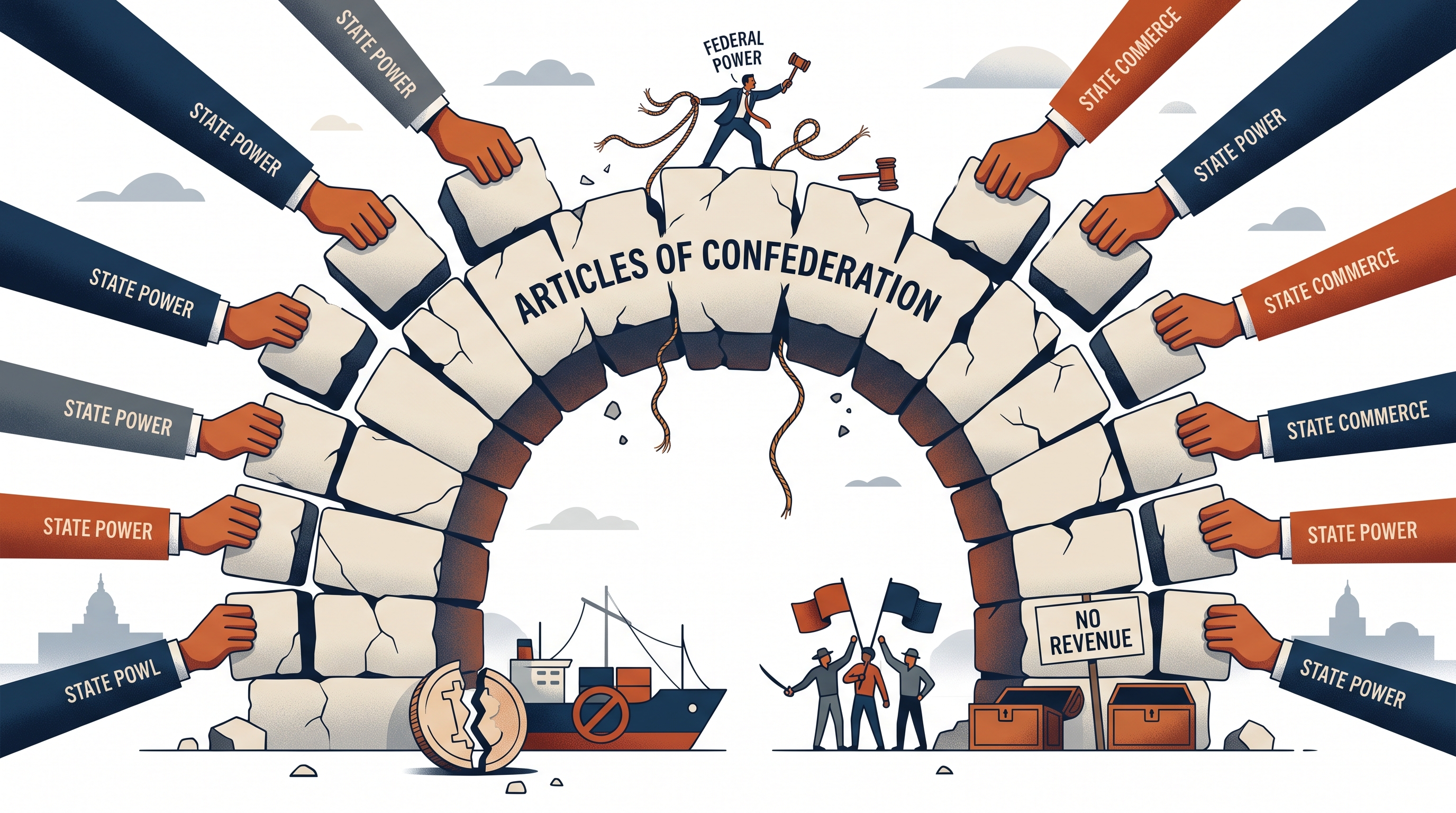
The Articles of Confederation created a national government that depended heavily on the states. Instead of concentrating authority in a strong central government, the Articles reserved more power to state governments—a design intended to protect local self-rule but one that made coordinated national action difficult.
1.4 Challenges of the Articles of Confederation
The Articles of Confederation created a national government that depended heavily on the states. Instead of concentrating authority in a strong central government, the Articles reserved more power to state governments—a design intended to protect local self-rule but one that made coordinated national action difficult.
Investigative question: How can a government protect the people from centralized power without becoming too weak to govern effectively?
A government built to fear central power
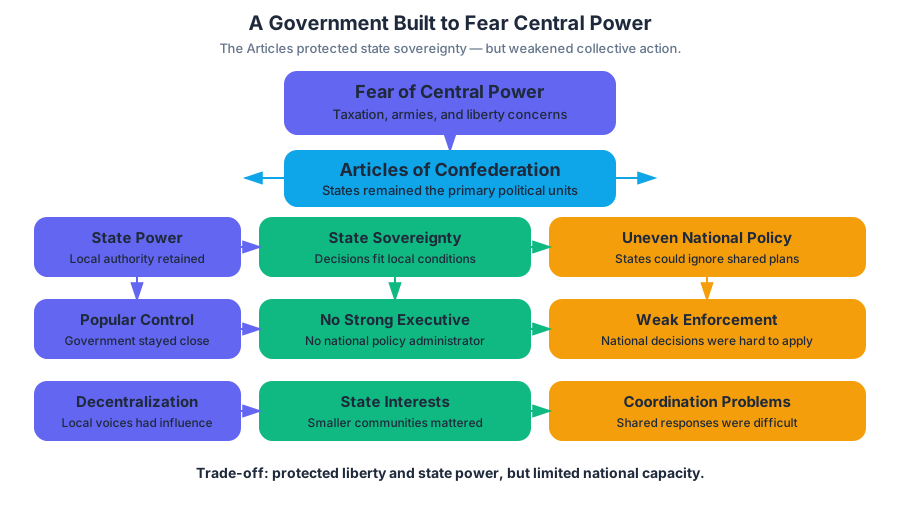
The Articles emerged from a political climate shaped by resistance to British rule. Many Americans associated centralized authority with taxation without representation, standing armies, and threats to personal liberty. The resulting system treated the states as the primary political units and made the national government comparatively weak.
Under the Articles, the national government lacked several powers commonly associated with effective central authority. It could request money from the states but had difficulty compelling them to provide it; it could conduct diplomacy but struggled to enforce national decisions; and it had no strong executive structure to administer policy. The arrangement therefore protected state sovereignty, but it also made national problems harder to solve collectively.
The basic trade-off can be visualized as a balance:
| Political priority | Advantage under the Articles | Resulting difficulty |
|---|---|---|
| State power | Local governments retained substantial authority | National policies could be uneven or ignored |
| Fear of centralized power | No powerful national executive dominated the states | National enforcement was weak |
| Popular control | Government remained close to local communities | Smaller state interests could conflict with national interests |
| Decentralization | Political decisions could reflect local conditions | Coordinated responses were difficult |
The Anti-Federalist perspective
Anti-Federalists opposed ratification of the Constitution because they believed it would transfer too much authority from the states to a large central government. Their position was not simply opposition to government; it was an argument about which level of government could best protect liberty and preserve meaningful popular control.
Anti-Federalist writings favored a small, decentralized republic. In this context, decentralized means that political power is distributed among state and local governments rather than concentrated nationally. Supporters believed smaller political communities would make representatives more accountable and allow citizens to recognize and influence their government more directly.
This perspective rested on popular democratic theory, the idea that legitimate government depends on the active political role of the people. If representatives governed close to their communities, Anti-Federalists reasoned, citizens would be better able to monitor them, replace them, and resist abuses of power.
Brutus No. 1: liberty versus national scale
Brutus No. 1 is a required foundational document associated with the Anti-Federalist argument. Its perspective warned that a large, centralized republic could endanger personal liberty because national officials would be geographically distant from ordinary citizens and might accumulate authority beyond effective popular control.
Brutus’s reasoning follows a clear chain:
Large territory
      ↓
Citizens are distant from national representatives
      ↓
Representatives understand local concerns less directly
      ↓
Public oversight becomes harder
      ↓
Central officials may gain power at the expense of liberty
The argument therefore connects a constitutional design choice—centralization—to a political principle—liberty—and to political behavior: whether citizens can effectively monitor, influence, and hold representatives accountable. This is the essential move in Source Analysis 4.B: “Explain how the argument or perspective in the source relates to political principles, institutions, processes, policies, and behaviors.”
Worked source-analysis example
Suppose a passage from Brutus No. 1 argues that representatives in a vast republic will become too distant from the people to reflect their interests. A strong analysis should not merely label the passage “Anti-Federalist.” It should explain the connection:
- Perspective: Brutus favors stronger state power and distrusts a large national republic.
- Political principle: The argument appeals to popular control and protection of personal liberty.
- Institutional implication: It prefers a decentralized structure in which state governments remain powerful.
- Predicted behavior: Citizens are more likely to monitor and influence representatives who govern closer to home.
- Constitutional conflict: A stronger national government might coordinate policy more effectively, but it could also appear less accountable to local communities.
This analysis shows how philosophical debate shaped the architecture of government. The question was not merely whether government should exist; it was whether liberty was safer when power was concentrated enough to act or dispersed enough to remain closely controlled by the people.
Misconception check
Common misconception: “The Anti-Federalists wanted no national government.”
Correction: Anti-Federalists criticized the proposed expansion of national power and favored greater authority for the states. Their central concern was that a large, centralized government could threaten liberty and weaken popular control.
Key distinction: The Articles’ weakness was a structural consequence of reserving power to the states. Anti-Federalist arguments defended that decentralization as a protection for liberty, even though critics believed it limited effective national action.
Retrieval check
Why would an Anti-Federalist use popular democratic theory to defend state power? In two sentences, identify the connection between a decentralized republic, citizen oversight, and the fear of a large centralized government. A complete answer should name Brutus No. 1 and explain how its perspective relates to liberty, institutions, and political behavior.
Source Materials
- AP U.S. Government and Politics Course and Exam Description
- Learn More (.pdf)
- AP U.S. Government and Politics Course Overview
- AP U.S. Government and Politics Course at a Glance
- AP United States Government and Politics Course at a Glance Poster
- AP United States Government and Politics
- AP United States Government and Politics
- United States Government and Politics Sample Syllabus 1
- 1.4 Challenges of the Articles of Confederation
- Source: Pew Research, 2020
- Based on your experience at the AP® Reading with student responses, what advice would you offer teachers to help them improve student performance on the exam? Teachers can spend time on the nine found
- Source: Tax Policy Center, 2020