From the free course AP United States Government and Politics on Lykke
3.2 First Amendment: Freedom of Religion
Key concepts: First Amendment freedom of religion · Free Exercise Clause · Establishment Clause · Wisconsin v. Yoder (1972) · Cantwell v. Connecticut (1940) · SCOTUS case comparison · Religious liberty versus government power · Compulsory education requirements · School vouchers and religious schools · Civil liberties as protection against arbitrary government interference
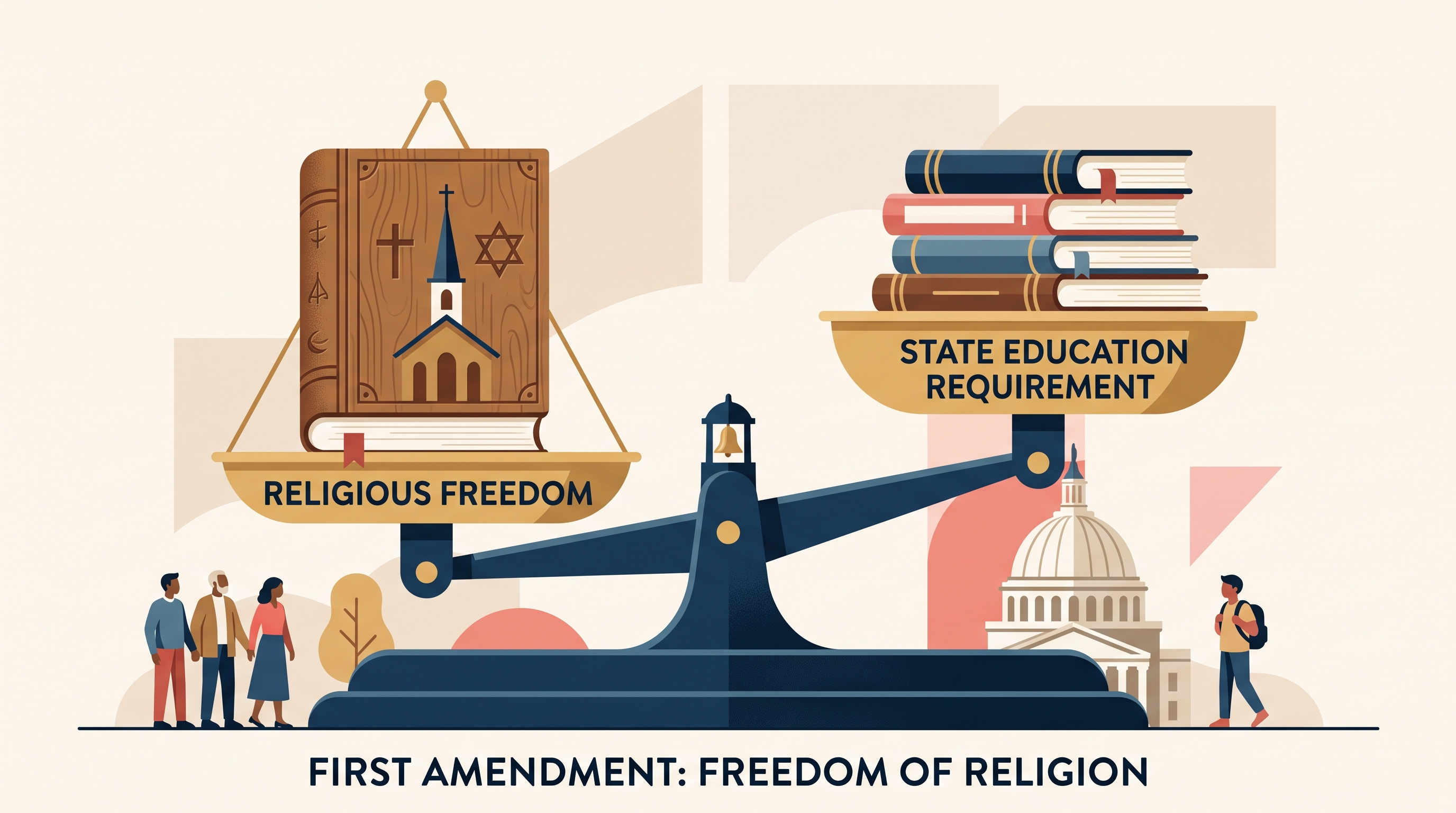
The First Amendment protects religious liberty in two different ways: it limits government from establishing religion and protects individuals who wish to practice religion. The distinction becomes clearest when the government is not choosing a religion, but is regulating conduct that a person considers religiously…
3.2 First Amendment: Freedom of Religion
The First Amendment protects religious liberty in two different ways: it limits government from establishing religion and protects individuals who wish to practice religion. The distinction becomes clearest when the government is not choosing a religion, but is regulating conduct that a person considers religiously required.
Investigative question: When does a neutral government rule become an unconstitutional burden on religious practice?
Two clauses, two constitutional problems
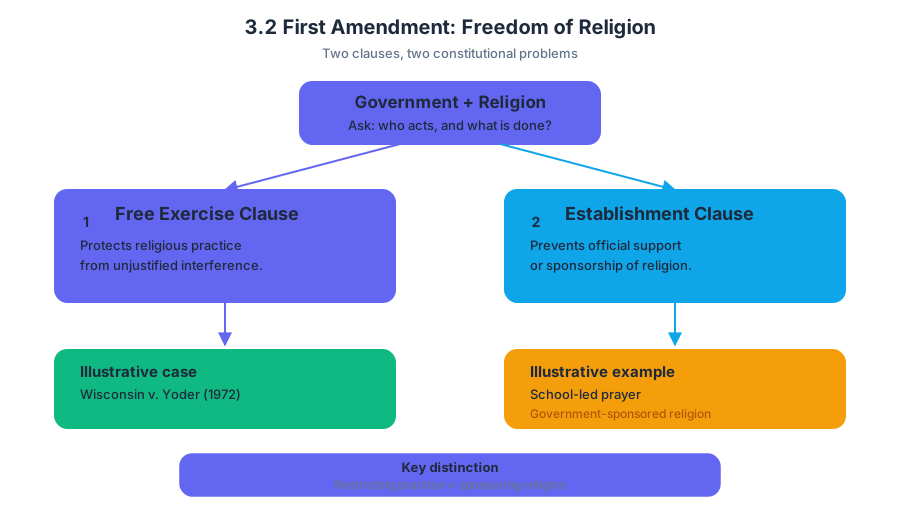
The Free Exercise Clause protects an individual’s ability to practice, express, and live according to religious beliefs without unjustified government interference. The Establishment Clause prevents government from officially supporting, promoting, or sponsoring religion.
A useful diagnostic is to identify who is acting and what the government is doing:
| Constitutional clause | Government problem | Illustrative example |
|---|---|---|
| Free Exercise Clause | Government burdens religious practice or expression | Requiring Amish children to remain in school beyond the age their faith permits |
| Establishment Clause | Government promotes or endorses religious belief | School-led prayer |
| Both can involve religion | The key question is whether government is restricting practice or sponsoring religion | A neutral rule may still require constitutional analysis |
The most common misconception is that the Establishment Clause means “freedom of religion” generally. It does not. Establishment concerns government sponsorship of religion; free exercise concerns the individual’s religious practice. In Wisconsin v. Yoder (1972) and Cantwell v. Connecticut (1940), the common constitutional issue is the Free Exercise Clause.
Worked comparison: Wisconsin v. Yoder and Cantwell v. Connecticut
In Wisconsin v. Yoder, Wisconsin required children to attend school until age 16. Amish parents objected because continued formal schooling conflicted with their religious beliefs and community practices. The Supreme Court held that applying the compulsory-education requirement to these parents violated their First Amendment religious rights.
In Cantwell v. Connecticut, Jehovah’s Witnesses objected to Connecticut regulations governing door-to-door religious solicitation. The Court held that the soliciting activities were protected by the Free Exercise Clause. The case also helped incorporate the Free Exercise Clause through the Fourteenth Amendment’s Due Process Clause, making the protection applicable against state governments.
The cases share a constitutional principle but involve different government actions:
| Feature | Wisconsin v. Yoder | Cantwell v. Connecticut |
|---|---|---|
| Religious group | Amish parents | Jehovah’s Witnesses |
| Government action | Compulsory education until age 16 | Regulation of door-to-door solicitation |
| Religious practice affected | Raising children within Amish religious life | Religious proselytizing and solicitation |
| Holding | The requirement conflicted with protected religious rights | The soliciting activity was protected |
| Larger significance | Religious liberty outweighed the state’s educational interest in these facts | States could not use regulation to suppress religious expression |
The important comparison is not merely that “the Court sided with religion.” In each case, the Court examined a specific government interest and a specific burden on religious practice. In Yoder, the state’s compulsory-education rule threatened the Amish way of life; in Cantwell, state solicitation regulations burdened religious outreach. The facts explain why the government’s authority had to be balanced against constitutional rights.
AP reasoning pattern: Identify the clause → state the relevant facts → connect those facts to the holding → explain the constitutional significance.
The Establishment Clause in action
The Establishment Clause prohibits school-led prayer because a public school is a government institution. When school officials organize or direct prayer, the government is not merely allowing private religious expression; it is sponsoring religious activity.
Zelman illustrates a different constitutional arrangement. The Court supported the constitutionality of a school-voucher program that included religious schools because public aid reached those schools through the independent choices of families rather than through a government decision favoring a particular religion. The constitutional question therefore turned on the structure of the program, not simply on whether religious schools ultimately received funds.
AP skill focus: SCOTUS Application
This topic most directly develops Skill 2: SCOTUS Application, especially 2.A—describing the relevant facts, issue, holding, reasoning, or implications of a Supreme Court case—and 2.B—comparing the reasoning, decision, or implications of Supreme Court cases. A strong response uses case facts as evidence rather than listing case names.
For a comparison, write: “Both cases involved the Free Exercise Clause, but Yoder concerned compulsory education while Cantwell concerned solicitation regulations. In each case, the Court found that state authority burdened protected religious practice, so the relevant facts supported similar holdings.”
Retrieval check
A state requires students to attend school until age 16; a religious community objects because the requirement conflicts with its way of life. Which clause is implicated, and which case provides the closest comparison? Answer: the Free Exercise Clause, with Wisconsin v. Yoder as the closest comparison. A school administrator who leads students in prayer raises an Establishment Clause issue instead.
Source Materials
- AP U.S. Government and Politics Course and Exam Description
- Learn More (.pdf)
- AP U.S. Government and Politics Course Overview
- AP U.S. Government and Politics Course at a Glance
- AP United States Government and Politics Course at a Glance Poster
- AP United States Government and Politics
- AP United States Government and Politics
- United States Government and Politics Sample Syllabus 1