From the free course AP United States Government and Politics on Lykke
5.4 How and Why Political Parties Change and Adapt
Key concepts: Political party adaptation · Candidate-centered campaigns · Public focus on candidate characteristics rather than party identity · Political parties’ role in the nominating process · Educating voters · Recruiting candidates · Organizing leadership within legislative bodies · Explaining how and why political processes change
A modern presidential campaign can look less like a party selling a fixed product and more like a candidate building a personal brand. Voters may respond to a candidate’s biography, communication style, identity, or perceived leadership before they think carefully about the party label.
5.4 How and Why Political Parties Change and Adapt
A modern presidential campaign can look less like a party selling a fixed product and more like a candidate building a personal brand. Voters may respond to a candidate’s biography, communication style, identity, or perceived leadership before they think carefully about the party label. This is the central shift behind candidate-centered campaigns: public attention focuses primarily on the characteristics of the candidate rather than on the political party.
LO 5.4.A — Explain why and how political parties change and adapt.
EK 5.4.A.1 — Parties have adapted to candidate-centered campaigns where the public focus is on the characteristics of the candidate and not on the party. The role of parties in nominating candidates has also been weakened.
From party-centered politics to candidate-centered campaigns
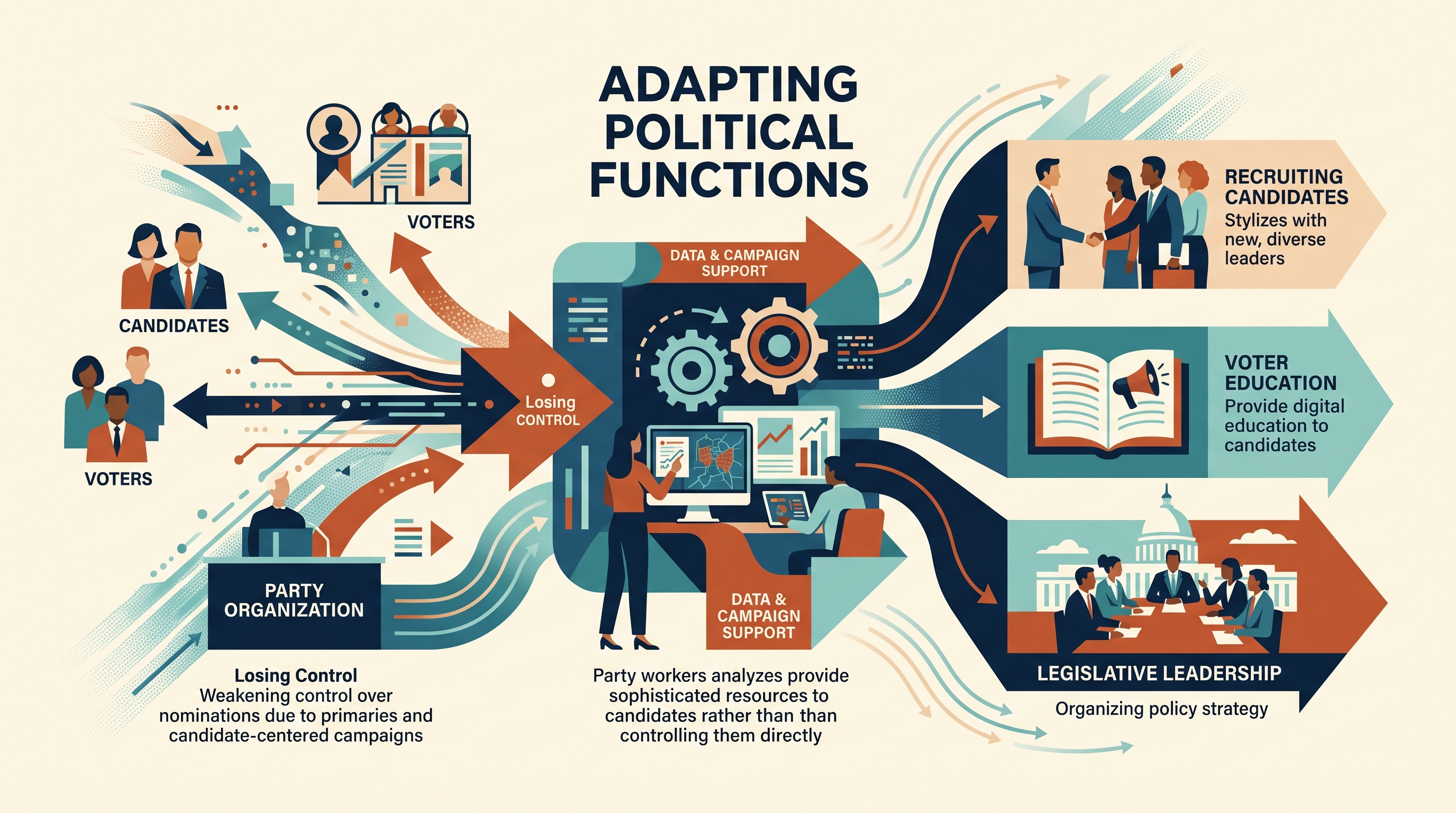
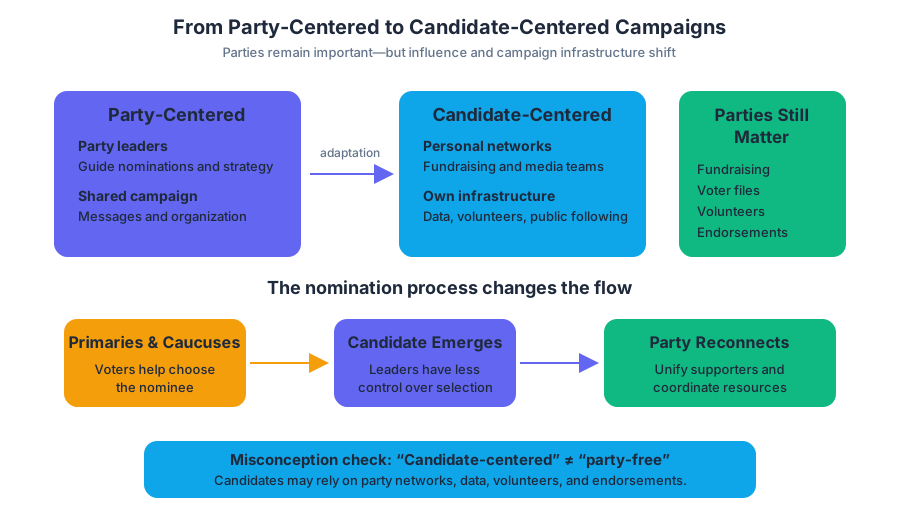
In a more party-centered system, party organizations had greater control over nominations, campaign messages, and electoral strategy. In a candidate-centered system, individual candidates often build their own fundraising networks, media operations, data systems, and personal organizations. Parties still provide valuable support, but they must adapt to candidates who may already possess their own public following and campaign infrastructure.
The change in the nominating process is especially important. Primaries and caucuses give voters a larger role in selecting party nominees, reducing the ability of party leaders alone to determine which candidate represents the party. As a result, parties often work after candidates emerge from the nomination process to unify supporters, coordinate campaign resources, and connect the candidate to the party platform.
Misconception check — “Candidate-centered” means “party-free.” It does not. A candidate-centered campaign may depend heavily on party fundraising networks, voter files, volunteers, endorsements, and organizational support. The point is not that parties disappear; the point is that the candidate becomes the campaign’s most visible and influential center.
Worked example: campaign technology and adaptation
Consider the 2012 presidential campaign. Mitt Romney’s campaign used ORCA, while Barack Obama’s campaign used Project Narwhal. These operations illustrate how campaigns adapted to large-scale voter data, digital communication, targeted mobilization, and rapid coordination. The technology was associated with the candidates’ campaign organizations, showing how modern parties and campaigns respond when electoral competition revolves around an individual candidate’s operation.
The reasoning chain is:
- Voters and media focus heavily on the presidential candidate.
- The candidate’s organization develops specialized data and communication systems.
- The party adapts by supporting, coordinating with, and learning from candidate-centered campaign structures.
- Campaign strategy becomes more personalized and technologically sophisticated.
- The party’s traditional control over nominations and messaging becomes less exclusive.
This example demonstrates why parties change: institutions such as primaries, media systems, campaign technology, and voter behavior alter the environment in which parties operate. It also demonstrates how they change: parties modify their organization, messaging, recruitment, and campaign support to remain electorally useful.
What parties continue to do
Candidate-centered politics has not eliminated the core functions of parties. Political parties remain linkage institutions, connecting citizens to government through several activities:
| Party function | How adaptation appears |
|---|---|
| Educating voters | Parties explain policy choices, frame political issues, distribute information, and help voters interpret candidates and public events. |
| Recruiting candidates | Parties identify, encourage, train, endorse, and support people seeking office at national, state, and local levels. |
| Organizing legislative leadership | Party organizations structure leadership within legislative bodies by helping select leaders, assign committee positions, coordinate agendas, and organize voting coalitions. |
| Shaping policies and messaging | Parties adjust platforms and communication to appeal to different demographic coalitions, or groups of voters with shared characteristics or interests. |
EK 5.4.A.2 — Parties may adapt their policies and messaging to appeal to various demographic coalitions.
A party might therefore preserve broad commitments while changing the language, examples, messengers, or policy priorities it emphasizes for different constituencies. Adaptation is not automatically hypocrisy or abandonment of principle; it can be a strategic response to changing voters, institutions, and political conditions. At the same time, adaptation can create internal conflict when different coalitions demand incompatible policies.
EK 5.4.A.3 — The structure of parties has been influenced by changes in campaign organization, communication, and the wider electoral environment.
EK 5.4.A.4 — Political parties perform continuing functions that include educating voters, recruiting candidates, and organizing the leadership structure within legislative bodies.
AP skill connection: explaining an argument
The relevant Source Analysis skill is: “Explain how the argument or perspective in the source relates to political principles, institutions, processes, policies, and behaviors.” For this topic, do not merely identify that a source discusses candidate-centered campaigns. Explain the relationship: for example, a source arguing that candidates control more campaign resources can be connected to the nominating process, voter behavior, party organization, and the weakening of traditional party-leader control.
Retrieval check: A party loses some control over nominations because primary voters choose nominees, while candidates increasingly build independent campaign organizations. Name one way a party can adapt and one continuing function it performs. A strong answer might identify data-driven campaign support as the adaptation and voter education, candidate recruitment, or legislative leadership organization as the continuing function.
Source Materials
- AP U.S. Government and Politics Course and Exam Description
- Learn More (.pdf)
- AP U.S. Government and Politics Course Overview
- AP U.S. Government and Politics Course at a Glance
- AP United States Government and Politics Course at a Glance Poster
- AP United States Government and Politics
- AP United States Government and Politics
- United States Government and Politics Sample Syllabus 1
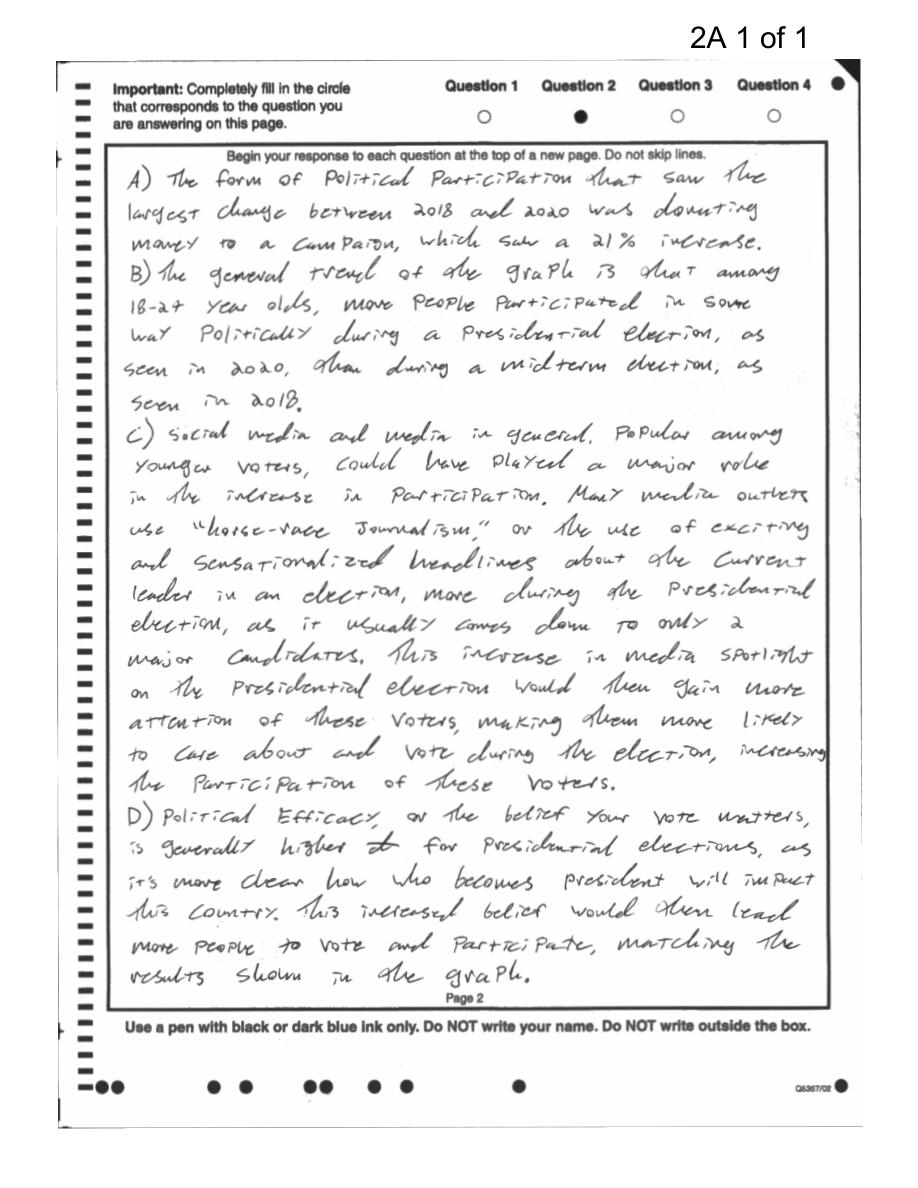
- Figure — Sample Responses Q2 - Set 1 (p. 3)
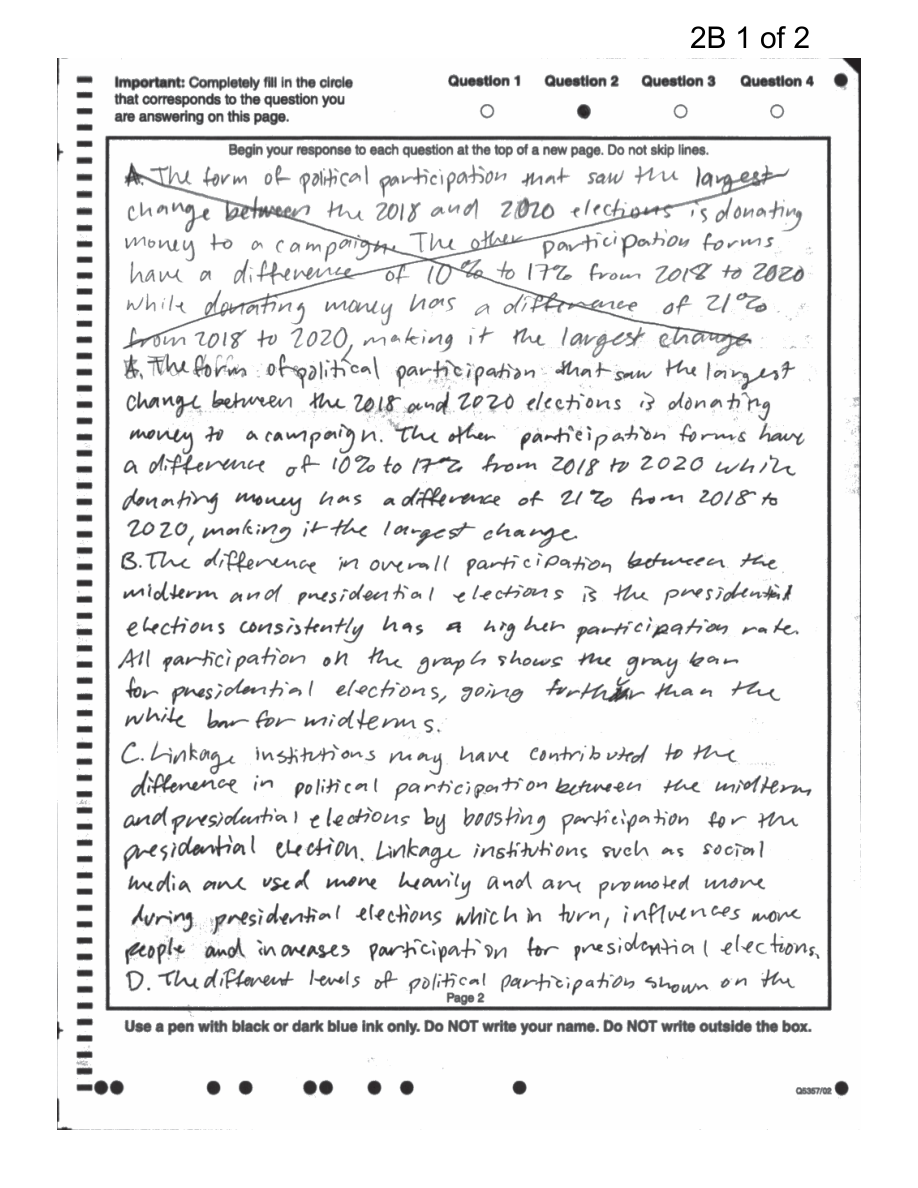
- Figure — Sample Responses Q2 - Set 1 (p. 4)
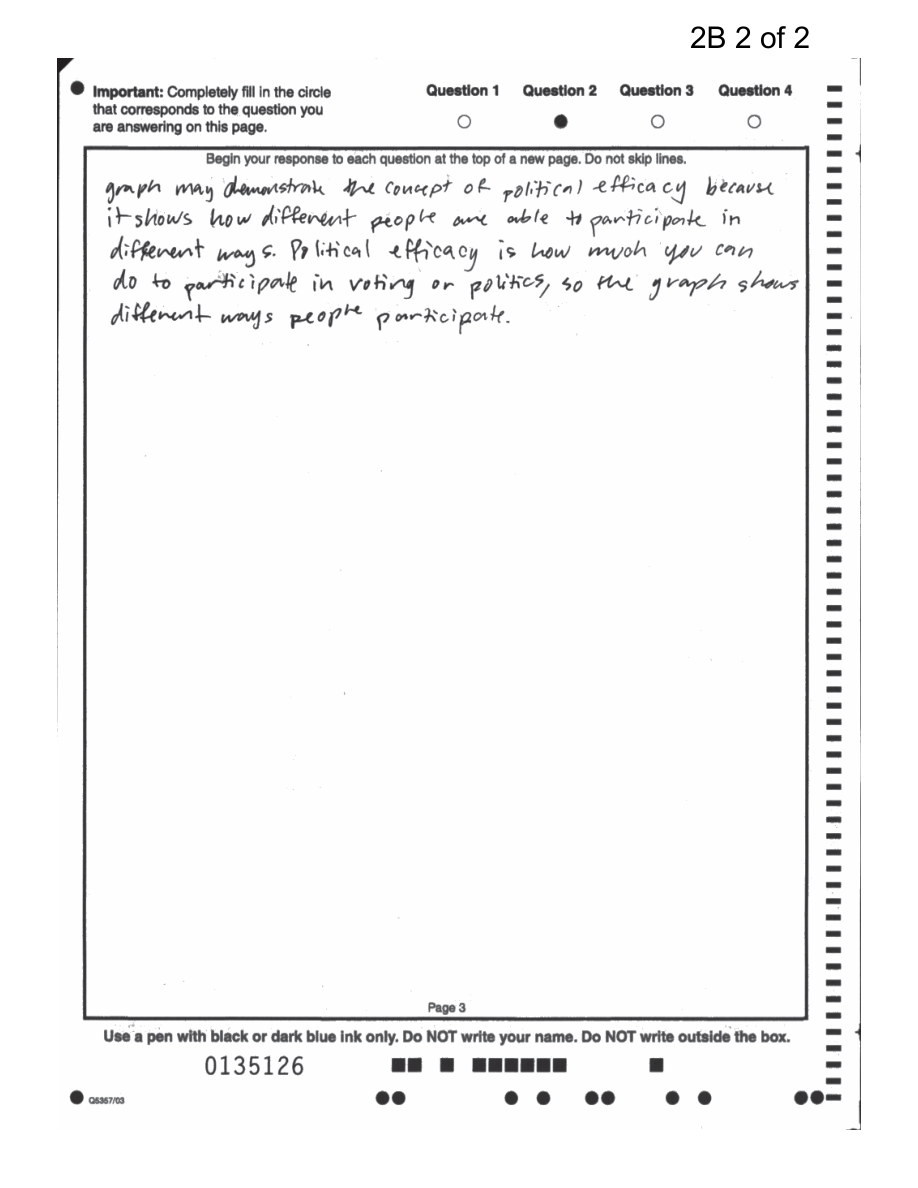
- Figure — Sample Responses Q2 - Set 1 (p. 5)
- Figure — Sample Responses Q2 - Set 1 (p. 6)