From the free course AP United States Government and Politics on Lykke
2.1 Congress: The Senate and the House of Representatives
Key concepts: Bicameral structure of Congress · Equal state representation in the Senate · Popular representation in the House of Representatives · Chamber size and formality of debate · Interactions among members of Congress during the legislative process · House discharge petitions · Representative decision-making based on constituents’ long-term interests
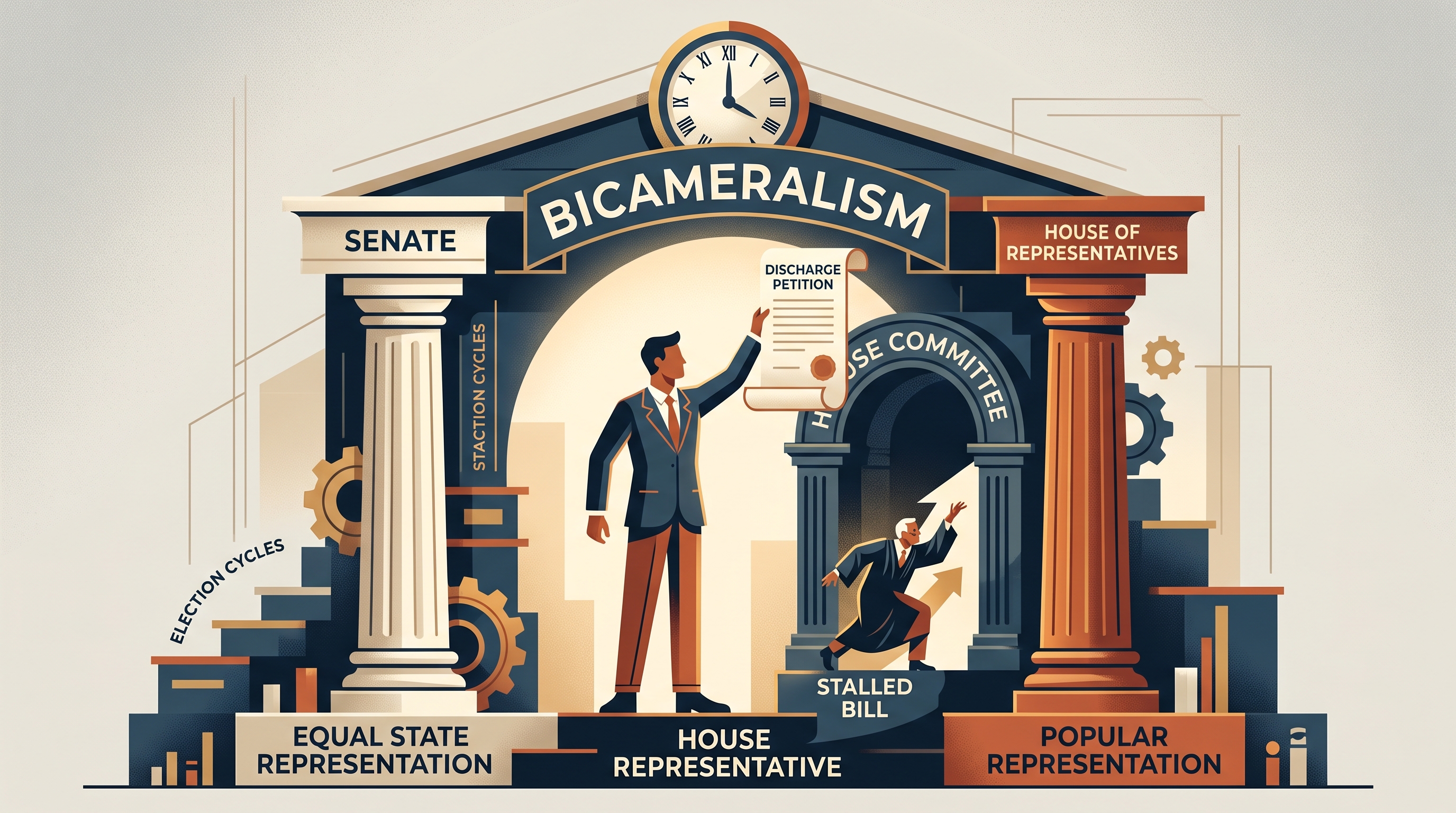
Why does the United States use two legislative chambers instead of one? The answer is representation: Congress is bicameral, meaning that it has two houses—the Senate and the House of Representatives—designed to represent different political communities.
2.1 Congress: The Senate and the House of Representatives
Why does the United States use two legislative chambers instead of one? The answer is representation: Congress is bicameral, meaning that it has two houses—the Senate and the House of Representatives—designed to represent different political communities.
Two chambers, two representational principles
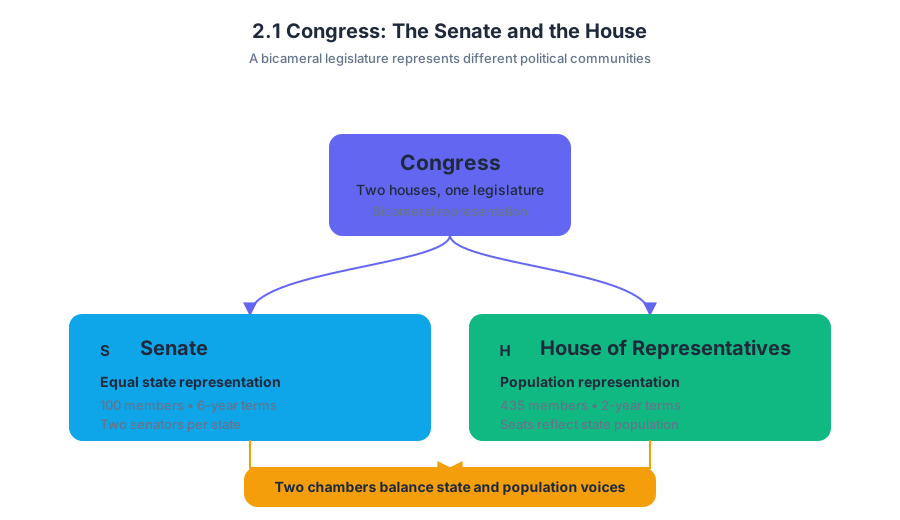
The Senate represents the states equally: every state has two senators, regardless of population. The House of Representatives represents the people through membership based largely on state population, so more populous states have more representatives.
This arrangement expresses republicanism, the democratic principle that the people’s will enters government through elected representatives who debate and make decisions. Bicameralism does not mean that both chambers represent the same constituency in the same way; it creates two routes through which public preferences can influence national law.
| Feature | Senate | House of Representatives |
|---|---|---|
| Representational basis | Equal representation of states | Representation of the people by population |
| Membership | 100 members | 435 members |
| Election cycle | One-third elected every two years | All members elected every two years |
| Legislative character | Smaller, less formal debate | Larger, more formal debate |
Retrieval check: A bill concerns a policy supported by voters in a large state but opposed by several small states. Which chamber’s representational design is more likely to reflect the large state’s population, and which chamber gives each state equal weight? The answer is the House for population-based representation and the Senate for equal state representation.
Size changes how debate works
The House has 435 members, while the Senate has 100 members. That numerical difference shapes legislative interaction: debate in the House is generally more formal because hundreds of members cannot all participate freely in an extended, spontaneous discussion.
The smaller Senate can operate with greater individual participation and a less formal debating culture. This does not mean that Senate debate is unstructured or that House members never negotiate; it means that chamber size creates different procedural conditions for speaking, amending, and coordinating.
The two-party system also affects interaction inside both chambers. Members must often cooperate with colleagues in their own party, bargain across party lines, and respond to constituents whose preferences may not match the party’s position.
Election cycles and continuity
All House members face election every two years. The Senate is different: one-third of its members are elected every two years. Because the entire Senate is never replaced at once, the Senate functions as a continuous legislative body, retaining institutional experience while still responding regularly to voters.
These different term structures influence congressional behavior. A House representative may face immediate electoral pressure from district opinion, while a senator represents an entire state and serves in a chamber where membership changes gradually.
Members, constituents, and legislative choices
A member of Congress represents constituents, meaning the people who live in the member’s district or state. Representation does not always require voting for whatever position appears most popular at a particular moment. A representative may support a bill because they believe it serves constituents’ long-term interests, even if some constituents currently oppose it.
For example, suppose a representative supports a costly infrastructure bill. The bill may impose short-term financial burdens, but the representative may judge that improved transportation, employment, and public safety will benefit the district over time. The decision reflects a judgment about representation rather than simple obedience to the latest opinion poll.
Key distinction: Representation involves making political judgments on behalf of constituents; it is not identical to acting as a mechanical messenger for every immediate preference.
House discharge petitions
The House’s formal structure can give party leaders and committees substantial control over which bills receive floor consideration. A discharge petition is a procedure through which an individual House representative can seek to bring a bill out of committee and onto the House floor for a vote.
The petition matters because it gives rank-and-file representatives a possible route around committee inaction or leadership resistance. Filing the petition alone does not guarantee passage of the bill: the measure still must be considered and voted on, and representatives may disagree about its merits.
Misconception check
Misconception: “The Senate and House are simply duplicate chambers.” They are not. Their different representational bases, membership sizes, and election cycles produce different incentives and debating environments. Another misconception is that a discharge petition automatically makes a bill law; it can bring a bill toward a floor vote, but it does not determine the vote’s outcome.
AP skill connection
This topic most directly develops Concept Application (CON-1): apply bicameralism, equal state representation, popular representation, chamber size, election cycles, and discharge petitions to a new congressional scenario. A strong response identifies the relevant chamber feature and explains its political consequence—for example, connecting the House’s larger membership to more formal debate or connecting staggered Senate elections to institutional continuity.
It also supports Argumentation (ARG-1) when evaluating whether a member’s vote represents constituents effectively. The reasoning must link a claim—such as “the vote reflects long-term representation”—to evidence in the scenario and explain why the representative’s judgment could serve constituents beyond their immediate preferences.
Final retrieval check: A bill remains stalled in a House committee, but several representatives believe it deserves a floor vote. What mechanism can one representative initiate, and what does that mechanism accomplish? An individual representative can file a discharge petition; if the petition receives the required support, it can move the bill toward consideration by the full House, but it does not guarantee passage.

Source Materials
- AP U.S. Government and Politics Course and Exam Description
- Learn More (.pdf)
- AP U.S. Government and Politics Course Overview
- AP U.S. Government and Politics Course at a Glance
- AP United States Government and Politics Course at a Glance Poster
- AP United States Government and Politics
- AP United States Government and Politics
- United States Government and Politics Sample Syllabus 1
- Figure — Sample Responses Q2 - Set 1 (p. 3)
- Figure — Sample Responses Q2 - Set 1 (p. 4)
- Figure — Sample Responses Q2 - Set 1 (p. 5)
- AP US Gov Past Exam Questions — AP Central