From the free course AP United States Government and Politics on Lykke
2.13 Discretionary and Rulemaking Authority
Key concepts: Federal bureaucratic agencies use discretion to implement policy · Bureaucratic agencies have rulemaking authority · Discretion allows agencies to make choices about how to implement laws or missions · Rulemaking allows agencies to establish regulations and safety requirements · Agency policymaking involves interaction among bureaucratic agencies, Congress, and citizens · Congress can exercise oversight of bureaucratic agencies · NASA, as part of the bureaucracy, can use discretionary or rulemaking authority · The president can influence the bureaucratic agenda through persuasion or the bully pulpit · Citizens can pressure Congress to oversee agency implementation · Congressional hearings are a tool of oversight
A president can announce a mission, but an agency determines what that mission requires in practice. When President John F. Kennedy committed the United States to sending a person to the Moon, NASA did not merely “carry out orders.” Its experts had to choose timelines, technical methods, safety procedures, and…
2.13 Discretionary and Rulemaking Authority
A president can announce a mission, but an agency determines what that mission requires in practice. When President John F. Kennedy committed the United States to sending a person to the Moon, NASA did not merely “carry out orders.” Its experts had to choose timelines, technical methods, safety procedures, and implementation standards. That space between a broad political goal and its concrete execution is where discretionary authority and rulemaking authority operate.
Learning Objective 2.13.A: Explain how the bureaucracy uses discretionary authority and rulemaking authority to implement policy.
Essential Knowledge 2.13.A.1: Federal bureaucratic agencies use discretionary authority to make choices about how to implement laws, policies, and missions. Essential Knowledge 2.13.A.2: Bureaucratic agencies use rulemaking authority to establish regulations that give policy practical force.
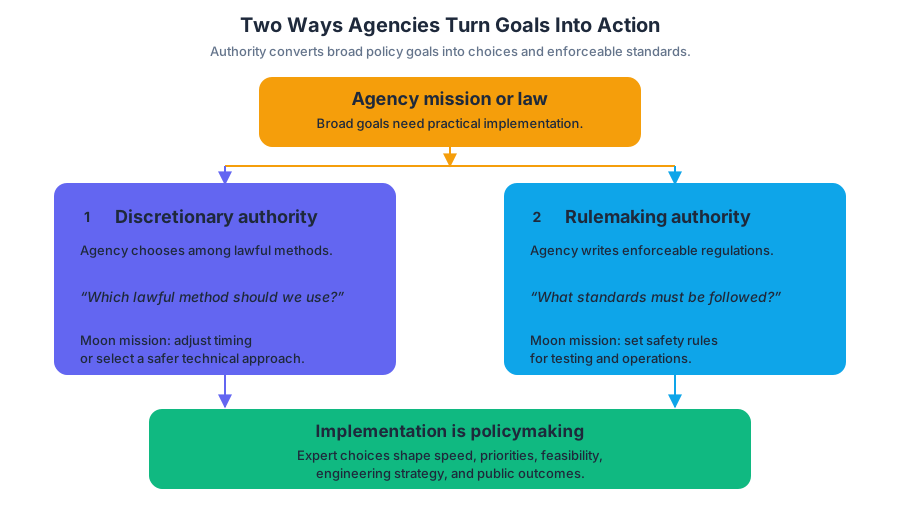
Two ways agencies turn goals into action
Discretionary authority is an agency’s power to make its own implementation decisions within the boundaries established by law. Congress may create a general program, and the president may establish an agenda, but agency officials often possess the expertise needed to decide the sequence, timing, priorities, and methods of implementation.
Rulemaking authority is an agency’s power to create and enforce regulations—detailed requirements that explain how a law or mission will operate. A statute might require safe transportation, clean air, or secure workplaces without specifying every technical standard. The responsible agency can write regulations that translate the broad requirement into enforceable rules.
| Authority | Central question | Example in the Moon mission |
|---|---|---|
| Discretionary authority | “Which lawful method should we use?” | NASA adjusts the mission timeline or selects the safest technical approach. |
| Rulemaking authority | “What specific standards must be followed?” | NASA establishes safety requirements for spacecraft testing and mission operations. |
The distinction matters because implementing policy is itself a policymaking process. NASA could use its expertise to slow down or speed up the Moon mission, select a particular engineering strategy, or determine that a proposed step was not yet feasible. It could also write regulations for safety and mission success. These choices would shape the president’s agenda without necessarily rejecting it.
Worked example: the Moon mission
Suppose a president publicly announces that the United States will complete a crewed Moon mission. The president supplies the political objective, but NASA must convert that objective into an operational plan.
Step 1 — Exercise discretion. NASA evaluates launch technology, crew training, testing schedules, and the risks of different designs. Its technical judgment might lead the agency to accelerate one phase, delay another, or revise the implementation sequence.
Step 2 — Use rulemaking authority. NASA establishes specific safety requirements for equipment, testing, mission control, and crew procedures. Those regulations determine what contractors and agency personnel must do before a launch can proceed.
Step 3 — Implement the agenda. NASA’s choices help realize the presidential mission. The agency is not legally obstructing the president; it is using lawful expertise and authority to determine the best way to carry out the mission. An answer that merely says “NASA carries out the policy” is incomplete because it does not identify the agency’s policy choices.
Agencies, Congress, citizens, and presidential persuasion
Agency policymaking occurs through interaction among bureaucratic agencies, Congress, and citizens. Congress creates agencies, writes statutes, authorizes programs, and controls funding. Agencies apply expertise and make implementation choices. Citizens, organized groups, affected industries, and voters respond to those choices and can pressure elected officials to change or monitor them.
Congress can check agency power through oversight, the legislative practice of monitoring executive-branch implementation. A congressional committee might hold hearings on space exploration, question NASA officials, investigate delays or safety decisions, or use funding decisions to pressure the agency to follow congressional intent.
The president can influence this process through the bully pulpit—the informal power to use the presidency’s public visibility to persuade citizens and set the policy agenda. A presidential speech supporting the Moon mission could encourage voters to demand that Congress fund and oversee the project. It could also provoke political opponents in Congress to demand closer scrutiny of NASA’s activities.
Misconception check
Misconception: “Discretion means the agency may ignore the president.” Discretion is not unlimited independence or illegal obstruction. It is lawful choice within an agency’s mission and governing statutes. Misconception: “The iron triangle is the answer whenever an agency appears in a scenario.” An iron triangle concerns relationships among an agency, congressional committees, and interest groups; it does not substitute for explaining how NASA’s discretion or rulemaking directly implements policy.
Retrieval check
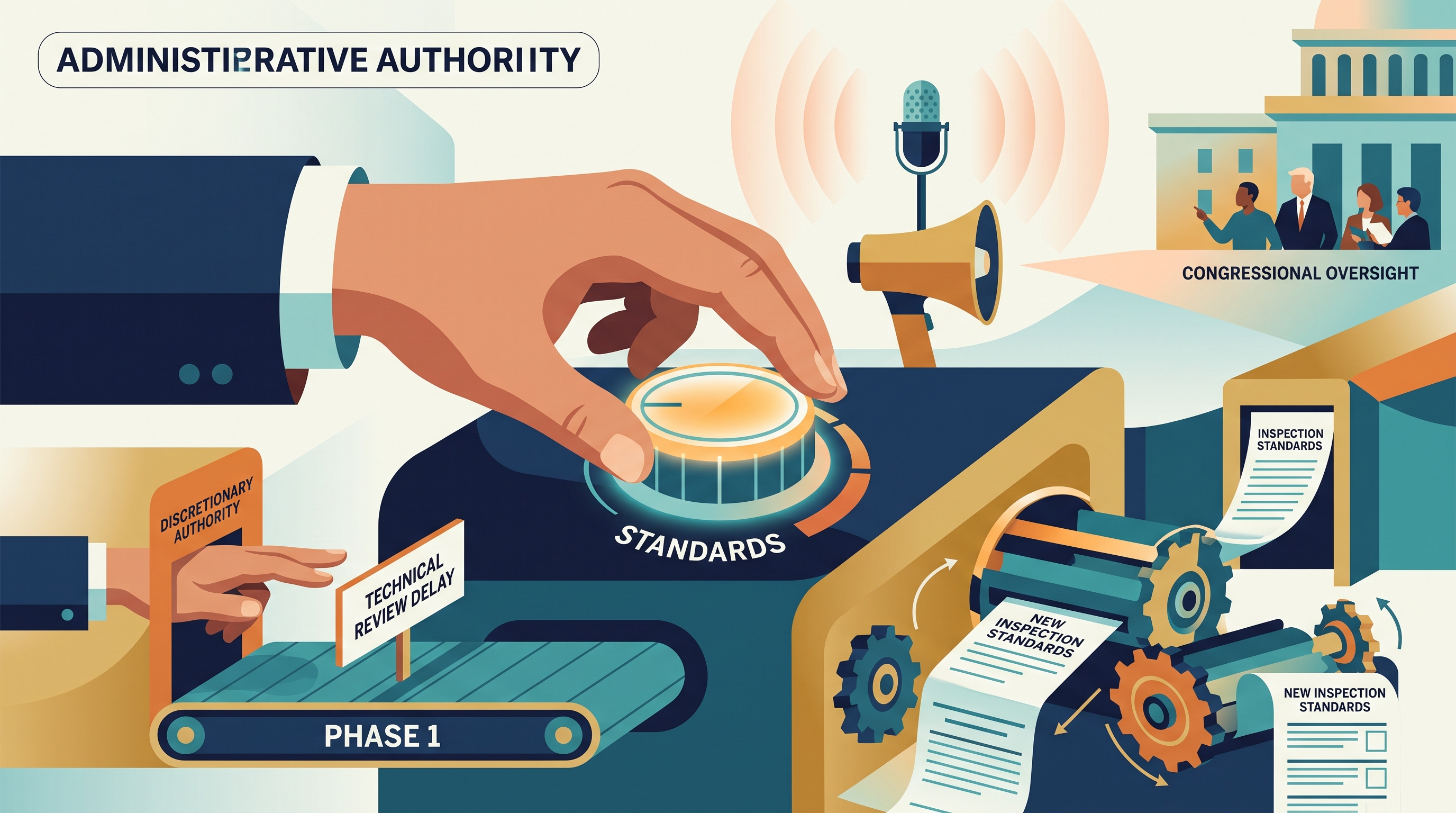
A president gives a speech demanding rapid development of a national safety program. The agency delays one phase after technical review and issues new inspection standards. Identify one use of discretionary authority, one use of rulemaking authority, and one way the president’s bully pulpit could increase congressional oversight. A complete response must connect each concept to a specific action and its effect.
Source Materials
- AP U.S. Government and Politics Course and Exam Description
- Learn More (.pdf)
- AP U.S. Government and Politics Course Overview
- AP U.S. Government and Politics Course at a Glance
- AP United States Government and Politics Course at a Glance Poster
- AP United States Government and Politics
- AP United States Government and Politics
- United States Government and Politics Sample Syllabus 1