From the free course AP United States Government and Politics on Lykke
2.9 The Role of the Judicial Branch
Key concepts: Role of the judicial branch · Independent judiciary · Judicial review · Limited government · Checks and balances · Congressional oversight · New Deal conflict between Congress and the judiciary · Judicial decision making · Natural rights and protection from discrimination · Lessee (1816)
An independent judiciary can preserve limited government by reviewing whether government officials and institutions have acted within constitutional boundaries.
2.9 The Role of the Judicial Branch
An independent judiciary can preserve limited government by reviewing whether government officials and institutions have acted within constitutional boundaries.
LO 2.9.A: Explain the role of legal precedent in judicial decision making.
The central tension is straightforward: courts must be strong enough to restrain unconstitutional government action, yet limited enough to respect elected institutions and legal precedent. Judicial review gives courts this checking role; stare decisis gives their decisions continuity.
Independence, judicial review, and limited government
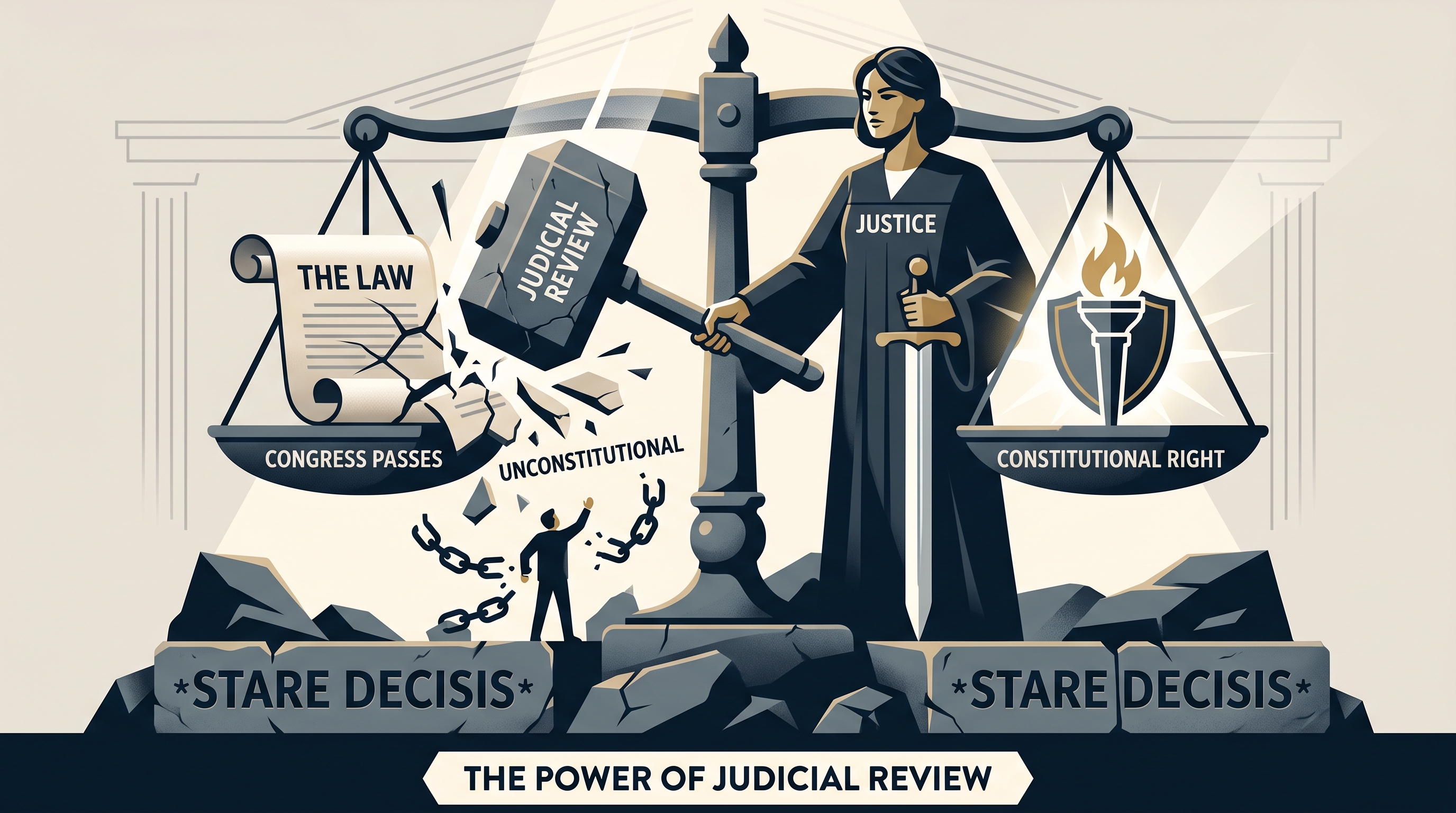
Judicial review is the authority of courts to determine whether laws or government actions conflict with the Constitution. It supports limited government, the principle that government power is restricted by law, constitutional rules, and individual rights.
Alexander Hamilton defended an independent judiciary in Federalist No. 78. Article III establishes the federal judicial branch and protects the conditions under which judges exercise judgment rather than simply follow temporary political pressures. Life tenure during “good Behaviour” is designed to reduce direct dependence on elected officials, although the judiciary remains connected to the political system through presidential appointments and Senate confirmation.
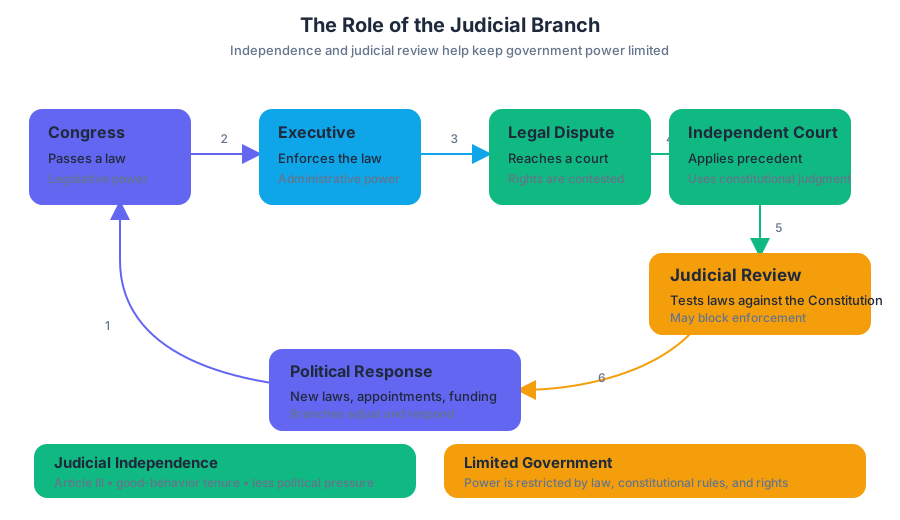
The relationship can be represented as a constitutional feedback loop:
- Congress passes a law.
- The executive branch enforces it.
- A legal dispute reaches a court.
- The court applies constitutional principles and precedent.
- If the law violates the Constitution, judicial review can block its enforcement.
- Congress and the executive may respond through new legislation, appointments, funding decisions, or changes in enforcement.
This arrangement illustrates checks and balances: each branch has tools that limit the others. Judicial review is a particularly important check because courts can protect constitutional boundaries even when a law has been approved by elected officials.
Precedent and stare decisis
EK 2.9.A.1: Stare decisis is the legal doctrine under which courts follow legal precedents when deciding cases with similar facts. A precedent is an earlier judicial decision that supplies a rule or reasoning for later cases.
Precedent makes law more predictable. If two cases involve substantially similar constitutional questions, treating them alike promotes stability and reduces the risk that legal outcomes will depend only on which judges happen to be sitting on a particular day. However, stare decisis is not an absolute command. Courts may distinguish a precedent because the facts differ, limit its reach, or reject it when constitutional interpretation changes.
EK 2.9.A.2: Ideological changes in the composition of the Supreme Court resulting from presidential appointments have led the Court to establish new precedents or reject existing ones. Appointments therefore can influence constitutional meaning over time, but a new justice does not automatically produce a new ruling; the Court must still decide an actual case and justify its reasoning.
Worked example: Martin v. Hunter’s Lessee (1816)
In Martin v. Hunter’s Lessee (1816), the Supreme Court addressed whether it could review a decision by a state court involving federal law. The practical issue was not merely who owned disputed property. The larger constitutional question was whether federal judicial authority could operate consistently across the states.
Reasoning chain:
| Question | Constitutional significance |
|---|---|
| Could a state court’s interpretation of federal law be reviewed? | Federal law requires a uniform national interpretation. |
| Could state courts have the final word on federal questions? | Different state interpretations could weaken national constitutional authority. |
| What institutional principle follows? | The federal judiciary has a role in maintaining consistent constitutional law. |
The case demonstrates the judicial branch’s role as an interpreter of federal law and constitutional limits. It also shows why judicial review is connected to federalism: courts help determine how authority is divided between state and national governments.
The legislature as both check and accountable institution
Some argue that the judiciary is more effective than the legislature at preserving limited government because judicial review allows courts to invalidate unconstitutional actions directly. Courts are insulated from immediate electoral pressure, and an individual or group can challenge government action even when it is politically popular.
The legislature, however, has its own constitutional importance. Members of Congress can be held responsible by voters through elections, and Congress can check the other branches through legislation, appropriations, confirmations, investigations, and congressional oversight—the process of monitoring executive agencies and officials. This creates a trade-off: courts may offer stronger protection against majoritarian violations, while legislators possess greater direct democratic accountability.
A New Deal conflict illustrates this tension. During the 1930s, the Supreme Court invalidated parts of President Franklin Roosevelt’s economic program, while Congress had enacted major legislation to respond to the Great Depression. Critics viewed the Court as obstructing elected lawmakers’ efforts to address an emergency; defenders argued that constitutional limits must remain enforceable even during a crisis.
Misconception check
Misconception: “Judicial review makes the Supreme Court superior to Congress.” Judicial review gives courts authority to judge constitutionality in cases, but it does not make the judiciary the only branch that interprets the Constitution. Congress remains electorally accountable and can write new laws, oversee implementation, propose amendments, control funding, and shape the federal courts through appointments and jurisdictional decisions permitted by the Constitution.
Judicial outcomes can therefore be connected to foundational principles such as natural rights and the government’s responsibility to protect people from discrimination. The judicial branch does not simply settle private disputes; through precedent and constitutional interpretation, it helps define how liberty, equality, and limited government operate in practice.
Suggested Skill — Concept Application: Describe political principles, institutions, processes, policies, and behaviors illustrated in different scenarios in context. SCOTUS Application is especially useful here: connect a case such as Martin v. Hunter’s Lessee to judicial review, federal authority, and an independent judiciary rather than merely recalling its name.
Retrieval check
A law is popular, Congress passes it, and the executive begins enforcing it. A court later finds that it violates a constitutional right. Identify the mechanism involved, explain how it supports limited government, and name the doctrine that encourages courts to treat similar future cases consistently.
Answer: The mechanism is judicial review; it supports limited government by enforcing constitutional restrictions on government power; and the doctrine is stare decisis.
Source Materials
- AP U.S. Government and Politics Course and Exam Description
- Learn More (.pdf)
- AP U.S. Government and Politics Course Overview
- AP U.S. Government and Politics Course at a Glance
- AP United States Government and Politics Course at a Glance Poster
- AP United States Government and Politics
- AP United States Government and Politics
- United States Government and Politics Sample Syllabus 1