From the free course AP United States Government and Politics on Lykke
AP Practice 1
A Concept Application free-response question asks you to use a political concept in a specific scenario—not merely define a term from memory. You must identify the relevant institution, process, policy, or behavior and explain how it operates in context.
AP Practice 1
A Concept Application free-response question asks you to use a political concept in a specific scenario—not merely define a term from memory. You must identify the relevant institution, process, policy, or behavior and explain how it operates in context.
Exam task: Concept Application
On the current AP U.S. Government and Politics exam, the Concept Application question is one of the four free-response questions in Section II, which lasts 1 hour 40 minutes and represents 50% of the exam score. This task commonly presents a political scenario and asks you to describe or explain the effects of a political institution, behavior, or process.
A reliable response follows this chain:
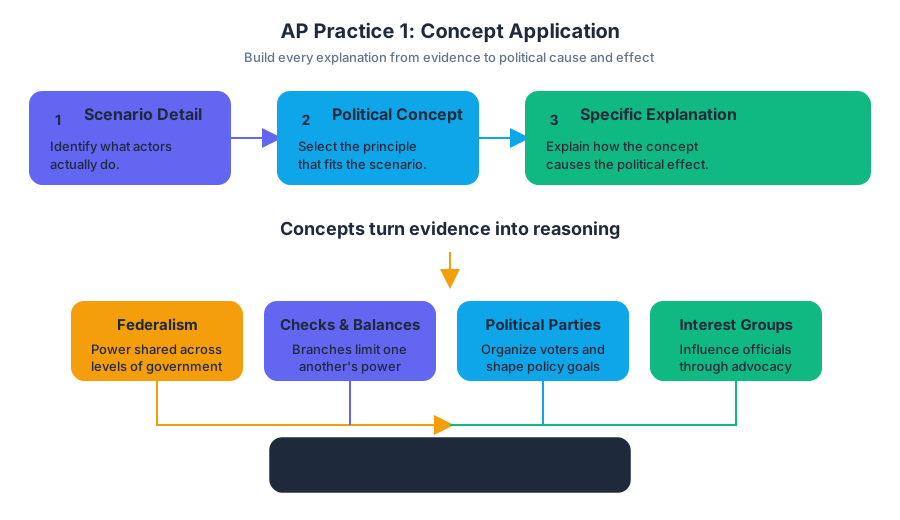
Scenario detail → Political concept → Specific explanation of cause and effect
Do not begin with a dictionary definition and stop. The point is to show that you can connect an abstract principle—such as federalism, checks and balances, political parties, or interest-group influence—to what the actors in the scenario actually do.
Original practice prompt
This original question is unofficial and does not reproduce released College Board wording.
A state legislature passes a law requiring all public schools to use a newly developed digital platform for reporting student attendance and academic progress. The federal Department of Education announces that states using the platform will receive additional administrative grants. Several state education officials support the program, but a state teachers’ association argues that the platform imposes costly reporting requirements without providing enough funding. The association begins contacting legislators and testifies at a committee hearing.
(a) Identify the political process demonstrated when the teachers’ association testifies before the legislative committee.
(b) Explain how the teachers’ association could use this process to influence education policy.
(c) Explain one reason the federal grant program might increase cooperation between the federal government and state governments.
Timing plan
| Task | Suggested time |
|---|---|
| Read and annotate the scenario | $1$–$2$ minutes |
| Answer part (a) | About $1$ minute |
| Answer part (b) | About $2$ minutes |
| Answer part (c) | About $2$ minutes |
| Check for missing explanations | About $1$ minute |
Underline the actors, action verbs, and government level in the prompt. Here, the important clues are teachers’ association, testifies, legislators, committee hearing, federal Department of Education, and state governments.
Worked reasoning
Part (a): Identify the process
The teachers’ association is engaging in interest-group lobbying or interest-group influence on policymaking. Lobbying occurs when an organized group attempts to affect government decisions by communicating with public officials.
Credit-worthy answer:
The teachers’ association is engaging in interest-group lobbying by testifying before a legislative committee.
The answer earns the identification point because it names a political process and connects it to the action in the scenario. Naming only “political participation” is too broad; naming only “testifying” repeats the scenario without identifying the process.
Part (b): Explain policy influence
A strong explanation includes a mechanism. The association is not influential simply because it exists. Its testimony can provide legislators with information about implementation costs, persuade lawmakers to amend the law, and mobilize teachers or other members to contact representatives.
Credit-worthy answer:
The association could influence education policy by presenting legislators with information about the platform’s costs and practical effects. This information could persuade committee members to revise the law, increase its funding, or delay implementation.
The examiner rewards the explanation because it shows a causal sequence: testimony supplies information → legislators reassess the proposal → policy changes. A vague statement such as “the group can make its opinion known” does not explain how the process affects policymaking.
Part (c): Explain federal–state cooperation
The grant program uses a financial incentive to encourage states to participate in a federal policy. This reflects cooperative federalism: national and state governments work together, although the federal government may use funding conditions to shape state behavior.
Credit-worthy answer:
The grants could increase cooperation because state governments receive financial resources in exchange for adopting the federal government’s platform. The states retain responsibility for operating their schools, while the federal government provides funding and encourages a shared administrative policy.
This response explains both sides of the relationship. It does not incorrectly claim that the federal government automatically controls public schools merely because it offers grants.
What the rubric is looking for
| Rubric target | What earns credit | Common weak response |
|---|---|---|
| Identify | Names the relevant process or principle and links it to the scenario | Gives a broad label such as “democracy” |
| Explain influence or effect | Shows how one action produces a political result | Restates what happened |
| Apply the concept | Uses the scenario’s actors and institutions specifically | Gives a memorized textbook paragraph |
The relevant AP skill is Skill 1.D: Describe political principles, institutions, processes, policies, and behaviors illustrated in different scenarios in context. The central move is contextual application: the same concept must be attached to the facts presented, not floating above them.
Misconception check
Misconception: “Interest groups are the same as political parties.”
Political parties seek to win elections and organize government across many policy areas. Interest groups usually focus on influencing policy without nominating a broad slate of candidates for office. The teachers’ association is therefore an interest group, even though it may support or oppose particular candidates.
Retrieval check
A city-government employee speaks at a public hearing urging council members to reject a proposed budget cut. Is this automatically lobbying by an interest group? Identify the best concept and explain what additional fact would be needed to classify the action more precisely.
Answer: The action is political advocacy or participation, but it is not automatically interest-group lobbying. To classify it as lobbying, the scenario would need to show that the employee is representing an organized group or attempting to influence lawmakers on that group’s behalf.
Error-review routine
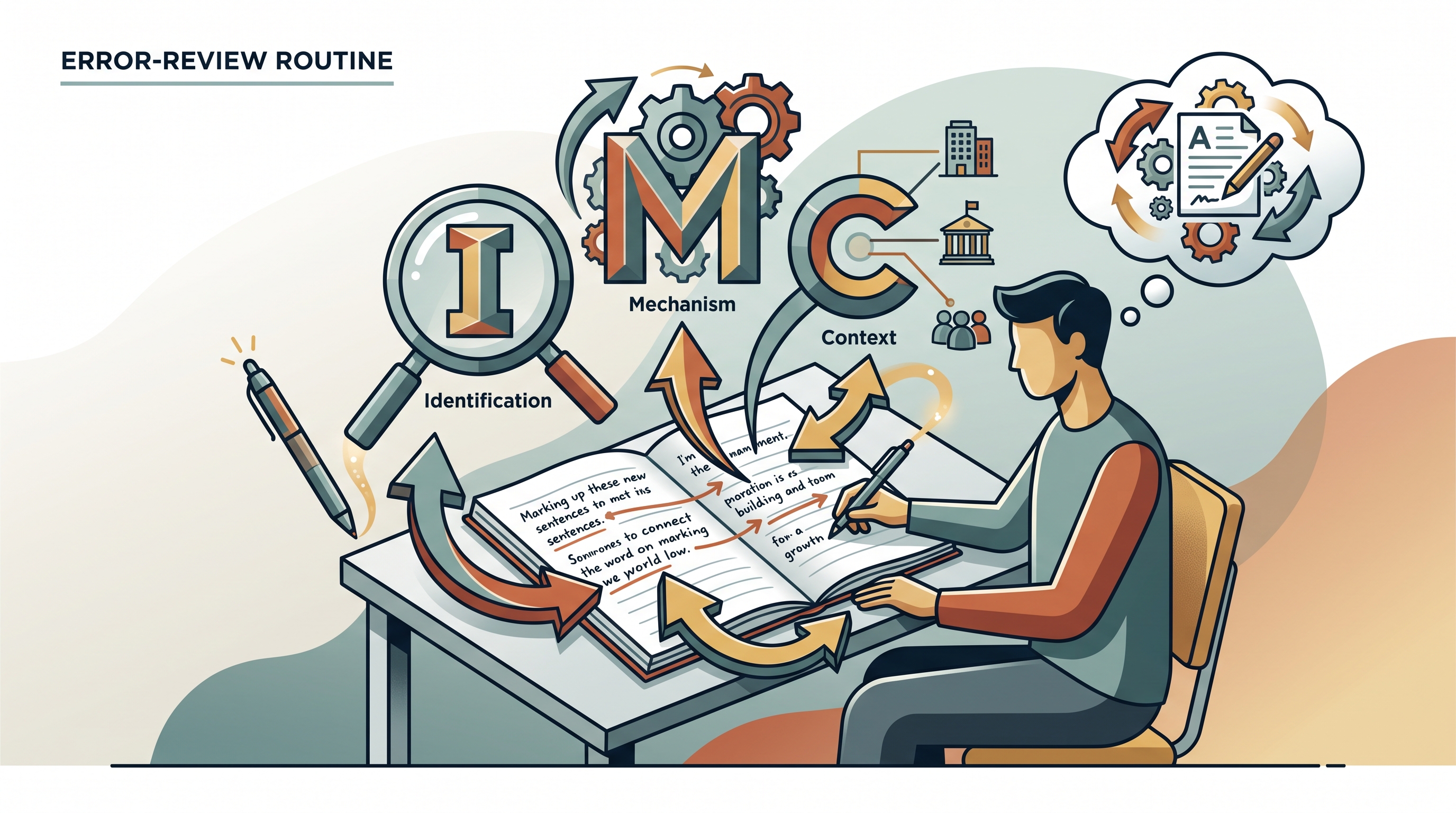
After completing a Concept Application question, label each sentence I for identification, M for mechanism, or C for context. If an answer contains only definitions, add the missing mechanism. If it contains a mechanism but no scenario detail, insert the relevant actor, institution, or action. A high-quality response repeatedly connects the political concept to the exact facts presented.
Source Materials
- AP U.S. Government and Politics Course and Exam Description
- Learn More (.pdf)
- AP U.S. Government and Politics Course Overview
- AP U.S. Government and Politics Course at a Glance
- AP United States Government and Politics Course at a Glance Poster
- AP United States Government and Politics
- AP United States Government and Politics
- United States Government and Politics Sample Syllabus 1
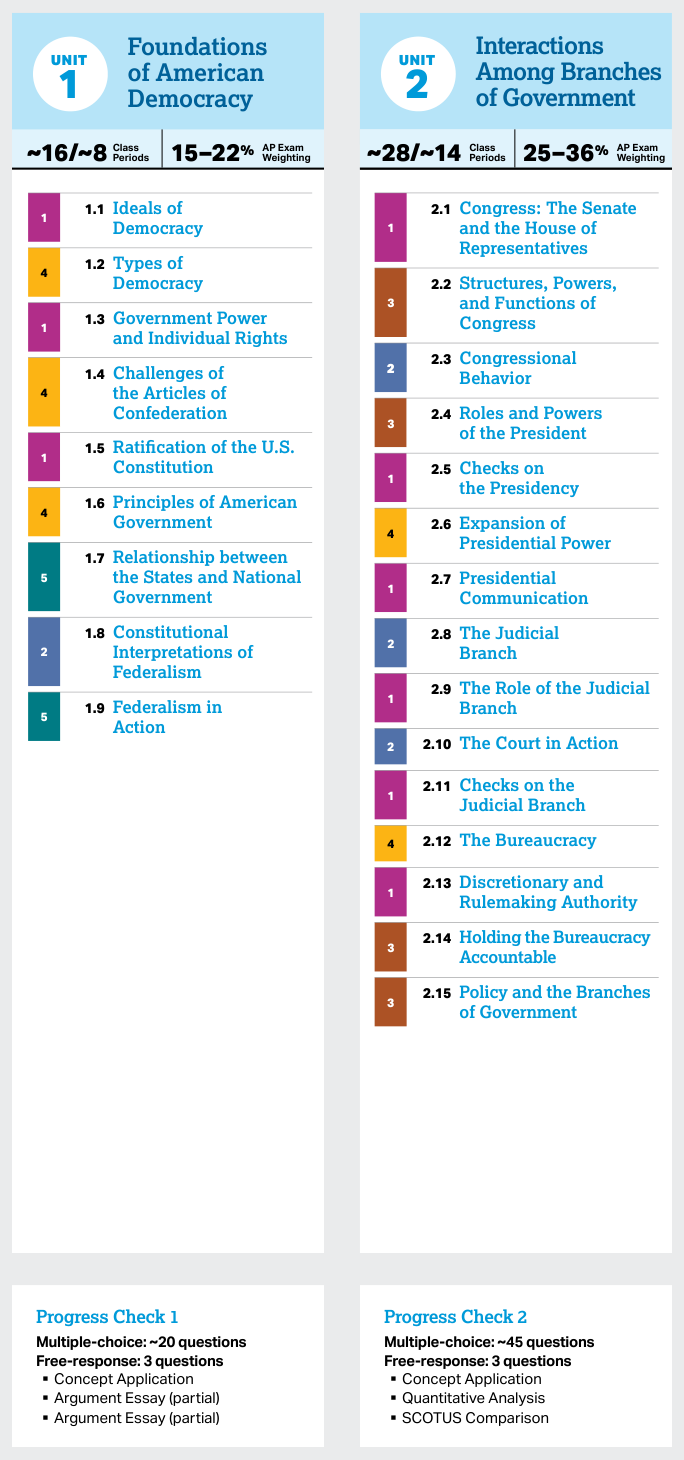
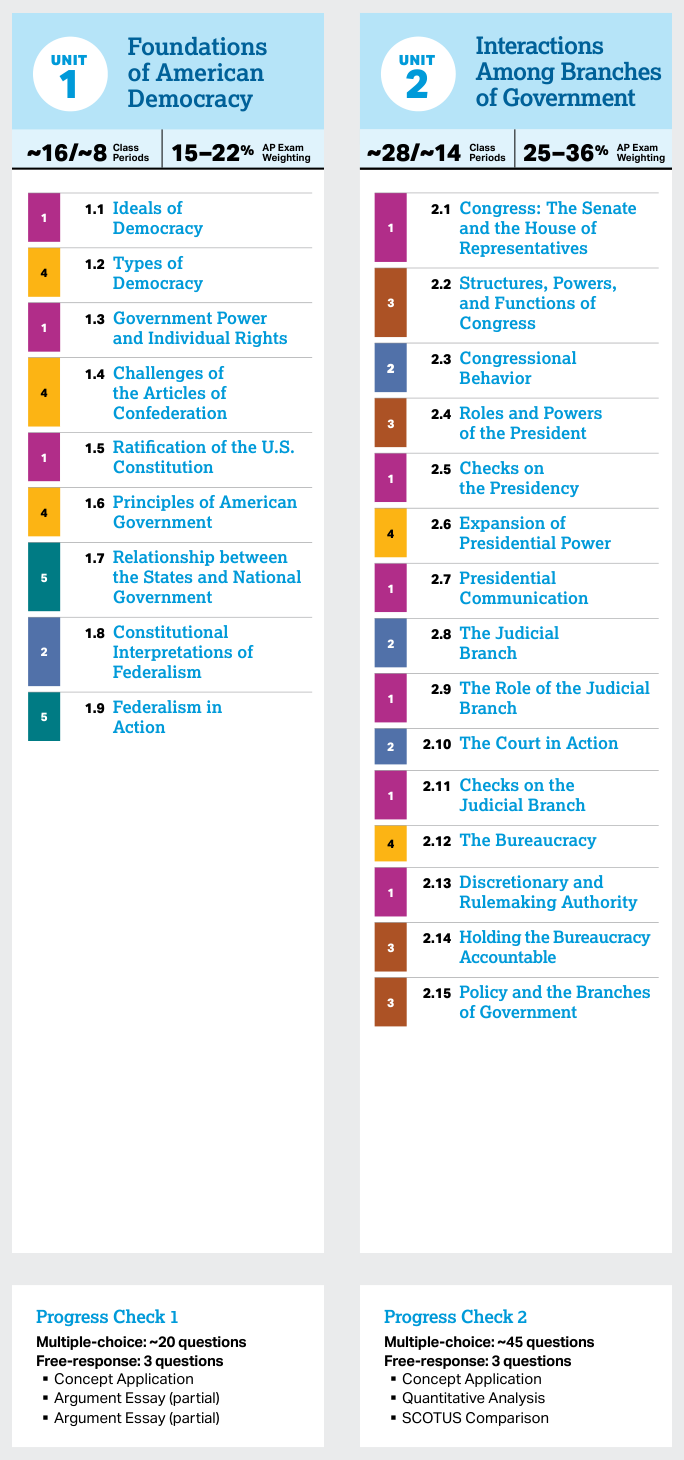
- NOTE: Partial versions of the free-response questions are provided to prepare students for more complex, full questions that they will encounter on the AP Exam. 18
- NOTE: Partial versions of the free-response questions are provided to prepare students for more complex, full questions that they will encounter on the AP Exam. V.1 | 18 © 2023 College Board
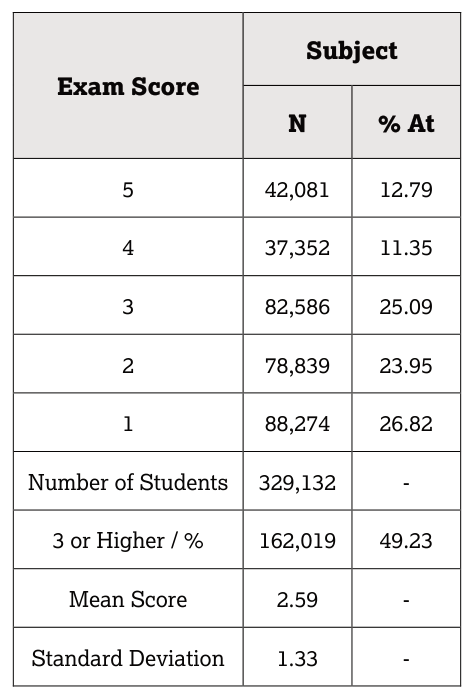
- Figure — Score Distributions (p. 1)
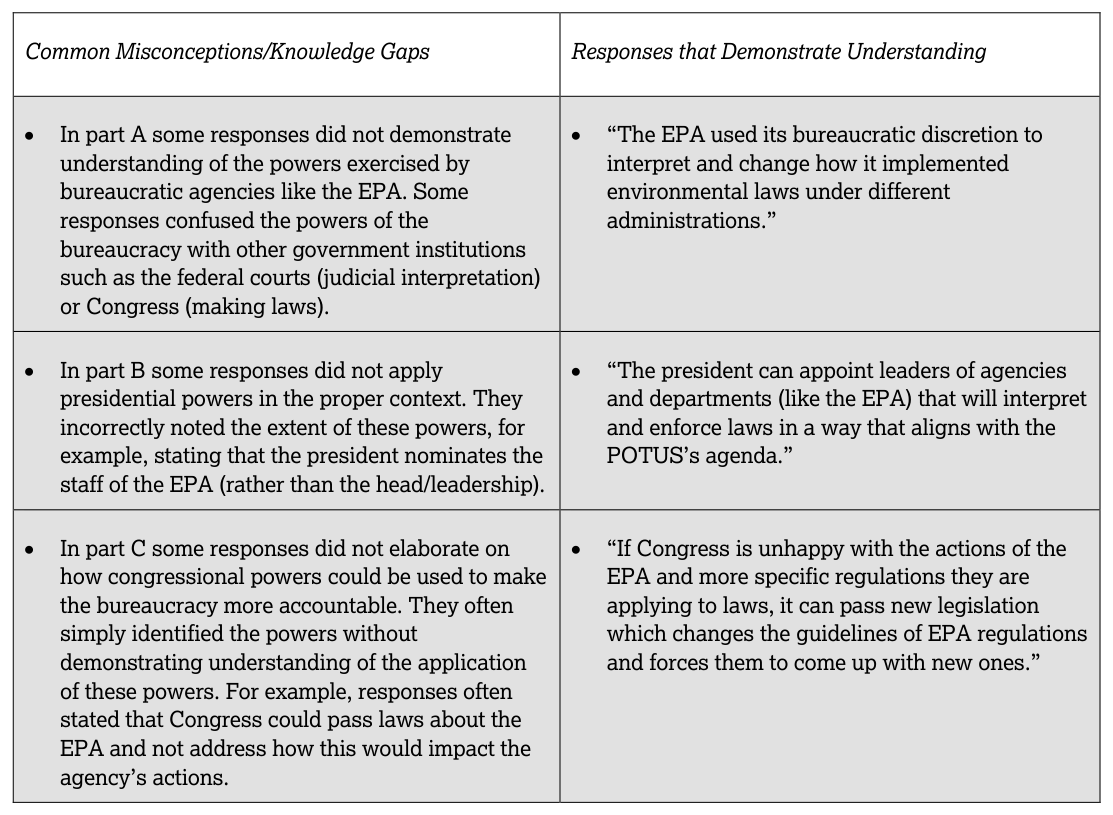
- Based on your experience at the AP® Reading with student responses, what advice would you offer teachers to help them improve student performance on the exam? Students would benefit from reviewing the