From the free course AP United States Government and Politics on Lykke
1.7 Relationship Between the States and National Government
Key concepts: Federalism and the relationship between the national and state governments · Exclusive powers of the national government · Exclusive powers of state governments · Concurrent powers shared by national and state governments · Implied powers inferred from the Constitution · Reserved powers granted to the states by the Tenth Amendment · The ongoing debate over the balance of power between national and state governments · Federal intervention in response to natural disasters · Federalist No. 39 and republican principles · Federalist No. 51 and checks and balances
When a hurricane destroys highways, who should rebuild them: the state where the damage occurred, the national government, or both? Federalism answers that power is divided between the national government and the states rather than placed entirely in one level of government.
1.7 Relationship Between the States and National Government
When a hurricane destroys highways, who should rebuild them: the state where the damage occurred, the national government, or both? Federalism answers that power is divided between the national government and the states rather than placed entirely in one level of government. The difficult question is not whether both levels possess authority, but where the boundary lies.
L.O. 1.7.A — Explain how the constitutional allocation of power between the national and state governments affects society.
Federalism: one country, two levels of government
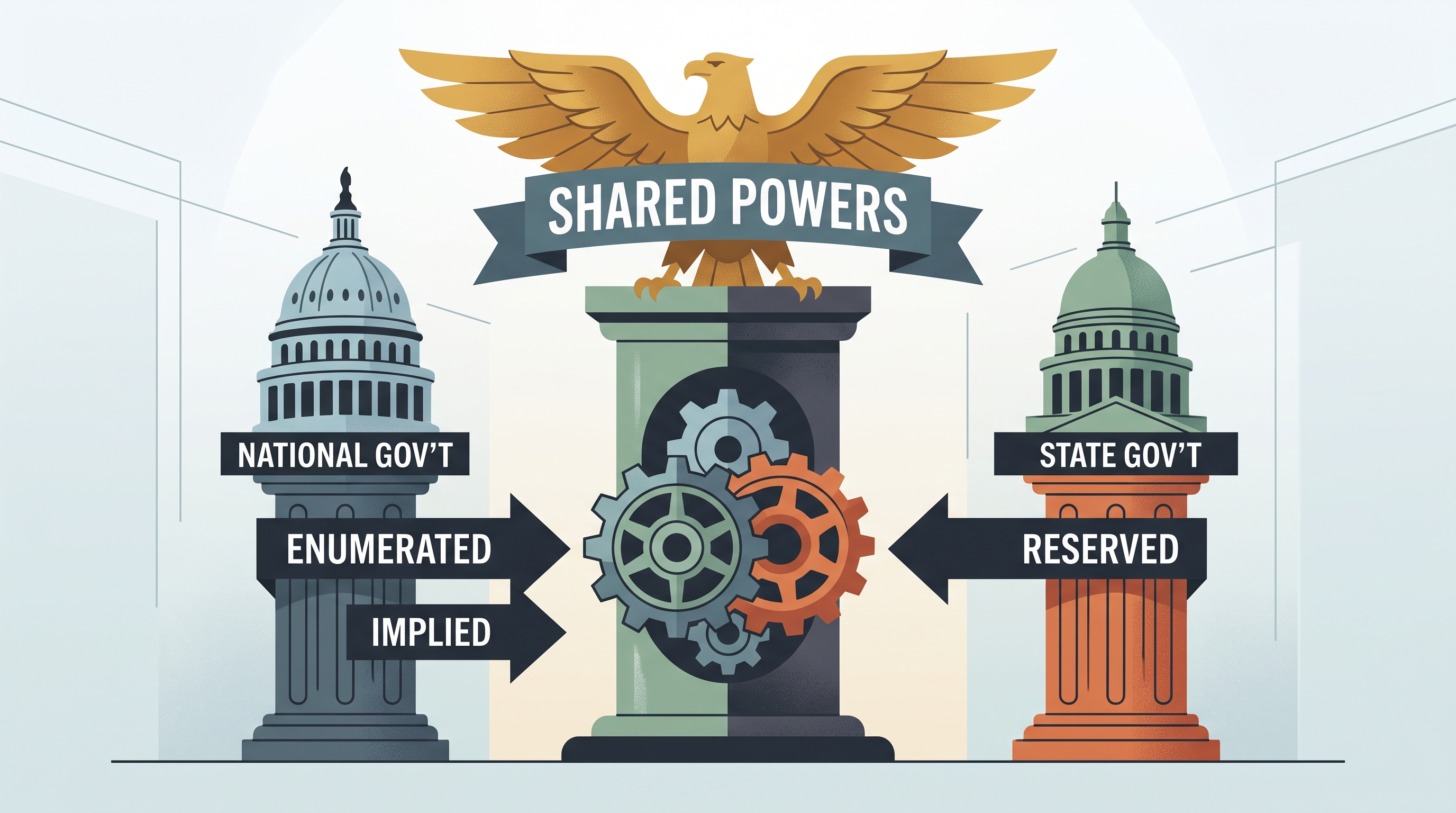
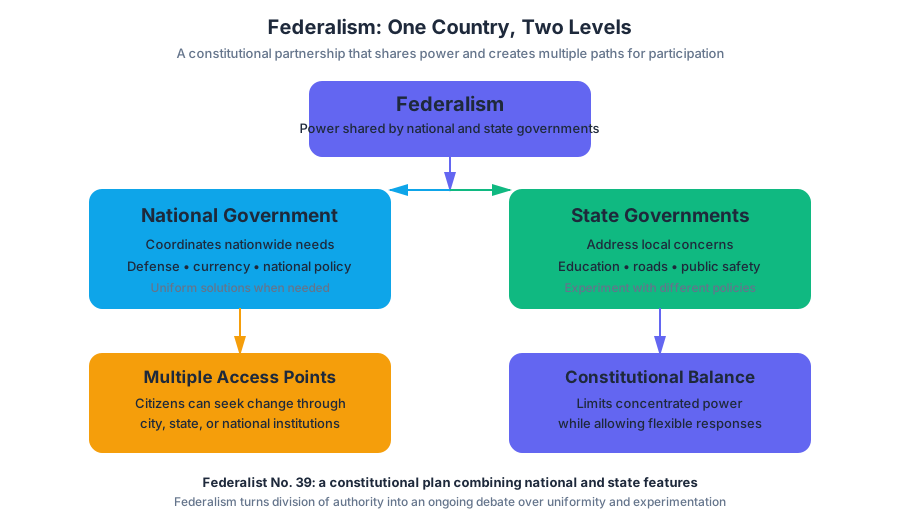
Federalism creates a constitutional partnership. The national government handles matters requiring national coordination, while state governments retain authority over many local concerns. Because the Constitution divides authority instead of assigning every responsibility to one government, federalism creates multiple access points for political participation: citizens can seek change in a city, state, or national institution.
EK 1.7.A.1 — Federalism is the system in which power is shared between the national and state governments. Federalist No. 39 describes the constitutional plan as combining national and state features. This arrangement limits the concentration of power in one part of government while permitting government to respond at different levels.
The division also creates an enduring political debate. One side may argue that a national problem requires a uniform national solution; another may argue that states should experiment with different policies. Federalism therefore affects practical questions about roads, public safety, education, health, environmental regulation, and disaster response—not merely abstract constitutional theory.
Four categories of governmental power
The most useful way to analyze federalism is to classify powers by who possesses them.
| Power category | Meaning | Example |
|---|---|---|
| Exclusive national powers | Held only by the national government | Conducting foreign policy or coining money |
| Exclusive state powers | Held only by the states through reserved authority | Establishing state and local governments |
| Concurrent powers | Shared by national and state governments | Taxing, enforcing laws, and building roads |
| Implied powers | Not specifically written but inferred from constitutional authority | Actions reasonably connected to an enumerated power |
EK 1.7.A.2 — Exclusive power is held by only one level of government. National exclusive powers include enumerated powers, which are written in the Constitution, and implied powers, which are inferred from the Necessary and Proper Clause. Implied does not mean unlimited: the power must connect logically to an authority granted to the national government.
For example, the Constitution gives Congress enumerated authority to raise and support armies. It does not list every administrative action needed to maintain a modern military. The authority to create military offices, procedures, and support systems can be understood as implied powers because those actions help execute an enumerated power.
EK 1.7.A.3 — Reserved powers are powers not delegated or enumerated to the national government but reserved to the states by the Tenth Amendment. State authority over many laws governing daily life reflects this principle. Reserved powers are not simply “whatever states want”; they remain subject to constitutional limits and other valid national authority.
EK 1.7.A.4 — Concurrent powers are shared by both levels of government. Taxation illustrates this clearly: the national government can collect federal taxes, while states can impose state taxes. Both levels can also enforce laws and build roads, although the scale, purpose, and legal basis of those actions may differ.
Worked example: Hurricane Katrina
Hurricane Katrina exposed the practical difficulty of divided authority. State and local officials possessed important responsibilities for emergency response, but the scale of the disaster created a need for national resources, coordination, and assistance. The central issue was therefore not whether one level of government mattered; it was how effectively multiple governments could act together.
Suppose a damaged road connects several communities inside one state. The state may plan and repair it using state authority. If the disaster also disrupts interstate transportation, housing, communications, and national emergency programs, national involvement becomes more significant. The example shows why concurrent powers can produce cooperation—but also delay, disagreement, and arguments over accountability.
Constitutional design and competing controls
Federalism works alongside the broader constitutional structure. Federalist No. 39 emphasizes that the government plan conforms to republican principles while combining national and state characteristics. Federalist No. 51 adds that checks and balances among government departments help prevent any one department from dominating the political system. Together, these ideas support a system in which power is divided both vertically between governments and horizontally among branches.
Named misconception — “The Tenth Amendment makes states completely sovereign.” Correction: the Tenth Amendment reserves powers not delegated to the national government, but state action can still be limited by the Constitution and by valid national laws. Named misconception — “Concurrent powers belong mainly to the national government.” Correction: concurrent powers are genuinely shared; taxing, enforcing laws, and building roads can be performed by both levels.
AP skill in action
This topic most directly develops Concept Application (1.A) by classifying a governmental action as exclusive, reserved, concurrent, enumerated, or implied. It develops Source Analysis (4.A) when interpreting Federalist No. 39 or Federalist No. 51, and Argumentation (5.A), Articulate a defensible claim/thesis, when arguing whether a problem should be addressed nationally, by the states, or cooperatively.
A strong argument does more than announce “the national government should act.” It identifies the constitutional allocation of power, applies a specific category—such as concurrent or implied power—and explains the social consequence, such as faster disaster relief or greater state policy independence.
Retrieval check: A state and the national government both impose taxes and repair roads after a disaster. What category of power is involved, and why might the response still generate debate over the proper balance of power?
Source Materials
- AP U.S. Government and Politics Course and Exam Description
- Learn More (.pdf)
- AP U.S. Government and Politics Course Overview
- AP U.S. Government and Politics Course at a Glance
- AP United States Government and Politics Course at a Glance Poster
- AP United States Government and Politics
- AP United States Government and Politics
- United States Government and Politics Sample Syllabus 1
- Figure — Sample Responses Q1 - Set 1 (p. 3)
- Figure — Sample Responses Q1 - Set 1 (p. 4)
- Figure — Sample Responses Q1 - Set 1 (p. 5)
- Figure — Sample Responses Q1 - Set 2 (p. 3)