From the free course AP United States Government and Politics on Lykke
1.6 Principles of American Government
Key concepts: Principles of American government · Political principles, institutions, processes, policies, and behaviors · Defensible claims and theses · Arguments and perspectives in sources · Text-based and visual sources · Political parties and party platforms · The Constitution · Checks on the presidency · Supreme Court decision-making · Federalism and limits of federal power
American government rests on a design problem: How can a government be powerful enough to protect rights and solve collective problems without becoming powerful enough to destroy liberty?
1.6 Principles of American Government
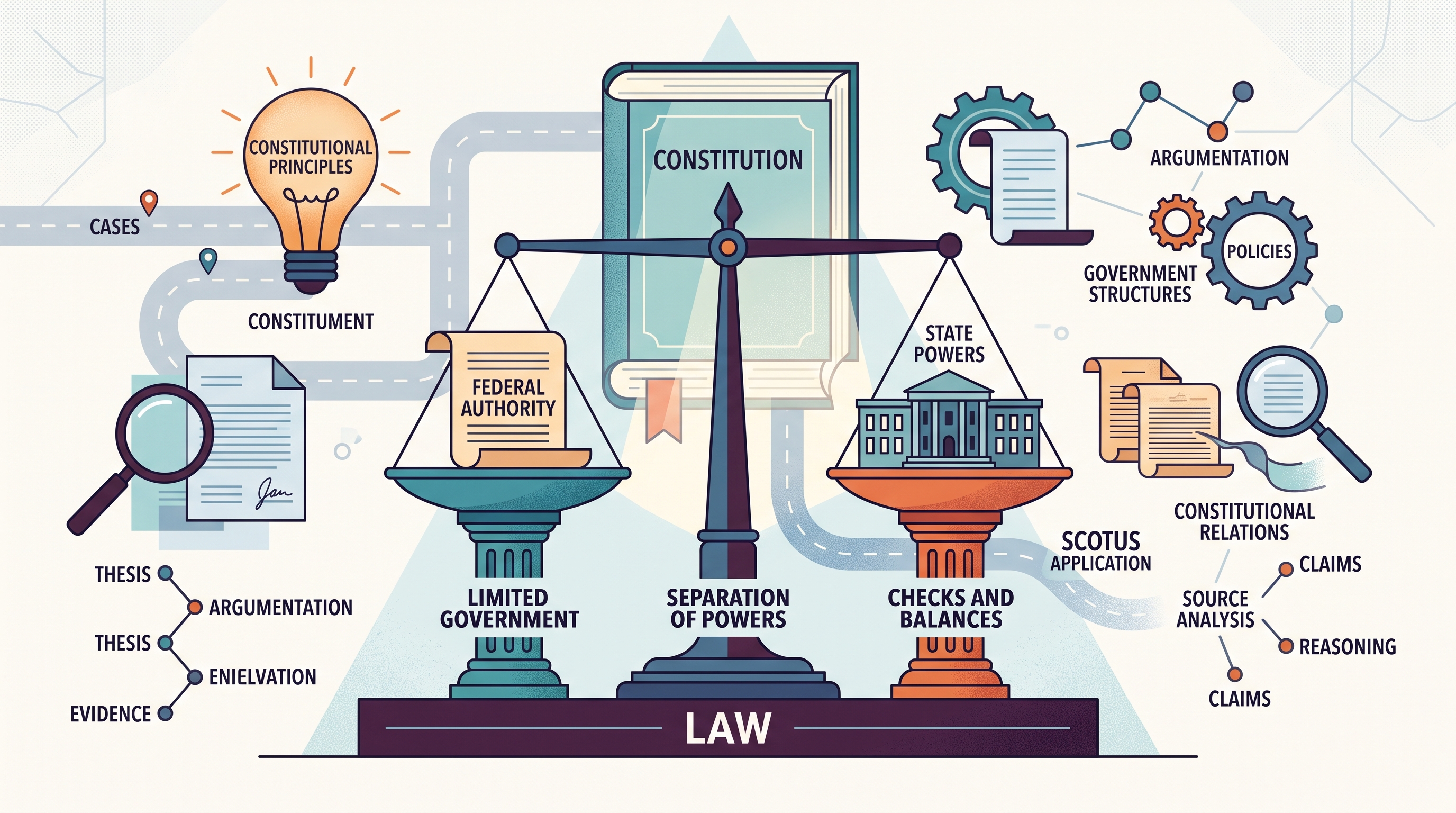
American government rests on a design problem: How can a government be powerful enough to protect rights and solve collective problems without becoming powerful enough to destroy liberty? The Constitution answers through a network of political principles, institutions, processes, policies, and behaviors rather than through a single governing rule.
The constitutional design
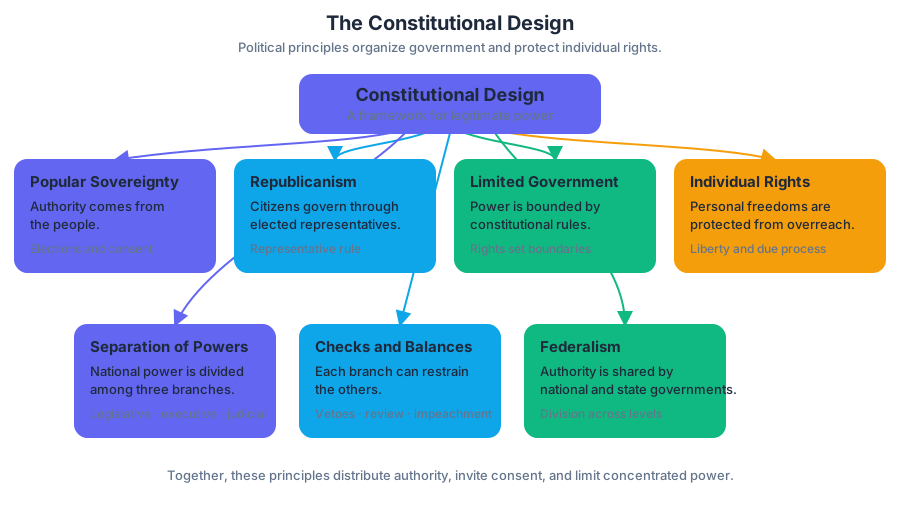
Political principles are ideas about how government should be organized and what it should protect. The central principles of American government include popular sovereignty, republicanism, limited government, separation of powers, checks and balances, federalism, and protection of individual rights.
A useful way to visualize the system is:
| Principle | Core question | Constitutional expression |
|---|---|---|
| Popular sovereignty | Who gives government its authority? | The people, through elections and consent |
| Republicanism | How do citizens govern in a large country? | Elected representatives make policy |
| Limited government | What may government not do? | Constitutional boundaries and protected rights |
| Separation of powers | How is power divided within the national government? | Legislative, executive, and judicial branches |
| Checks and balances | How is concentrated power restrained? | Vetoes, confirmations, judicial review, impeachment |
| Federalism | How is authority divided geographically? | National and state governments share power |
These principles become concrete through institutions such as Congress, the presidency, and the Supreme Court; processes such as elections, lawmaking, and judicial review; policies such as civil-rights protections or campaign-finance rules; and behaviors such as voting, lobbying, protesting, and party organizing. A strong explanation connects the abstract principle to the specific political activity.
Checks on presidential power
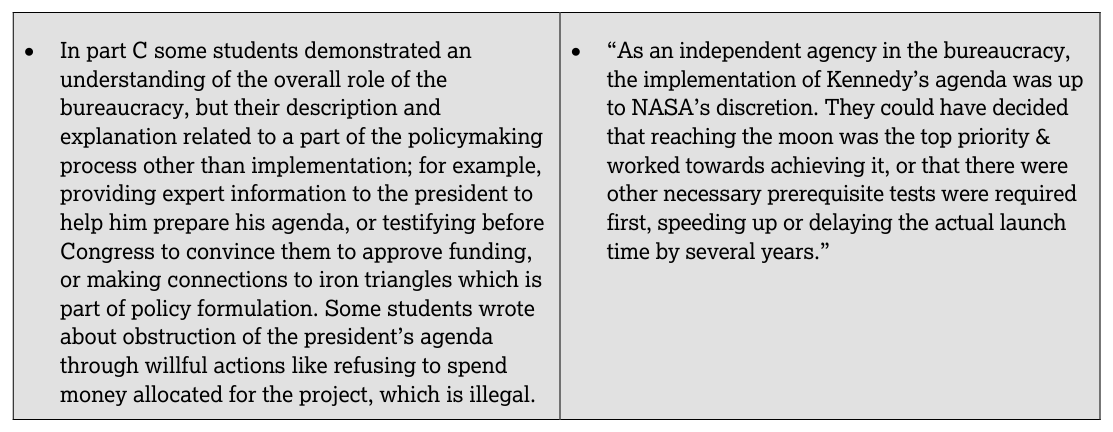
The president is not an elected monarch. The presidency has important powers—including directing the executive branch, vetoing legislation, appointing officials, and serving as commander in chief—but other institutions can constrain those powers.
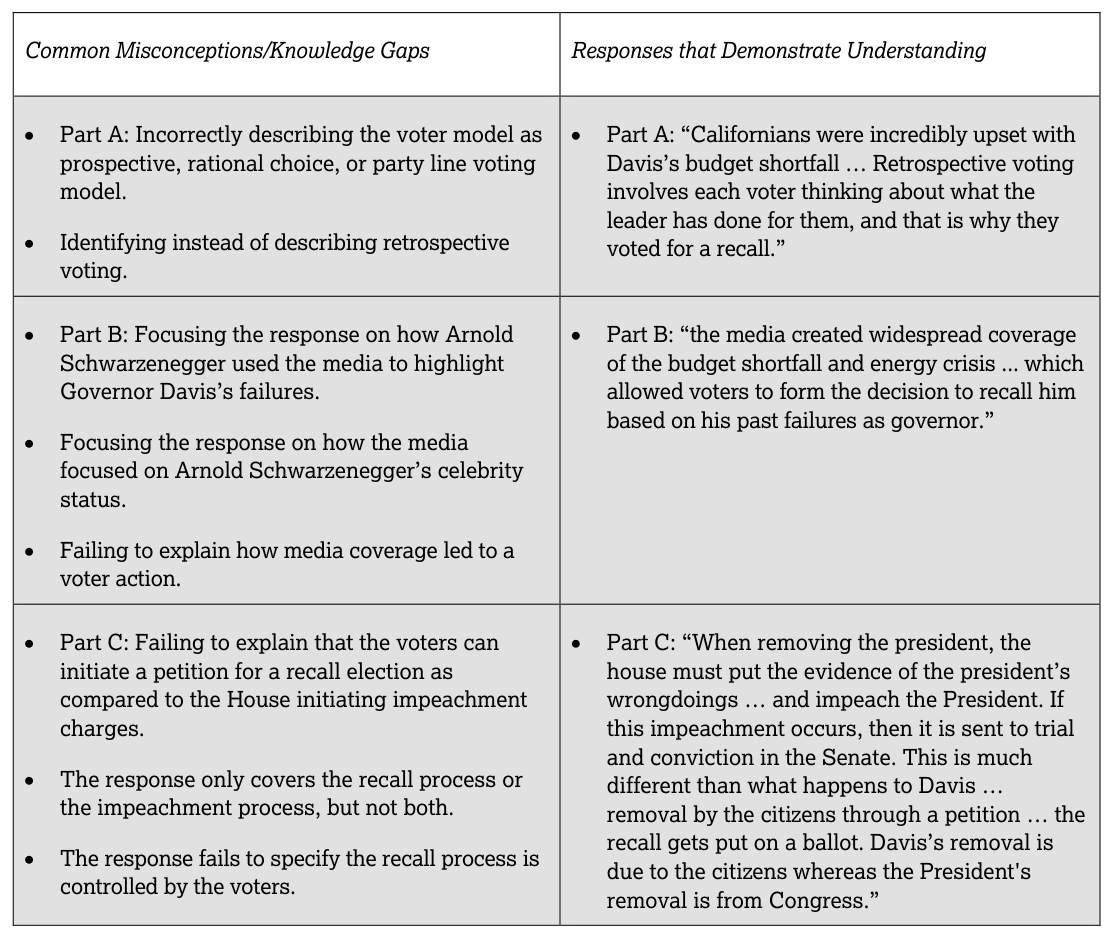
For example, if a president vetoes a bill, Congress may override the veto with a two-thirds vote in both chambers. The Senate confirms many presidential appointments, Congress controls appropriations, courts can review executive actions, and the House may impeach while the Senate conducts the trial. These mechanisms illustrate checks and balances: each branch has tools that limit the others.
Misconception check — “Checks and balances require every branch to have equal power in every situation.” They do not. Different branches possess different constitutional tools. The point is not identical power; it is preventing one branch from exercising unchecked power.
Supreme Court comparison: Heart of Atlanta Motel and United States v. Lopez
Both cases asked whether Congress had acted within its power under the Commerce Clause, but the Court reached opposite results because the connection between the regulated conduct and interstate commerce differed.
| Case | Congressional action | Majority reasoning | Result |
|---|---|---|---|
| Heart of Atlanta Motel v. United States (1964) | Applied the Civil Rights Act of 1964 to a motel that refused service based on race | Racial discrimination in lodging burdened interstate travel and commerce | Law upheld |
| United States v. Lopez (1995) | Applied a federal law banning guns near schools | Possessing a gun near a school was too weakly connected to interstate commerce | Law struck down |
In Heart of Atlanta Motel, the motel served interstate travelers, and racial exclusion could obstruct movement across state lines. The Court therefore accepted Congress’s conclusion that regulating the motel was a permissible use of commerce power. In Lopez, the government argued that gun possession could indirectly affect education, employment, and the economy, but the Court rejected that remote chain of reasoning.
Why did the United States prevail in both cases? The phrase “the United States won” must be handled carefully. In Heart of Atlanta Motel, the United States won because the Court upheld federal authority. In Lopez, the United States was the party defending the federal law but lost because the Court found Congress had exceeded its Commerce Clause authority.
The strongest reason supporting the Lopez majority was constitutional limiting: if every local activity could be regulated merely because it might eventually affect the national economy, Congress’s enumerated powers would have no meaningful boundary. The strongest reason supporting Heart of Atlanta Motel was the direct commercial and interstate connection between the motel’s conduct and travel.
Parties, platforms, and constitutional consequences
Political parties convert principles into choices. A party platform is a formal statement of a party’s policy goals and political priorities. Comparing platforms requires more than labeling a party “liberal” or “conservative”: identify the policy, the underlying principle, the institution responsible, and the likely effect on political behavior.
Consider a hypothetical Supreme Court decision overturning Citizens United v. Federal Election Commission. Supporters might argue that restricting corporate independent expenditures would reduce the political influence of wealthy organizations and strengthen political equality. Opponents might argue that such restrictions suppress political speech and give government excessive control over participation in elections. The political implications would include changes in campaign strategy, party messaging, interest-group activity, and the constitutional balance between free expression and democratic equality.
Skills: turning analysis into an argument
This topic develops Skill Category 1: Concept Application: 1.A Describe political principles, institutions, processes, policies, and behaviors; 1.B Explain them; 1.C Compare them; 1.D Describe how they appear in different contextual scenarios; and 1.E Explain how they apply in context.
It also develops Skill Category 2: SCOTUS Application: 2.A Describe the facts, issue, holding, reasoning, decision, and majority opinion; 2.B Explain how a required Supreme Court case relates to a foundational document or other source; 2.C Explain how required and non-required cases compare; and 2.D Explain how a required case relates to a political principle, institution, process, policy, or behavior.
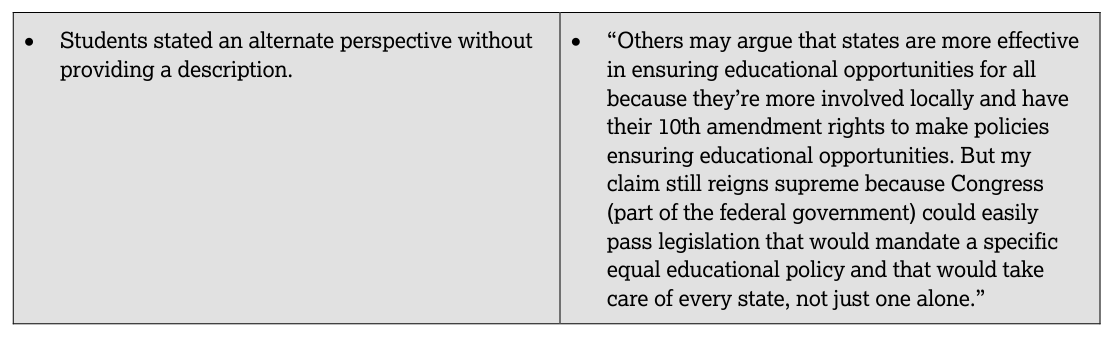
For sources, Skill Category 4: Source Analysis requires explaining claims, reasoning, evidence, and perspectives in text-based and visual sources. Skill Category 5: Argumentation requires 5.A Develop a defensible claim or thesis, 5.B Support it with specific evidence, 5.C Use reasoning to connect evidence to the claim, and 5.D Respond to an alternate perspective through concession, refutation, or rebuttal.
Retrieval check: A court upholds federal regulation of an interstate motel but rejects federal regulation of a local school-zone activity. Which constitutional principle is most directly illustrated, and what distinction between the two cases supplies the strongest evidence?
Source Materials
- AP U.S. Government and Politics Course and Exam Description
- Learn More (.pdf)
- AP U.S. Government and Politics Course Overview
- AP U.S. Government and Politics Course at a Glance
- AP United States Government and Politics Course at a Glance Poster
- AP United States Government and Politics
- AP United States Government and Politics
- United States Government and Politics Sample Syllabus 1
- Based on your experience at the AP® Reading with student responses, what advice would you offer teachers to help them improve the student performance on the exam?
- Based on your experience at the AP® Reading with student responses, what advice would you offer teachers to help them improve the student performance on the exam?
- Based on your experience at the AP® Reading with student responses, what advice would you offer teachers to help them improve the student performance on the exam?
- Based on your experience at the AP® Reading with student responses, what advice would you offer teachers to help them improve the student performance on the exam?