From the free course AP United States Government and Politics on Lykke
3.5 Second Amendment: Right to Bear Arms
Key concepts: Second Amendment right to bear arms · Supreme Court interpretation of constitutional rights · Individual liberty · Right to keep and bear arms for self-defense · Incorporation of the Second Amendment against the states · McDonald v. Chicago · United States v. Lopez · Commerce Clause limits on congressional power · Gun possession in a school zone · Equal Protection Clause and related case comparisons
The Supreme Court’s interpretation of the Second Amendment asks a deceptively sharp question: is the right to keep and bear arms a collective power connected only to organized militia service, or an individual liberty that protects personal self-defense?
3.5 Second Amendment: Right to Bear Arms
The Supreme Court’s interpretation of the Second Amendment asks a deceptively sharp question: is the right to keep and bear arms a collective power connected only to organized militia service, or an individual liberty that protects personal self-defense? The Court’s answer, as reflected in the required course content, treats the Amendment as protecting an individual right.
Learning Objective LO 3.5.A: Explain the extent to which the Supreme Court’s interpretation of the Second Amendment reflects a commitment to individual liberty.
Essential Knowledge EK 3.5.A.1: The Supreme Court’s decisions on the Second Amendment rest upon its constitutional interpretation of the right to bear arms.
The core idea: individual liberty
Individual liberty means the protection of personal choices and freedoms from unnecessary government interference. Applied to the Second Amendment, the concept concerns whether individuals may keep and bear arms for the purpose of self-defense.
The constitutional reasoning can be pictured as a chain:
Second Amendment text
↓
Supreme Court interpretation of “the right to bear arms”
↓
Individual right to keep and bear arms for self-defense
↓
Fourteenth Amendment incorporation
↓
Protection applies against state and local governments
The key distinction is between recognizing a constitutional right and deciding the boundaries of that right. The Court’s interpretation reflects individual liberty because it identifies self-defense as a constitutionally protected purpose. That does not mean every firearm regulation is automatically unconstitutional; it means the government must regulate within the limits established by constitutional interpretation.
McDonald v. Chicago (2010): applying the right to the states
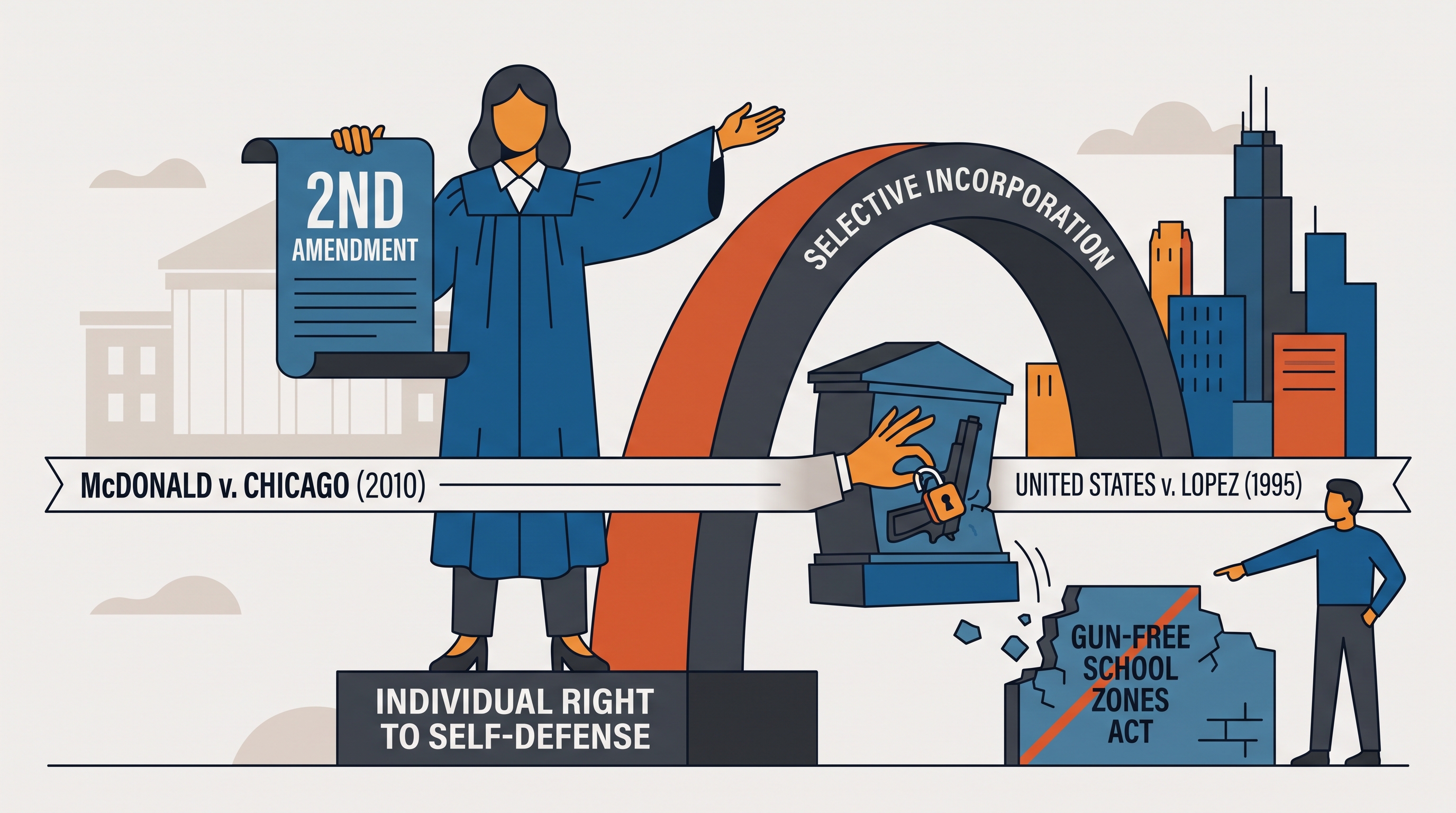
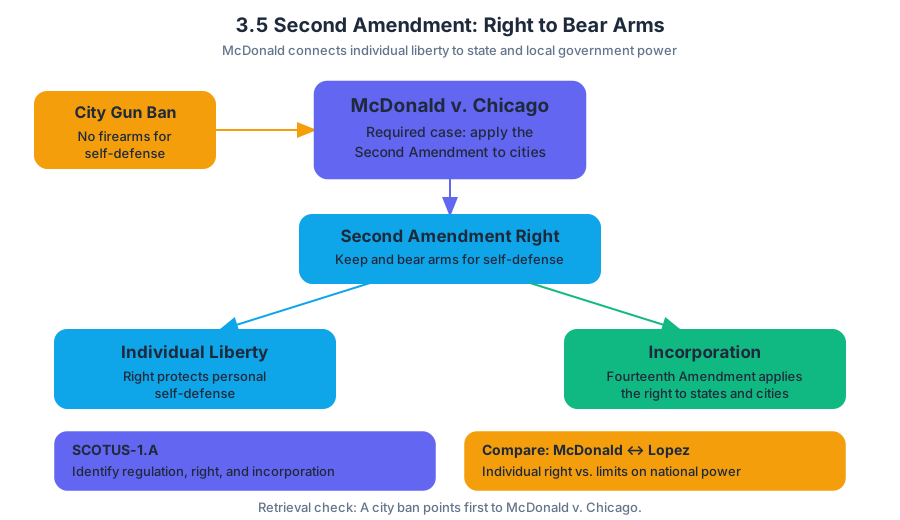
McDonald v. Chicago (2010) held that the Second Amendment right to keep and bear arms for self-defense applies to the states. This is an example of incorporation: the process through which rights listed in the Bill of Rights become enforceable against state and local governments through the Fourteenth Amendment.
Before incorporation, the Bill of Rights primarily restricted the national government. After incorporation, many of those protections also restrict state and local governments. McDonald therefore changed the practical reach of the Second Amendment: a city could not treat the right as relevant only to federal officials or federal laws.
Worked example: identifying the constitutional issue
Suppose a city adopts a regulation that effectively prevents residents from keeping a firearm in the home for self-defense. A strong constitutional analysis proceeds in three steps:
- Identify the right: The regulation concerns the Second Amendment right to keep and bear arms for self-defense.
- Identify the precedent: Under McDonald v. Chicago, the Second Amendment applies to the states and their local governments.
- Connect to the principle: Because the rule burdens an individual liberty protected by the Constitution, the city’s regulation must be evaluated against the Second Amendment rather than treated as an issue controlled solely by local policymaking.
The case does not turn on the Equal Protection Clause merely because the government is involved. The relevant constitutional question is the scope and application of the Second Amendment right.
United States v. Lopez (1995): a federalism case, not a Second Amendment holding
United States v. Lopez (1995) held that Congress exceeded its authority under the Commerce Clause when it made possession of a gun in a school zone a federal crime. The Court’s reasoning concerned the limits of congressional power: possessing a gun in a local school zone was not sufficiently connected to interstate commerce to justify federal regulation under the Commerce Clause.
Lopez is therefore useful beside Second Amendment cases, but it answers a different question:
| Case | Main constitutional issue | Holding |
|---|---|---|
| United States v. Lopez (1995) | Commerce Clause and federalism | Congress exceeded its commerce power by creating a federal school-zone gun-possession crime. |
| McDonald v. Chicago (2010) | Second Amendment and Fourteenth Amendment incorporation | The individual right to keep and bear arms for self-defense applies to the states. |
A federal law may fail because Congress lacked constitutional authority to enact it, while a state law may raise a separate question about whether it violates an individual right. Keeping those questions separate is essential to accurate Supreme Court application.
Misconception check: matching cases to clauses
Named misconception: “Every gun-related case is a Second Amendment case.” Not so. Lopez involved a gun, but its controlling issue was the Commerce Clause. Katzenbach v. McClung involved racial discrimination by a restaurant and is associated with congressional power and civil-rights enforcement, including the constitutional context of equal protection—not with the Second Amendment. Citizens United v. Federal Election Commission (2010) concerned political spending as protected speech under the First Amendment, not the right to bear arms.
For an exam response, begin with the constitutional clause before discussing the facts. Ask: What power or right is the Court interpreting? If the answer is the individual right to keep and bear arms for self-defense, McDonald is relevant. If the answer is whether Congress may regulate local gun possession under the Commerce Clause, Lopez is relevant.
AP skill connection
This topic most directly develops SCOTUS Application:
- SCOTUS-1.A — Identify the facts and reasoning presented in a required Supreme Court case. In McDonald, identify the state or local regulation, the Second Amendment right, and the incorporation issue.
- SCOTUS-1.B — Compare the reasoning and decision-making of required Supreme Court cases. Contrast McDonald’s individual-right and incorporation reasoning with Lopez’s Commerce Clause and federalism reasoning.
- SCOTUS-1.C — Explain how a required Supreme Court case relates to a foundational principle or constitutional concept. Connect McDonald to individual liberty and Lopez to limits on national power.
Retrieval check: A city bans residents from keeping firearms for self-defense. Which required case is the strongest starting point, and why? A complete answer names McDonald v. Chicago, identifies the Second Amendment right to keep and bear arms for self-defense, and explains that incorporation makes that right applicable to state and local governments.
Source Materials
- AP U.S. Government and Politics Course and Exam Description
- Learn More (.pdf)
- AP U.S. Government and Politics Course Overview
- AP U.S. Government and Politics Course at a Glance
- AP United States Government and Politics Course at a Glance Poster
- AP United States Government and Politics
- AP United States Government and Politics
- United States Government and Politics Sample Syllabus 1