From the free course AP United States Government and Politics on Lykke
5.2 Voter Turnout
Voter turnout is the proportion of eligible citizens who cast a ballot in an election. The central puzzle is simple: if voting can influence who governs and which policies are adopted, why does any eligible citizen stay home?
5.2 Voter Turnout
Voter turnout is the proportion of eligible citizens who cast a ballot in an election. The central puzzle is simple: if voting can influence who governs and which policies are adopted, why does any eligible citizen stay home?
Measurement matters: turnout can be calculated using the voting-age population—everyone old enough to vote—or the voting-eligible population—those old enough, citizens, and legally qualified to vote. Because the voting-age population includes people who cannot legally vote, the voting-eligible population usually gives a more precise measure of participation.
The turnout decision: benefits versus costs
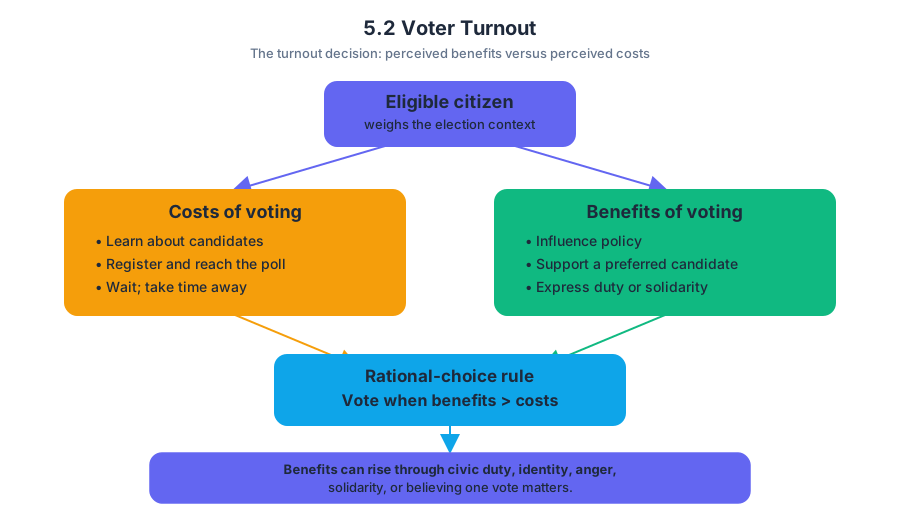
Voting requires resources: learning about candidates, registering, reaching a polling place, waiting in line, and finding time away from work or family responsibilities. These are the costs of voting. The perceived benefits include influencing policy, supporting a preferred candidate, expressing civic duty, and helping one’s political group win.
A rational-choice model represents the decision this way:
$$ \text{Vote when perceived benefits} > \text{perceived costs} $$
The model does not mean voters are selfish or uninterested in democracy. Civic duty, identity, anger, solidarity, and the belief that one vote matters can all increase the perceived benefit. The model simply asks why the same eligible citizen may vote in one election but not another.
Three families of turnout factors
| Factor family | How it changes turnout | Illustrative mechanism |
|---|---|---|
| Attitudinal factors | Raises or lowers the perceived benefit of voting | Political efficacy, civic duty, interest, trust, or belief that the election matters |
| Government requirements | Raises or lowers the practical cost | Registration deadlines, voter-identification rules, registration access, and election administration |
| Institutional forces | Changes convenience or the expected impact of voting | Election frequency, competitiveness, voting technology, and the type of election |
Political efficacy means the belief that one’s participation can affect government. A person with high internal efficacy may feel capable of understanding politics; a person with high external efficacy may believe government responds to citizens. Low efficacy can reduce turnout because voting appears unlikely to produce a meaningful result.
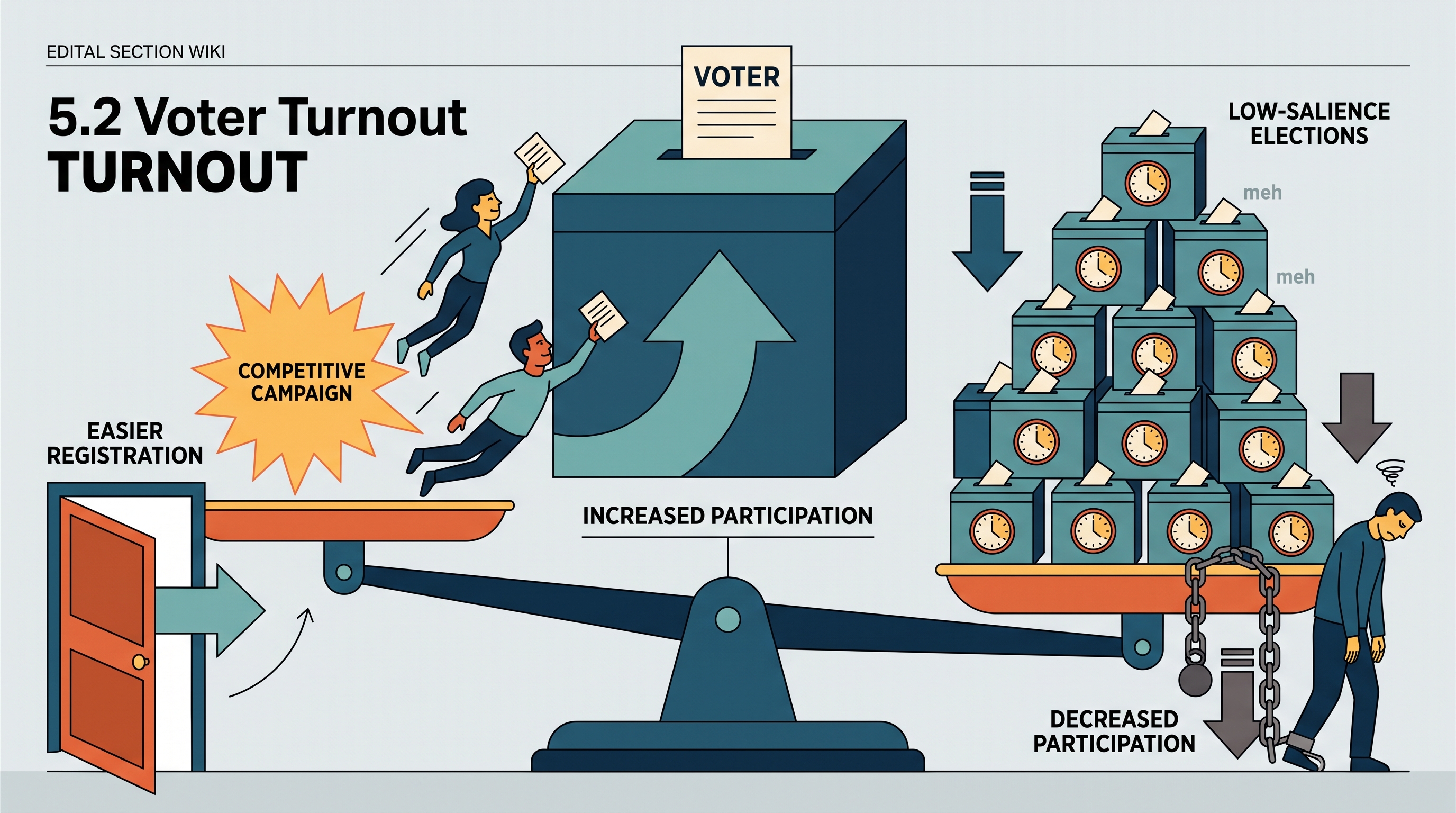
Election competitiveness also matters. When candidates are closely matched, citizens may believe their votes are more consequential, and campaigns have stronger incentives to mobilize them. In an overwhelmingly predictable election, the expected benefit of voting may seem smaller—even though the election still determines real policies.
Worked example: lowering the cost of voting
Imagine that State A has same-day registration and several convenient voting options. State B requires registration weeks before Election Day and requires voters to obtain a particular form of identification. Assume citizens in both states have similar interest in politics.
For a citizen in State A, registration can occur close to the election, travel time is limited, and the administrative process is relatively easy. The policy lowers the costs of voting, so more citizens may decide that the benefits outweigh the costs. In State B, the earlier deadline and identification requirement may create additional barriers; citizens who would otherwise vote may not complete the process.
This example does not prove that every turnout difference is caused by one law. Demographic characteristics, campaign mobilization, competitiveness, political interest, and election timing may also differ. A strong analysis identifies the likely mechanism while avoiding the claim that correlation alone establishes causation.
Why election type changes turnout
Turnout is generally higher in presidential elections than in midterm, state, or local elections. Presidential elections receive more media coverage, attract more campaign spending, and make the stakes more visible. Lower-salience elections often produce lower turnout because fewer citizens know about them or believe their participation will affect national outcomes.
Frequent elections can create voter fatigue, the decline in motivation that may occur when citizens are repeatedly asked to participate. The same institutional design that creates many opportunities for participation can therefore reduce participation by increasing the time and attention required.
Misconception check
Misconception: “Low turnout means citizens are apathetic.” Apathy is one possible explanation, but turnout is shaped by both motivation and access. A citizen may care deeply about politics yet fail to vote because of registration rules, work schedules, transportation problems, identification requirements, confusing procedures, or the belief that the election is not competitive.
AP skill connection: Skill 3.C
Skill 3.C — Explain the implications of political data. When analyzing a turnout graph or table, do more than identify which group has the higher percentage. Explain what the difference could imply about political influence, campaign strategy, representation, or public policy.
For example, if turnout rises after same-day registration is adopted, the implication may be that reducing administrative costs expands participation. A careful response should still consider other explanations, such as a more competitive election or an unusually strong mobilization campaign.
Retrieval check
A state makes registration easier but holds many low-salience elections. Predict two forces that could increase turnout and one that could reduce it. Then state whether the evidence would show causation automatically.
Answer: Easier registration could lower costs, and a competitive campaign could raise perceived benefits. Frequent low-salience elections could produce voter fatigue and reduce turnout. The pattern would suggest a relationship, but it would not automatically prove causation.
Source Materials
- AP U.S. Government and Politics Course and Exam Description
- Learn More (.pdf)
- AP U.S. Government and Politics Course Overview
- AP U.S. Government and Politics Course at a Glance
- AP United States Government and Politics Course at a Glance Poster
- AP United States Government and Politics
- AP United States Government and Politics
- United States Government and Politics Sample Syllabus 1