From the free course AP United States Government and Politics on Lykke
4.4 Influence of Political Events on Ideology
A major political event can change how people understand government, public problems, and the proper use of political power. Those changed attitudes may become part of an individual’s political ideology—a relatively consistent set of beliefs about government, policy, liberty, equality, and authority.
LO 4.4.A: Explain how major political events influence political ideology.
EK 4.4.A.1: Major political events can influence the development of individual political attitudes, which is an example of political socialization. Political socialization, in turn, influences political ideology.
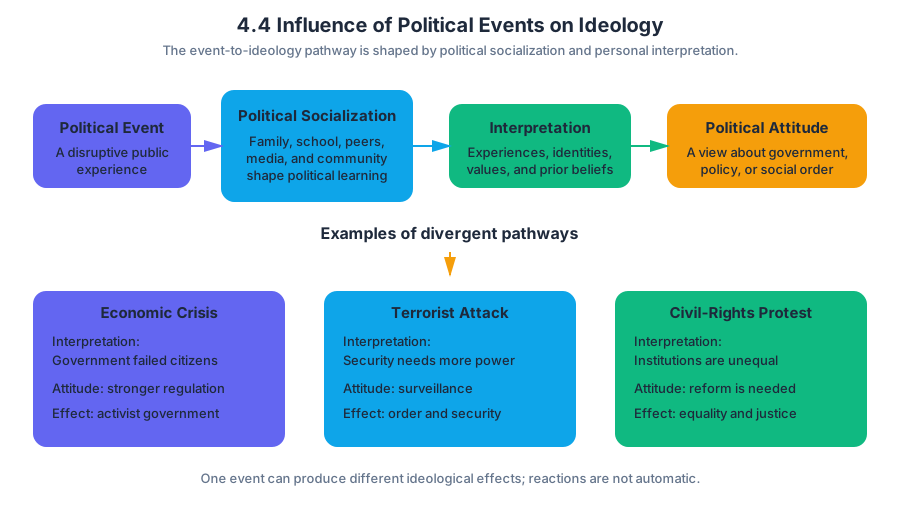
The event-to-ideology pathway
The key mechanism is political socialization, the process through which people develop political attitudes and beliefs. Families, schools, peers, media, and religious or community institutions all contribute to political socialization, but major political events can create especially powerful moments of learning and interpretation.
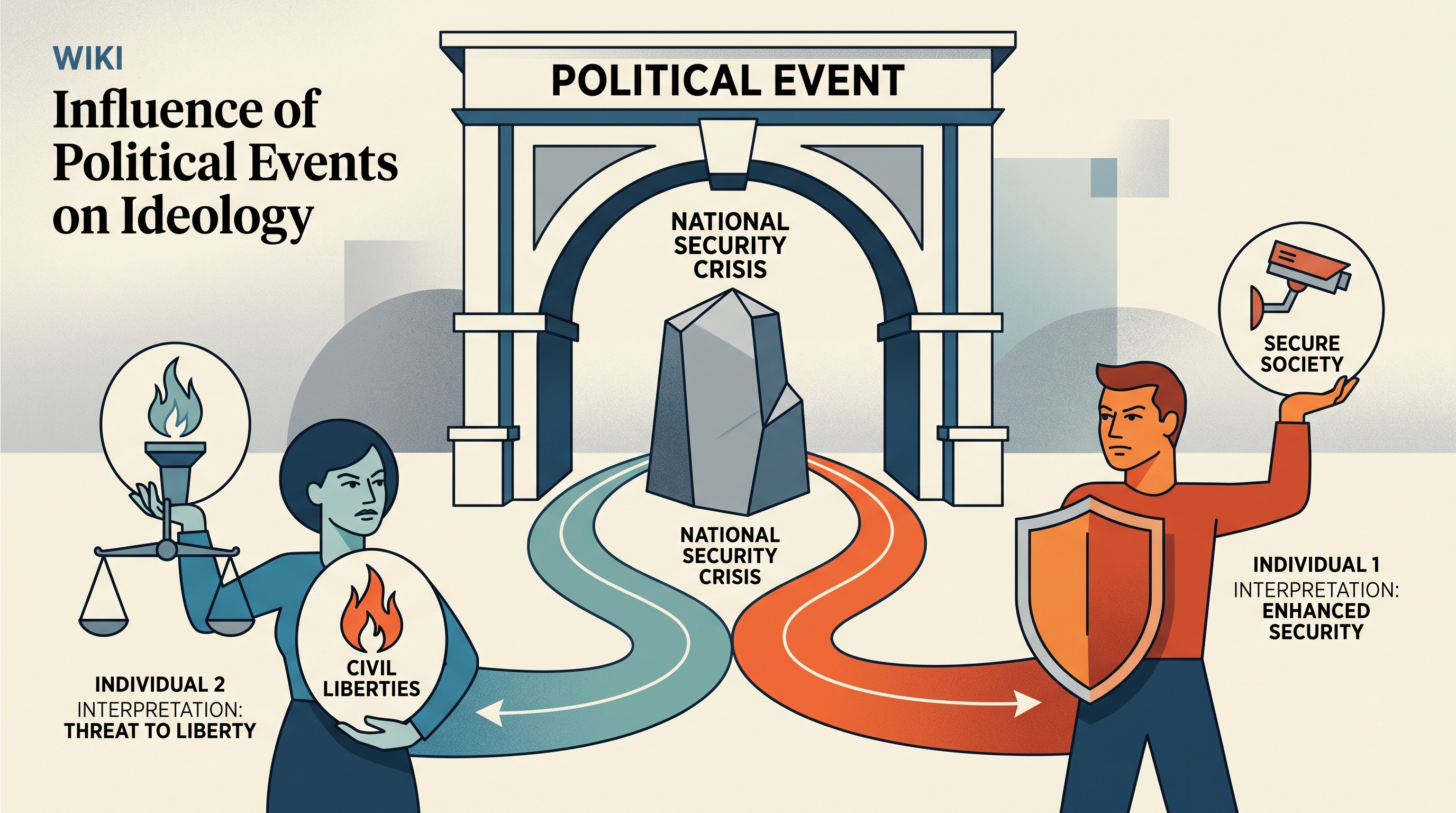
The relationship is not automatic. The same event may produce different ideological reactions because people interpret it through different experiences, identities, values, and prior beliefs.
| Political event | Individual interpretation | Political attitude | Possible ideological effect |
|---|---|---|---|
| Economic crisis | Government failed to protect citizens | Support for stronger regulation or social programs | Greater acceptance of activist government |
| Terrorist attack | National security requires expanded government power | Support for surveillance or military action | Greater emphasis on order and security |
| Civil-rights protest | Existing institutions deny equal treatment | Support for legal protections and reform | Greater emphasis on equality and government enforcement |
Worked example: an economic crisis
Imagine that a severe economic crisis causes widespread unemployment. A teenager watches a parent lose a job, sees a local business close, and observes the national government provide emergency assistance. The event is not merely something in a history book: it becomes a personal political experience.
The teenager may develop the attitude that government should intervene during economic emergencies. Over time, that attitude can influence support for unemployment benefits, financial regulation, or public investment. If these positions become connected to broader beliefs about the government’s responsibility to promote economic security, the person’s political ideology may shift toward a more supportive view of active government.
The same crisis could produce a different response. Another person might conclude that government mismanagement caused the crisis or that emergency programs create excessive dependence. That person may develop stronger preferences for limited government, private-sector solutions, or reduced regulation. The event influenced both individuals, but it did not determine their conclusions.
Why interpretation matters
Political events supply information, but individuals assign meaning to that information. A person who experiences a public-health emergency may favor expanded government action because coordinated institutions appeared necessary. Another person may become more skeptical of government mandates because the same event made government power feel intrusive.
This explains why political events can influence ideology without producing ideological uniformity. The event enters the process of political socialization; family discussion, media framing, group identity, and personal experience help shape the resulting attitude.
Source Analysis — Skill 4.B
The suggested skill for Topic 4.4 is Source Analysis: 4.B — Explain how the argument or perspective in the source relates to political principles, institutions, processes, policies, and behaviors.
To apply 4.B, identify the source’s argument or perspective, then connect it to the event-to-ideology pathway:
- Name the perspective. Does the source portray the event as evidence of government success, government failure, social injustice, or a threat to public order?
- Identify the political attitude. What belief about government or policy does that perspective encourage?
- Explain the ideological connection. How could that attitude contribute to a broader ideology?
- Connect to politics. Show how the belief could affect institutions, policies, political participation, or behavior.
For example, if a source argues that a crisis revealed the need for national government action, a strong explanation would connect the argument to the political principle of collective responsibility, the institution of the national government, support for assistance programs, and increased approval of leaders who favor intervention. Merely saying that “the event changed people’s opinions” is too vague because it does not explain the political mechanism.
Common misconception check
Misconception: A major event pushes everyone in the same ideological direction.
Correction: Events influence political attitudes, but people interpret them differently. Political socialization is an interaction between the event and the individual’s existing experiences, groups, information, and values.
Misconception: One changed opinion automatically equals a changed ideology.
Correction: An attitude is a belief about a particular issue. Ideology is a broader pattern of beliefs. A political event may change one attitude without reorganizing a person’s entire ideological outlook.
Retrieval check
A national security crisis leads one person to support expanded surveillance and another to oppose it as a threat to civil liberties. What does this contrast demonstrate? Answer: The event became part of both individuals’ political socialization, but different interpretations produced different political attitudes and possible ideological effects.
Source Materials
- AP U.S. Government and Politics Course and Exam Description
- Learn More (.pdf)
- AP U.S. Government and Politics Course Overview
- AP U.S. Government and Politics Course at a Glance
- AP United States Government and Politics Course at a Glance Poster
- AP United States Government and Politics
- AP United States Government and Politics
- United States Government and Politics Sample Syllabus 1