From the free course AP United States Government and Politics on Lykke
2.7 Presidential Communication
A president may possess formal constitutional powers, but those powers become politically effective only when the president can explain, defend, and build support for proposed action.
2.7 Presidential Communication
A president may possess formal constitutional powers, but those powers become politically effective only when the president can explain, defend, and build support for proposed action. Presidential communication is the use of speeches, news conferences, interviews, social media, public ceremonies, and other channels to shape public opinion, influence Congress, and establish a policy agenda.
CED Topic 2.7 — Presidential Communication
Learning Objective 2.7.A: Explain how the president’s use of media affects public opinion and policy.
Essential Knowledge 2.7.A.1: Presidents use various forms of communication to influence public opinion and policymaking.
The president as a national messenger
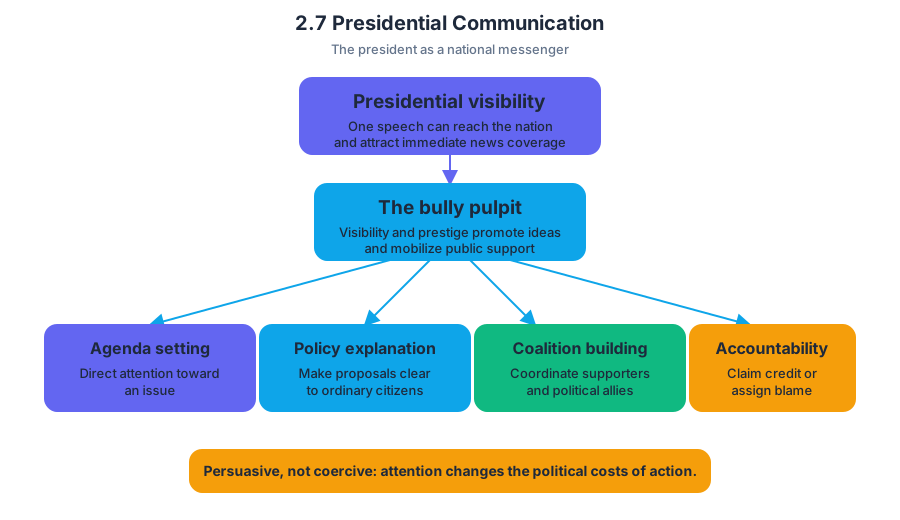
The president is unusually visible in American politics. A single presidential speech can reach citizens across the country, attract immediate news coverage, and pressure other political actors to respond. This communication advantage is often called the bully pulpit: the president’s ability to use the visibility and prestige of the office to promote ideas and mobilize support.
The bully pulpit is persuasive, not legally coercive. A president cannot make Congress pass a bill simply by delivering a speech, but public attention can change the political costs of opposing or supporting that bill.
Presidential communication commonly serves four connected purposes:
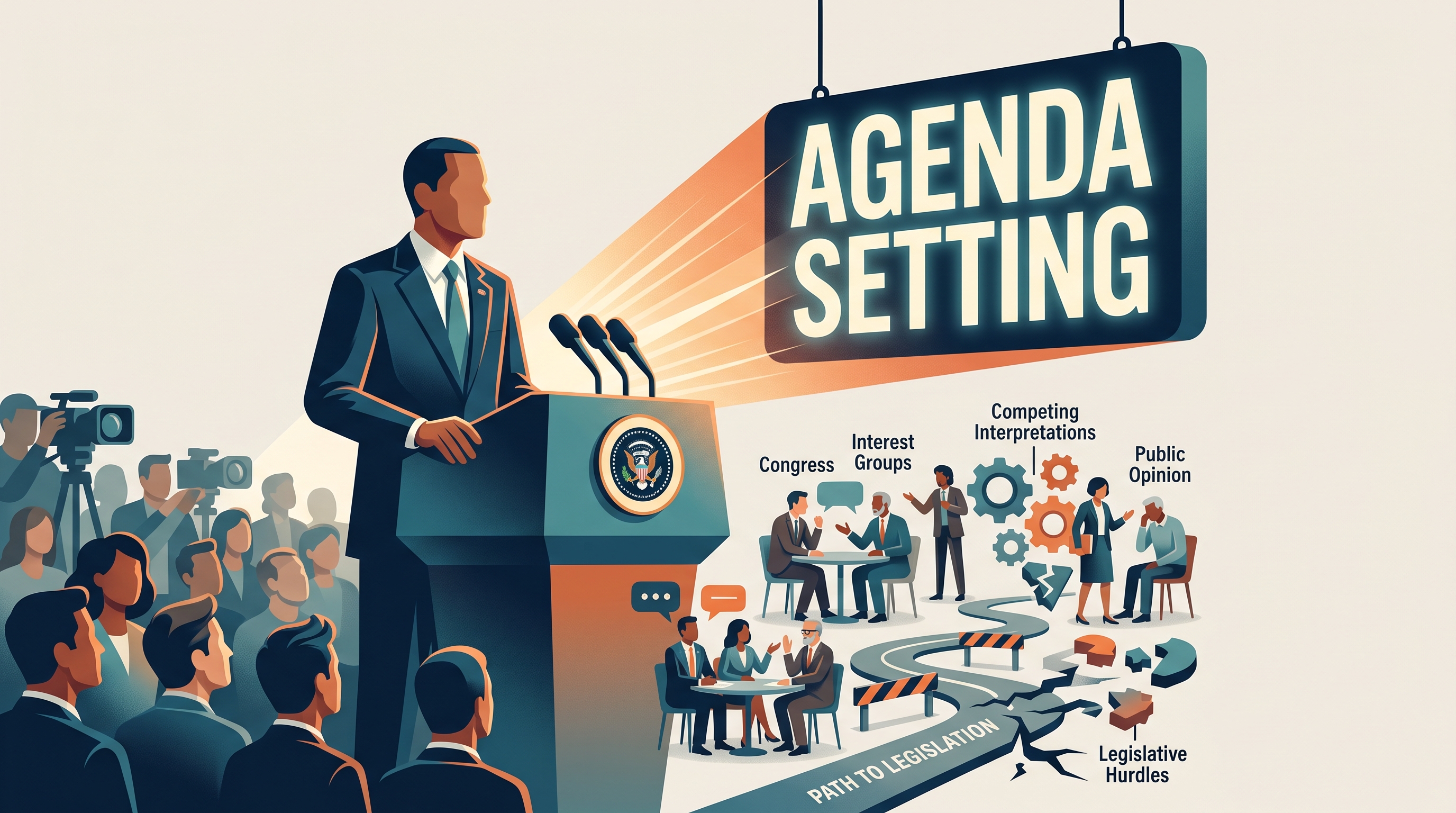
- Agenda setting: directing public and governmental attention toward an issue.
- Policy explanation: presenting a proposal in language ordinary citizens can understand.
- Coalition building: encouraging supporters, legislators, interest groups, and party organizations to act together.
- Political accountability: claiming credit for favorable outcomes or assigning blame for failures.
The same event can perform several functions at once. A president discussing disaster relief may reassure affected citizens, demonstrate command of the situation, pressure Congress to approve funding, and signal competence to voters.
Communication channels and audience effects
Presidents choose communication channels strategically. A formal address can create a sense of national importance; a news conference allows journalists to press for answers; a campaign-style rally energizes partisan supporters; and a social-media post can bypass traditional news organizations and reach followers directly.
| Communication channel | Likely audience | Political advantage | Limitation |
|---|---|---|---|
| National address | Broad national public | Creates shared attention | Citizens may interpret it through partisan preferences |
| News conference | Journalists and politically attentive citizens | Allows direct questioning | Unscripted answers can create political risks |
| Rally | Party supporters and activists | Builds enthusiasm and mobilization | May deepen partisan division |
| Social media | Targeted followers and rapid-response audiences | Speed and direct access | Encourages selective exposure and short, simplified messages |
| State of the Union address | Congress, citizens, and media | Publicly presents an agenda | Congress is not required to adopt the proposals |
Why communication does not guarantee persuasion
Presidential messages compete with partisan identity, prior beliefs, interest-group messaging, and media interpretation. Citizens frequently process the same statement through motivated reasoning, meaning they accept information that supports their existing views more readily than information that challenges them.
Modern presidents also communicate in a fragmented media environment. Instead of one shared national audience, citizens may receive different clips, headlines, commentary, and algorithmically selected posts. The president can reach supporters more directly, but direct access does not ensure broad agreement.
Key distinction: A president may successfully control what issue receives attention without successfully controlling what the public believes about that issue.
Worked contextual example: a climate-policy proposal
Imagine that a president proposes a national program to reduce carbon emissions. The president gives a televised address describing the plan as an effort to protect public health and create clean-energy jobs. The administration then releases short online videos aimed at younger voters, meets with business groups, and urges members of Congress to support legislation.
The communication strategy can be analyzed step by step:
- The televised address performs agenda setting by making climate policy a nationally visible issue.
- The explanation of health and employment benefits frames the proposal in terms likely to appeal beyond environmental activists.
- Meetings with business groups attempt coalition building.
- Appeals to Congress use public attention as indirect pressure.
- If the proposal fails, the president may communicate that congressional opposition caused the failure; if it succeeds, the president may claim credit.
The outcome still depends on congressional incentives, public opinion, party polarization, interest-group activity, and the strength of competing messages. Communication creates political pressure; it does not replace the constitutional lawmaking process.
Misconception check
Misconception: “The president controls the media and can persuade the public whenever desired.” Presidents can attract attention, frame issues, and communicate directly with citizens, but journalists, opposing parties, interest groups, platforms, and citizens all affect how messages are received. A popular speech may improve support temporarily without producing a lasting policy change.
AP skill in action
This topic is especially assessed through 1.A Concept Application: Explain how political principles, institutions, processes, policies, and behaviors apply to different scenarios in context. On an exam, identify the communication method described, explain its political purpose, and connect it to a likely effect on public opinion or policymaking. Naming a speech is not enough; the response must show the mechanism—for example, how agenda setting increases attention or how a rally mobilizes partisan supporters.
Retrieval check
A president uses a national address to make an unfamiliar infrastructure proposal the central subject of public debate. What presidential-communication function is most directly illustrated, and why might the address still fail to produce legislation?
Answer: It illustrates agenda setting because the president is directing attention toward the proposal. It may fail because Congress, parties, interest groups, public opinion, and competing interpretations—not presidential communication alone—determine whether legislation passes.
Source Materials
- AP U.S. Government and Politics Course and Exam Description
- Learn More (.pdf)
- AP U.S. Government and Politics Course Overview
- AP U.S. Government and Politics Course at a Glance
- AP United States Government and Politics Course at a Glance Poster
- AP United States Government and Politics
- AP United States Government and Politics
- United States Government and Politics Sample Syllabus 1