From the free course AP United States Government and Politics on Lykke
AP Practice 3
A Supreme Court case is not merely a name to memorize: it is a constitutional tool. On the AP exam, SCOTUS Application asks you to use that tool by identifying relevant facts, stating a case’s holding, explaining the majority’s reasoning, and applying that reasoning to a new constitutional situation.
This practice targets Skill 2.A: SCOTUS Application. The skill requires more than recognizing that two cases involve federalism or individual rights. A strong response connects the cases through a specific constitutional principle and explains why the Court reached its decision.
High-value rule: Do not compare case topics only. Compare the constitutional reasoning that links the facts to the holding.
The case pair: McCulloch v. Maryland and United States v. Lopez
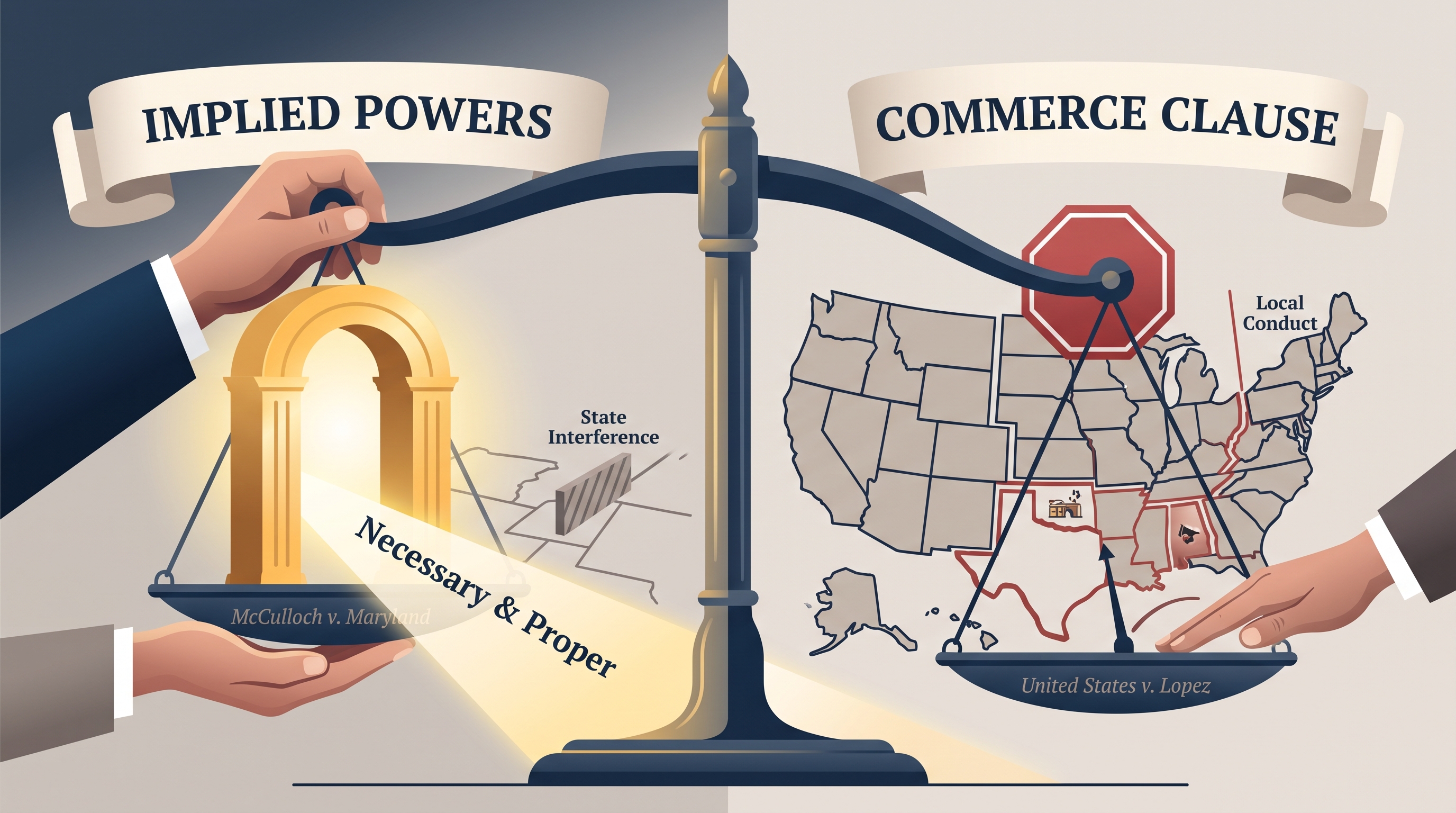
In McCulloch v. Maryland (1819), Congress created a national bank under its implied powers. Maryland attempted to tax the bank. The Supreme Court held that Congress had the power to create the bank under the Necessary and Proper Clause and that Maryland could not tax it because state action could not interfere with a legitimate constitutional exercise of national power.
In United States v. Lopez (1995), Congress enacted a law banning guns near schools. The Court held that Congress had exceeded its Commerce Clause authority because possessing a gun near a school was not sufficiently connected to interstate commerce. Unlike McCulloch, where the Court accepted a broad reading of national power, Lopez placed a meaningful limit on that power.
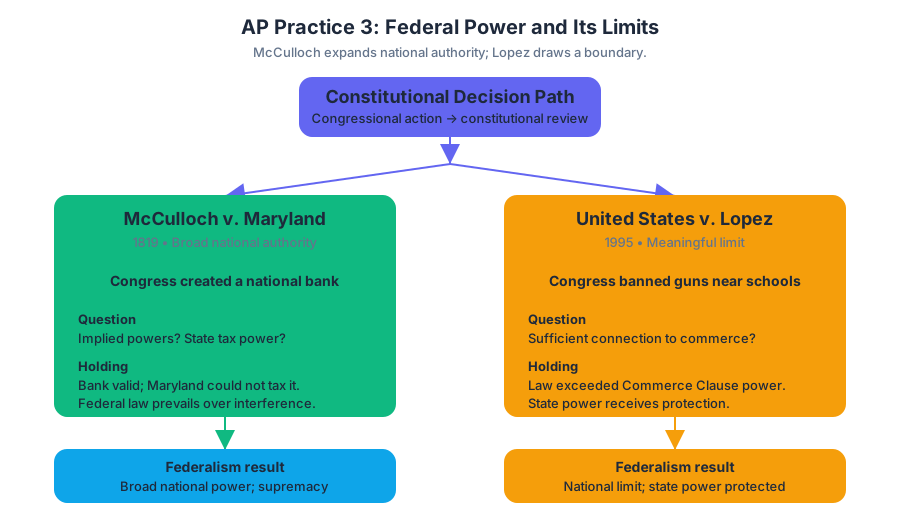
The contrast can be represented as a constitutional decision path:
| Case | Congressional action | Constitutional question | Holding | Federalism result |
|---|---|---|---|---|
| McCulloch | Created a national bank | Could Congress use implied powers? Could Maryland tax the bank? | Congress could create the bank; Maryland could not tax it | Broad national authority; federal law prevails |
| Lopez | Banned guns near schools | Did the law fall within the Commerce Clause? | Congress lacked sufficient commerce authority | Limitation on national authority; state power protected |
Original unofficial practice prompt
A state legislature passes a law imposing a special fee on a federally chartered emergency communications corporation. The corporation argues that the fee interferes with a federal program created under Congress’s implied powers. In a separate case, Congress passes a law regulating the possession of certain devices in local government buildings, asserting that the devices might indirectly affect the national economy.
Respond to all parts.
(A) Identify the constitutional principle from McCulloch v. Maryland that is most relevant to the emergency communications corporation.
(B) Explain how the holding in McCulloch v. Maryland would apply to the state fee.
(C) Identify the constitutional principle from United States v. Lopez that is most relevant to Congress’s regulation of devices in local government buildings.
(D) Explain how the reasoning in United States v. Lopez could be used to challenge Congress’s regulation.
Worked reasoning
Part A: Identify the principle
A complete answer identifies federal supremacy and implied powers. Congress may use powers that are not expressly listed when those powers are appropriate means of carrying out an enumerated power. In addition, a state may not interfere with a valid federal action.
Rewardable idea: The relevant principle is not simply “federalism.” It is that valid federal action is supreme over conflicting state action.
Part B: Apply McCulloch
The state fee would likely be unconstitutional if it functioned as a tax or burden designed to control, punish, or substantially interfere with the federally created corporation. Under McCulloch, the state cannot use its authority to obstruct a legitimate federal program because “the power to tax involves the power to destroy.”
Notice the reasoning chain:
$$ \text{Federal program is constitutionally authorized} \rightarrow \text{state measure burdens the program} \rightarrow \text{federal authority prevails} $$
A weak response would say only that “the federal government is more powerful.” A stronger response explains that the federal corporation exists through an implied congressional power and that state interference violates the Supremacy Clause principle applied in McCulloch.
Part C: Identify the principle
The relevant principle from Lopez is that the Commerce Clause does not give Congress unlimited authority over every activity that might have an indirect economic effect. The regulated conduct must have a sufficiently substantial connection to interstate commerce.
Part D: Apply Lopez
The regulation could be challenged because possessing devices in local government buildings may be noncommercial activity with no substantial connection to interstate commerce. Merely asserting that the activity might affect the national economy would not necessarily satisfy the constitutional limit recognized in Lopez.
The best answer distinguishes the result from McCulloch: McCulloch involved a federal instrument directly connected to an enumerated national power, while Lopez involved an attempt to regulate local conduct without a sufficiently demonstrated commerce connection.
Misconception check
Misconception: “Lopez overturned McCulloch.” It did not. The cases address different constitutional powers. McCulloch supports implied powers when Congress is carrying out an enumerated responsibility; Lopez limits the Commerce Clause when Congress regulates activity too weakly connected to interstate commerce.
Timing and error review
Allow approximately 20 minutes for this SCOTUS Application task. Spend the first few minutes identifying the constitutional clause or principle, then write one direct application for each part. Afterward, label each response as principle, holding, reasoning, or application. If an answer contains only a case name or conclusion, revise it by adding the constitutional mechanism that explains why the conclusion follows.
Retrieval check
Why would McCulloch generally support a federally chartered program against state interference, while Lopez could limit Congress’s attempt to regulate local conduct? Answer in one sentence using both implied powers and the Commerce Clause.
Source Materials
- AP U.S. Government and Politics Course and Exam Description
- Learn More (.pdf)
- AP U.S. Government and Politics Course Overview
- AP U.S. Government and Politics Course at a Glance
- AP United States Government and Politics Course at a Glance Poster
- AP United States Government and Politics
- AP United States Government and Politics
- United States Government and Politics Sample Syllabus 1
- AP US Gov Past Exam Questions — AP Central
- Khan Academy — AP US Government and Politics
- YouTube — Heimler's History
- YouTube — Jocz Productions