From the free course AP United States Government and Politics on Lykke
5.6 Interest Groups Influencing Policymaking
Key concepts: Interest groups and policymaking · Lobbying · Drafting legislation · Mobilizing members to apply pressure · Working with legislators · Interest-group influence on elections · Variation in interest-group resources · Large memberships and member mobilization · Financial resources and access to policymakers · Collective action and the influence of organized groups
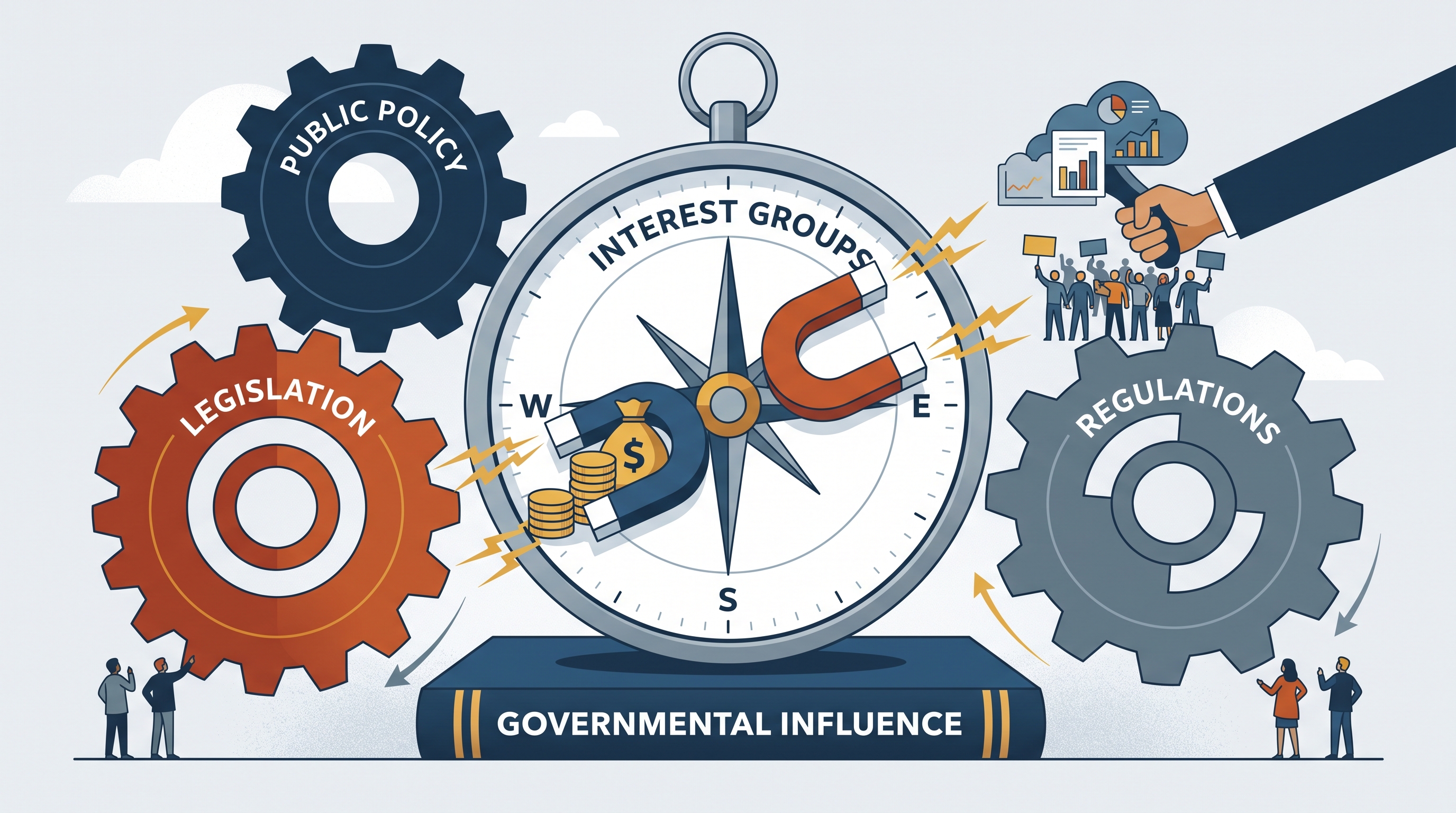
A policy rarely moves from public concern to government action by itself. Interest groups organize people or resources around a shared policy goal and attempt to influence voters, officeholders, government agencies, and sometimes courts.
5.6 Interest Groups Influencing Policymaking
A policy rarely moves from public concern to government action by itself. Interest groups organize people or resources around a shared policy goal and attempt to influence voters, officeholders, government agencies, and sometimes courts.
Investigative question: How can a group that does not hold public office nevertheless shape elections and public policy?
The influence pipeline
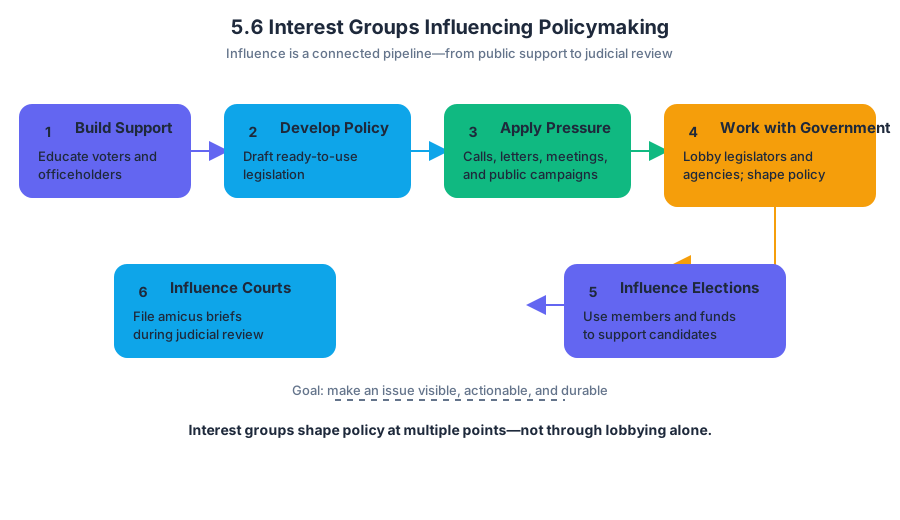
Interest groups influence policymaking through several connected strategies. The process is not a single “lobbying” conversation; it is a chain of activities that can begin with public education and continue through legislation, implementation, and judicial review.
| Stage | What an interest group may do | Intended effect |
|---|---|---|
| Build support | Educate voters and officeholders | Make an issue visible and persuasive |
| Develop policy | Draft proposed legislation | Give lawmakers ready-to-use policy language |
| Apply pressure | Mobilize members through calls, letters, meetings, or public campaigns | Raise the political cost of ignoring the group |
| Work with government | Lobby legislators and government agencies | Shape laws, regulations, and implementation |
| Influence elections | Use memberships and financial resources | Support favorable candidates or policy positions |
| Influence courts | File an amicus curiae brief, or “friend of the court” brief | Supply information and arguments for justices considering a case |
Lobbying is more than persuasion
Lobbying is organized communication intended to influence government decisions. A lobbyist may meet with a legislator, provide technical information, suggest amendments, or explain how a proposed rule would affect the group’s members.
Interest groups also draft legislation. This does not mean that legislators surrender their constitutional role. Rather, a group may possess specialized knowledge, legal staff, or policy language that helps lawmakers construct a bill. The legislator still decides whether to introduce, revise, support, or oppose the proposal.
Groups can also mobilize their members. A large membership gives an organization potential political reach, but membership matters most when people actually respond to messages, contact officials, attend meetings, donate, or vote. Mobilization converts a group’s size into visible political pressure.
Unequal resources produce unequal access
LO 5.6.B asks students to explain how differences in interest-group types and resources affect influence over elections and policymaking. EK 5.6.B.1 emphasizes that resources are unequal: groups with large memberships, strong member mobilization, and substantial financial reserves generally have greater access and influence.
A group such as AARP illustrates the potential strength of a large membership. Its members can be mobilized around policies affecting older Americans, while its organizational resources can support communication with policymakers. By contrast, a group with a narrow or poorly organized membership may struggle to gain sustained attention even when its policy argument is strong.
This inequality creates a central democratic tension. Interest groups can bring specialized knowledge and many voices into policymaking, but access is not distributed evenly. A policymaker may hear from groups that can afford professional staff, maintain long-term relationships, or quickly mobilize constituents more often than from less-resourced communities.
Parties, networks, and policymaking
Interest groups do not operate only through direct contact with individual legislators. They may work within party coalitions, joining other organizations that share a broad political outlook. They may also participate in iron triangles and issue networks—relationships connecting interest groups, congressional committees, bureaucratic agencies, and other policy actors.
An iron triangle tends to involve a relatively stable, mutually supportive relationship among a congressional committee, a government agency, and an interest group. An issue network is usually broader and less fixed, bringing together multiple groups, experts, officials, and advocates around a policy issue. Both mechanisms help groups influence policy across party coalitions.
Worked example: subsidies and tax policy
Consider tobacco subsidies. Tobacco-related interests can use lobbying, policy expertise, member or producer networks, and political resources to encourage policies favorable to their industry. The example demonstrates influence on policymaking: the group need not control government directly; it must persuade or pressure decision makers at relevant stages.
Tax cuts enacted under George W. Bush provide another example of interest-group influence. Groups favoring lower taxes could support candidates, communicate with lawmakers, mobilize members, and provide arguments for tax legislation. The example does not prove that one group alone caused the policy. It shows how organized interests can participate in a larger coalition influencing elected officials and policy outcomes.
Collective action and democratic participation
Mancur Olson’s The Logic of Collective Action: Public Goods and the Theory of Groups (1965) examines why people may fail to participate even when they would benefit from a group’s success. A public good is a benefit available broadly, including to people who did not help produce it. This creates a free-rider problem: individuals may prefer to let others do the organizing.
E. E. Schattschneider’s The Semisovereign People: A Realist’s View of Democracy in America (1960) examines participation and influence in American democracy. Together, Olson and Schattschneider help frame two competing insights: organized groups can expand participation by bringing voices into politics, but the political system may still favor groups able to overcome participation barriers and secure access.
Worked contextual example: the National Association of Home Builders
The National Association of Home Builders scenario illustrates an interest group taking action in an election or policymaking context. To analyze it, trace the mechanism rather than merely naming the group:
- Identify the group’s policy interest.
- Identify its resource—membership, money, expertise, or organizational access.
- Identify its action—such as lobbying, mobilizing members, working with legislators, or influencing elections.
- Explain how that action could affect government decisions.
This is the difference between identification and explanation. “The group lobbied” identifies a strategy; “the group used its resources to pressure lawmakers, increasing the political cost of rejecting its preferred policy” explains influence.
AP skills in action
This topic most directly develops CON-1 Concept Application, applying interest-group concepts to a new scenario; DAT-1 Data Analysis, if membership, spending, polling, or election data are provided; SRC-1 Source Analysis, when interpreting a group’s statement or political document; and ARG-1 Argumentation, when evaluating whether interest-group influence strengthens or weakens representative democracy. SCOTUS-1 SCOTUS Application may apply when an amicus curiae brief or a relevant court dispute is presented.
Named misconception check: Interest groups are not the same as political parties. Parties seek to win government office and organize broad electoral coalitions; interest groups seek to influence policy, elections, or implementation without primarily trying to control government through elected office.
Retrieval check: A well-funded group has few members, while a large-membership group has little money. Which group has the stronger potential influence, and why might the answer depend on whether policymakers value financial resources, specialized information, or visible member mobilization?
Source Materials
- AP U.S. Government and Politics Course and Exam Description
- Learn More (.pdf)
- AP U.S. Government and Politics Course Overview
- AP U.S. Government and Politics Course at a Glance
- AP United States Government and Politics Course at a Glance Poster
- AP United States Government and Politics
- AP United States Government and Politics
- United States Government and Politics Sample Syllabus 1