From the free course AP United States Government and Politics on Lykke
4.7 Ideologies of Political Parties
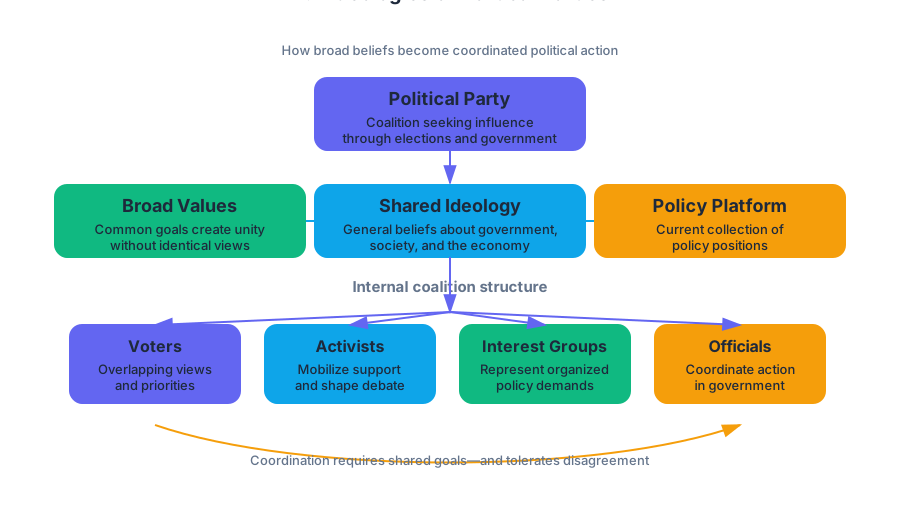
A political party is not simply a club with a single opinion: it is a coalition of people, organized around shared beliefs and policy goals, that seeks to win elections and influence government.
4.7 Ideologies of Political Parties
A political party is not simply a club with a single opinion: it is a coalition of people, organized around shared beliefs and policy goals, that seeks to win elections and influence government. The central puzzle is this: How can a party hold together voters who agree on broad values but disagree about specific policies?
Key distinction: A party’s ideology is its general set of beliefs about government, society, and the economy; a party’s platform is its current collection of policy positions.
In the United States, the Democratic and Republican parties are broad coalitions rather than perfectly uniform ideological groups. Each includes elected officials, activists, interest groups, donors, and voters whose views overlap but are not identical. A party therefore functions like a large team: members must coordinate around enough common goals to compete successfully, while tolerating some internal disagreement.
From core values to party platforms
American political debates often begin with values that many people share, including individualism, equality of opportunity, free enterprise, the rule of law, limited government, and popular sovereignty. Agreement on a value does not guarantee agreement about its meaning. For example, two people may support equality of opportunity but disagree about whether government should expand public programs to reduce unequal starting conditions.
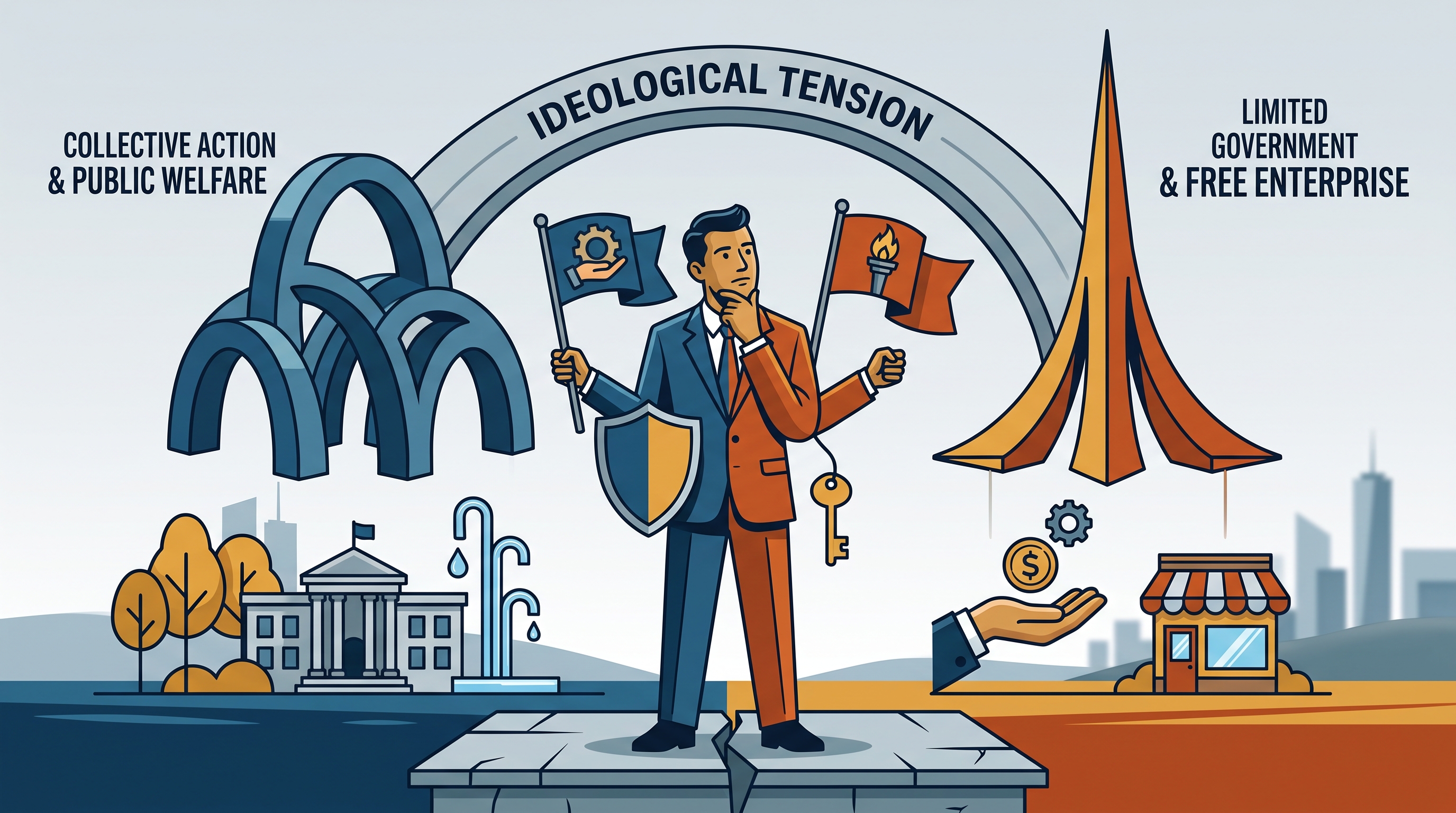
Political ideology supplies a pattern for answering these disagreements. In broad terms, liberal perspectives tend to view government action as a useful tool for addressing economic inequality, protecting civil rights, and providing public services. Conservative perspectives tend to place greater emphasis on limited government, individual responsibility, free enterprise, social stability, and preserving established institutions. These are general tendencies, not rigid rules that determine every position held by every party member.
A party platform translates broad principles into proposals. The translation is not mechanical: political leaders must decide which problems deserve attention, which government powers are legitimate, and which compromises can attract enough support. Platforms also change as parties respond to new social conditions, political events, demographic coalitions, and electoral incentives.
Worked example: reading a party position
Imagine that one party platform calls for expanded public investment in health care, arguing that government should ensure that citizens can obtain essential services. Another platform favors reducing federal involvement and relying more heavily on private providers, arguing that competition and individual choice produce better results.
Step 1 — Identify the policy. Both statements address the government’s role in health care.
Step 2 — Identify the underlying value. Both may appeal to individual well-being and equality of opportunity.
Step 3 — Identify the ideological difference. The first gives greater weight to government responsibility and collective provision; the second gives greater weight to limited government, private choice, and free enterprise.
Step 4 — Avoid overclaiming. The disagreement does not prove that one party supports “government” and the other opposes it. Both parties use government; they differ over its proper scope, methods, and priorities.
This same reasoning can be applied to excerpts from the Republican and Democratic Party platforms. Rather than labeling a statement only “liberal” or “conservative,” connect its language to a specific core value and explain how the proposed role of government reflects an ideological preference.
Party ideology is not voter uniformity
A common misconception is that every Democratic voter holds liberal views on every issue and every Republican voter holds conservative views on every issue. In reality, voters may cross ideological categories: a voter might favor conservative economic policies but liberal civil-liberties policies, or support a party mainly because of identity, leadership, group ties, or a particular issue.
A second misconception is that party platforms remain fixed. Parties adapt. A platform can preserve long-standing commitments while adding new priorities or reframing old ones for a changed electorate. The enduring party label provides continuity, but the coalition behind that label—and therefore the policy emphasis of the party—can shift over time.
AP skill focus: Skill 1.E — Concept Application
For Skill 1.E, apply ideological concepts to a concrete political statement, party platform, or policy dispute. A strong response does more than identify a party as “liberal” or “conservative”: it names the relevant concept, points to evidence in the scenario, and explains the connection.
In-flow retrieval check: A platform proposes stricter environmental regulations because pollution imposes costs on communities, while opponents argue that regulation threatens free enterprise and individual economic choice. Which core value or ideological tension is most directly present, and how does each side connect its position to that value? A complete answer should identify the conflict between collective government action and limited government or free enterprise, then tie each claim to the platform language.
Source Materials
- AP U.S. Government and Politics Course and Exam Description
- Learn More (.pdf)
- AP U.S. Government and Politics Course Overview
- AP U.S. Government and Politics Course at a Glance
- AP United States Government and Politics Course at a Glance Poster
- AP United States Government and Politics
- AP United States Government and Politics
- United States Government and Politics Sample Syllabus 1