From the free course AP United States Government and Politics on Lykke
5.11 Campaign Finance
A candidate may receive a donation, while an outside organization may spend millions supporting that candidate without coordinating with the campaign. The constitutional question is not simply who spent the money, but whether the spending counts as protected political expression and whether government may regulate it.
Campaign finance is the system of laws, institutions, and practices governing how political campaigns and political organizations raise and spend money. It shapes who can participate, how candidates communicate with voters, and how much influence wealthy individuals, corporations, unions, political parties, and organized interests may exercise.
Campaign-finance regulation attempts to balance two competing principles: protecting political participation and preventing corruption or its appearance.
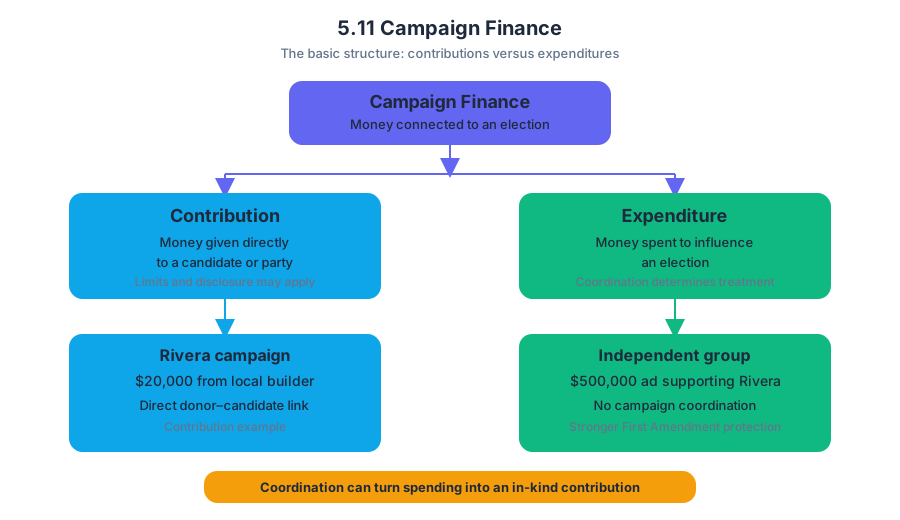
The basic structure: contributions versus expenditures
A contribution is money given directly to a candidate, campaign committee, or political party. An expenditure is money spent to influence an election. The distinction matters because direct contributions create a closer relationship between the donor and the candidate, while independent expenditures are made without coordination with the candidate.
Consider a fictional Senate election. A local construction company gives Candidate Rivera’s campaign $20,000. That is a direct contribution and may be subject to legal limits and disclosure requirements. A separate organization spends $500,000 producing its own advertisement supporting Rivera, without consulting the campaign; that is an independent expenditure.
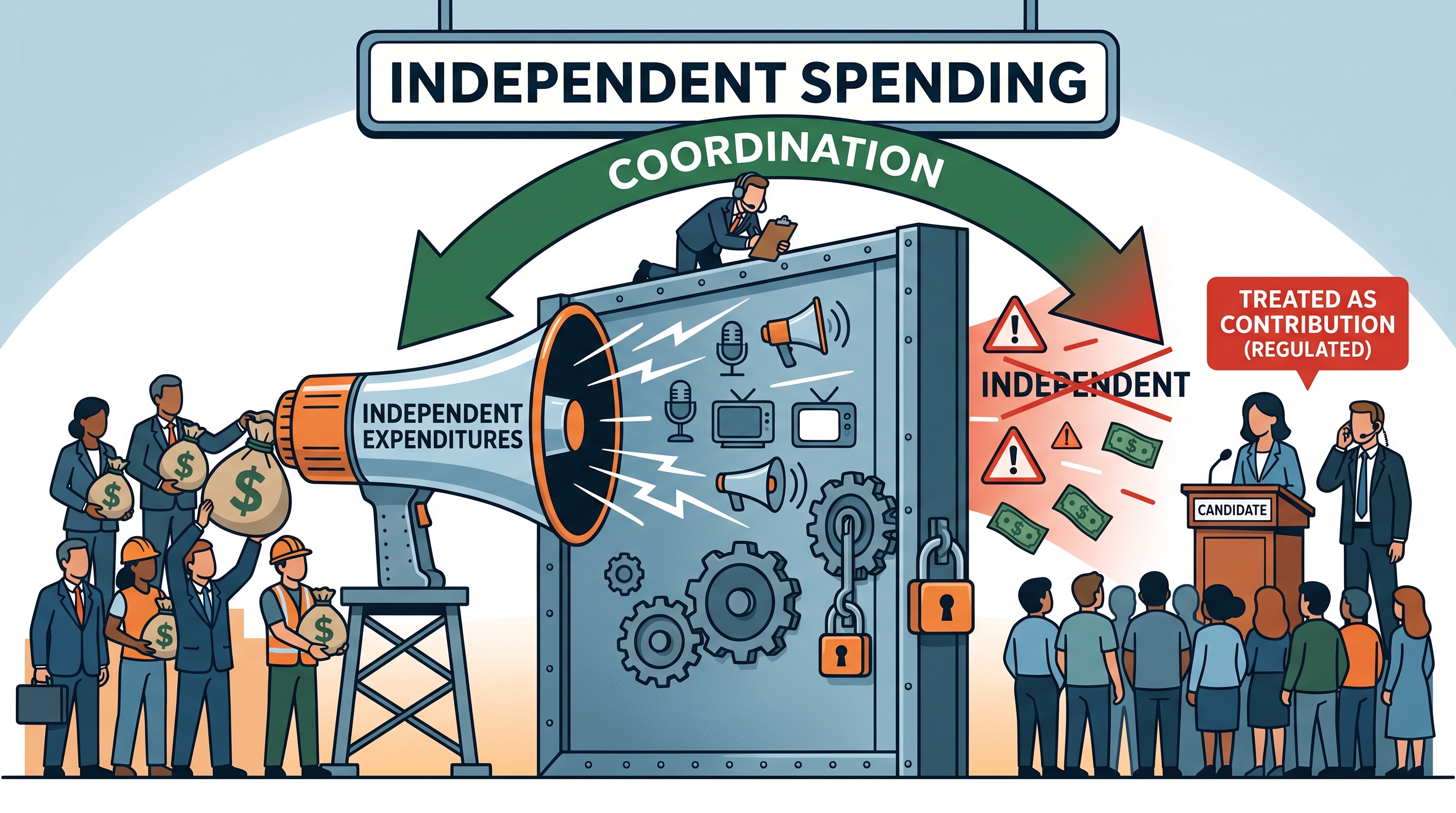
The second arrangement is constitutionally significant. If the organization coordinates its advertisement with Rivera’s campaign, the spending may be treated like an in-kind contribution. If it acts independently, the spending receives stronger First Amendment protection under modern campaign-finance doctrine.
Federal regulation and the Federal Election Commission
The Federal Election Commission, or FEC, is the federal agency responsible for administering and enforcing campaign-finance law. The Federal Election Campaign Act, or FECA, established the central federal framework for regulating contributions, requiring financial disclosure, and creating public-financing mechanisms.
The Bipartisan Campaign Reform Act of 2002, commonly called McCain-Feingold, attempted to limit the influence of unregulated “soft money” in federal elections. Soft money refers to funds that were not given directly to a specific candidate but could be used by political parties for activities affecting elections. The law also restricted certain election-related communications close to elections.
The regulatory challenge is persistent: when Congress closes one route for political spending, donors and organizations may search for another route. Money can move among candidate committees, party committees, political action committees, nonprofit organizations, and independent-expenditure groups.
PACs, Super PACs, and independent spending
A political action committee, or PAC, collects contributions and gives money to candidates or spends money to influence elections, subject to federal rules. A Super PAC may raise unlimited amounts from individuals, corporations, unions, and other organizations, but it may not contribute directly to candidates or coordinate its spending with their campaigns.
| Organization or activity | May contribute directly to a candidate? | May make independent expenditures? | Central limitation |
|---|---|---|---|
| Candidate campaign committee | Yes | Yes | Must follow contribution and disclosure rules |
| Traditional PAC | Yes, within limits | Yes | Contribution limits apply |
| Super PAC | No | Yes, without a spending cap | No coordination with candidates |
| Independent expenditure | Not itself an organization | Yes | Must remain independent |
This creates an important practical distinction. A Super PAC cannot hand Candidate Rivera a check for $500,000, but it can spend $500,000 on its own advertisement praising Rivera, provided the campaign does not direct or coordinate that spending.
Citizens United v. Federal Election Commission (2010)
In Citizens United v. Federal Election Commission (2010), the Supreme Court held that the government could not prohibit corporations and unions from making independent political expenditures. The decision treated independent political spending as a form of speech protected by the First Amendment.
The ruling did not allow corporations or unions to contribute unlimited money directly to candidates. Its key effect was to protect unlimited independent expenditures by organizations, helping create the legal environment in which Super PACs became powerful actors in elections.
Worked analysis: reading a campaign-finance graph
Suppose a graph shows the following independent expenditures in a House race:
- Year 1: $2 million
- Year 2: $8 million
- Year 3: $20 million
Using Skill 2.B — Describe the data presented in a graph, map, or visual representation, first state the pattern accurately: independent expenditures increased in every reported year, rising from $2 million to $20 million. Do not jump immediately to causation. The graph demonstrates a trend, but by itself it does not prove that Citizens United alone caused the increase; additional evidence would be needed to establish causation.
Misconception check
Misconception: “Citizens United allowed corporations to donate unlimited money directly to candidates.”
Correction: The decision protected independent expenditures by corporations and unions. Direct contributions to candidates remain subject to regulation. The legally decisive word is independent.
Retrieval check: A nonprofit spends $1 million supporting a presidential candidate after receiving advice from that candidate’s campaign. Is the spending independent? Explain why the coordination changes the legal analysis.
Answer: No. Coordination means the expenditure is not genuinely independent. It may therefore be treated as an in-kind contribution and regulated differently from spending made without campaign involvement.
Source Materials
- AP U.S. Government and Politics Course and Exam Description
- Learn More (.pdf)
- AP U.S. Government and Politics Course Overview
- AP U.S. Government and Politics Course at a Glance
- AP United States Government and Politics Course at a Glance Poster
- AP United States Government and Politics
- AP United States Government and Politics
- United States Government and Politics Sample Syllabus 1