From the free course AP United States Government and Politics on Lykke
Course Framework, Skills and Reasoning Processes
Key concepts: AP course framework · Course skills and reasoning processes · College-level course alignment · Instructional model · AP Course Audit · Maintaining political balance · AP Classroom resources · Progress monitoring and formative feedback · Question Bank practice · Teacher-directed curriculum design
The AP U.S. Government and Politics course treats government as a system of institutions, ideas, behaviors, and conflicts—not merely as a list of offices and constitutional clauses.
Course Framework, Skills and Reasoning Processes
The AP U.S. Government and Politics course treats government as a system of institutions, ideas, behaviors, and conflicts—not merely as a list of offices and constitutional clauses. Its central question is practical: How do Americans use political institutions and constitutional principles to make, challenge, and evaluate public policy?
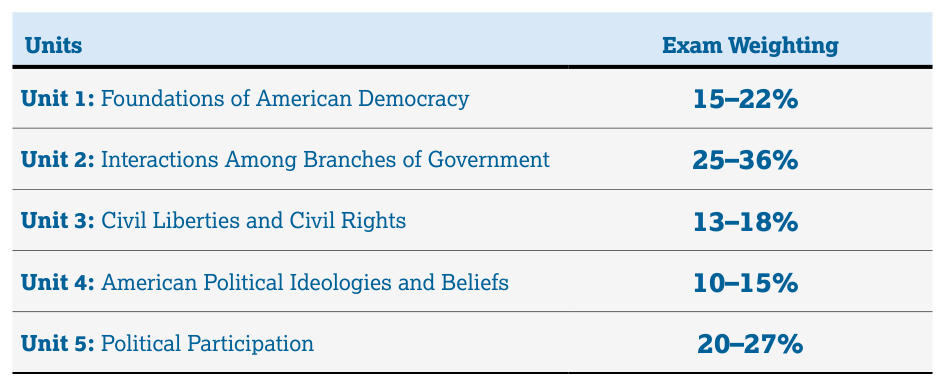
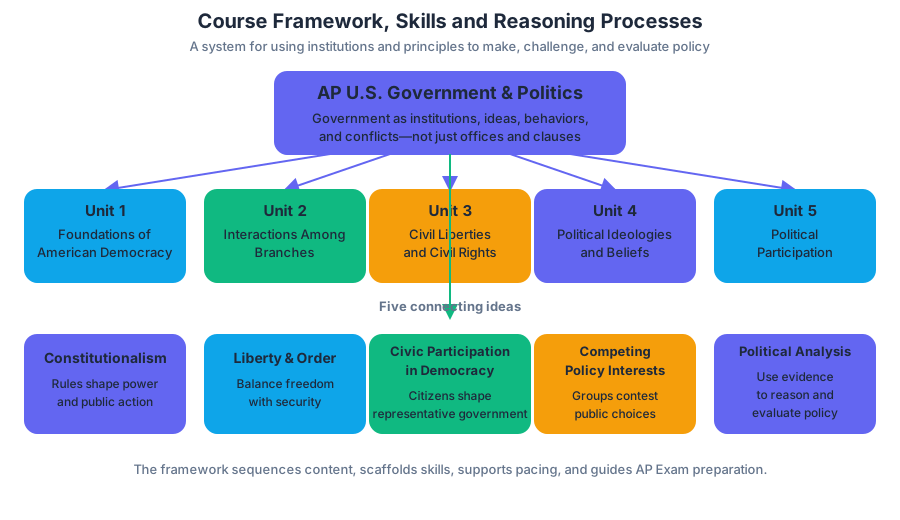
The course framework organizes that investigation into five units commonly found in introductory college courses:
- Unit 1: Foundations of American Democracy
- Unit 2: Interactions Among Branches of Government
- Unit 3: Civil Liberties and Civil Rights
- Unit 4: American Political Ideologies and Beliefs
- Unit 5: Political Participation
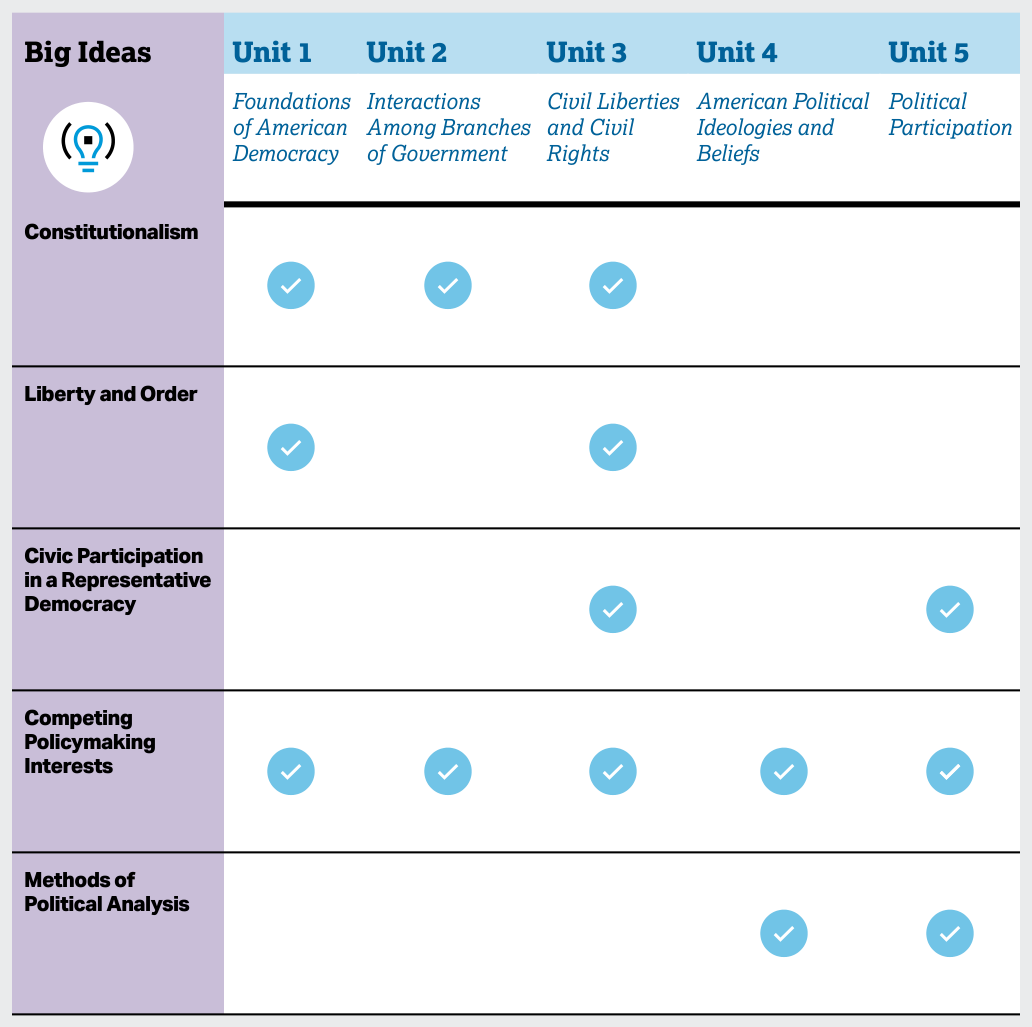
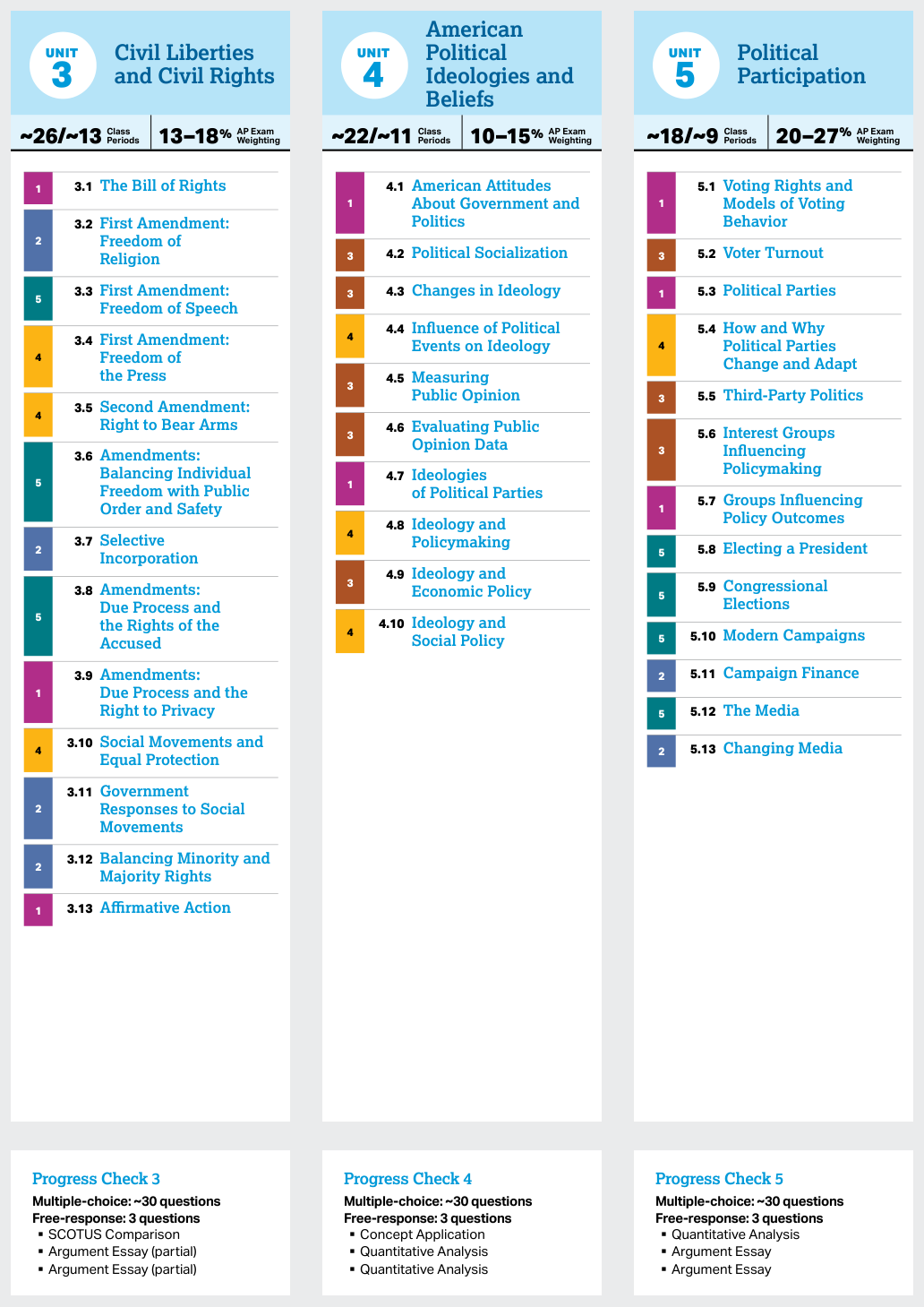
These units are connected by five broad ideas: Constitutionalism, Liberty and Order, Civic Participation in a Representative Democracy, Competing Policymaking Interests, and Methods of Political Analysis. The framework also organizes required content into numbered topics, sequences instruction, suggests pacing, scaffolds skills across units, and provides guidance for the AP Exam.
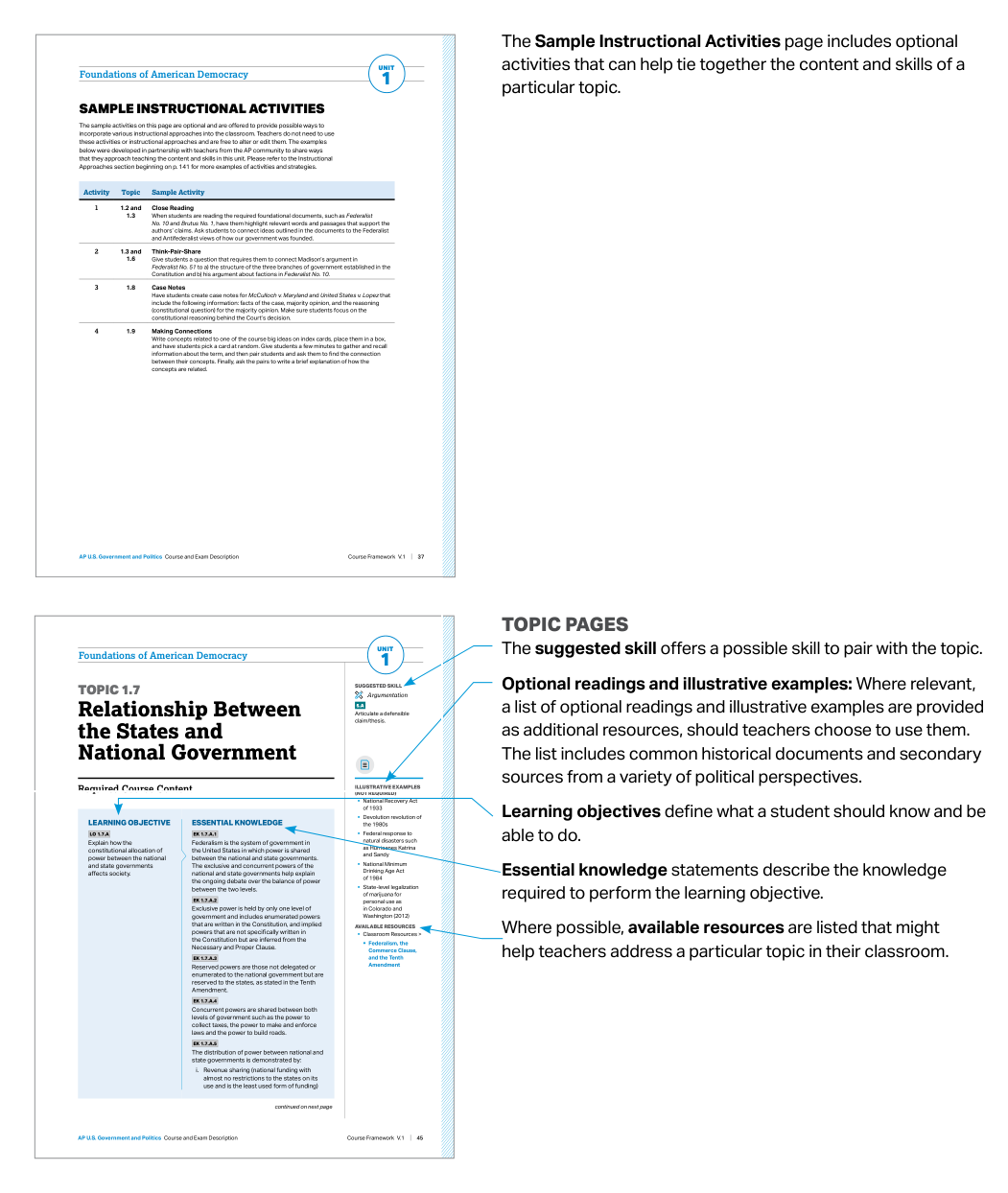
The framework is a map, not a script
A course framework is an organized outline of required understandings and skills. It identifies what students should be able to analyze, but it does not dictate every classroom activity, reading, simulation, or discussion. Knowledgeable teachers make instructional decisions based on their students, available time, current events, and the constitutional and political questions being studied.
Key distinction: The framework defines the destination and the analytical tools; teachers choose the most effective route.
Schools develop their own curricula, but those curricula must enable students to develop the content understandings and skills described in the framework. A strong course therefore combines foundational documents, Supreme Court decisions, data, visuals, multiple-perspective news sources, and applied political problems rather than treating government as memorization alone.
Five course skills and their reasoning processes
The five official course skills spiral through every unit. A student may first use Concept Application to explain federalism, then use Data Analysis to interpret public opinion about federalism, Source Analysis to examine a constitutional argument, SCOTUS Application to compare relevant Supreme Court reasoning, and Argumentation to defend a conclusion about national power.
| Official skill | What the reasoning requires | Typical evidence |
|---|---|---|
| Skill 1: Concept Application | Apply a political concept, institution, process, or behavior to a contextual situation | A scenario involving congressional procedure or federalism |
| Skill 2: SCOTUS Application | Apply and compare constitutional principles and Supreme Court decisions | A comparison of how two cases interpret individual rights |
| Skill 3: Data Analysis | Read quantitative, qualitative, and visual data; identify patterns; draw defensible conclusions | A graph of turnout, ideology, or approval ratings |
| Skill 4: Source Analysis | Analyze the argument, reasoning, perspective, and implications of a foundational or political text | A constitutional provision, court opinion, or political speech |
| Skill 5: Argumentation | Develop a defensible claim, support it with evidence, explain the reasoning, and address an opposing perspective | An essay evaluating a policy or constitutional controversy |
The exam assesses these skills through both sections. Multiple-choice questions may ask students to interpret a passage, graph, image, or political scenario. Free-response questions require students to apply concepts, analyze quantitative information, compare Supreme Court cases, and construct an argument using evidence and reasoning.
A useful reasoning sequence is:
Identify → Describe → Explain → Apply or Compare → Draw a conclusion → Support an argument.
For example, recognizing a filibuster is identification. Explaining that it can delay a vote is description. Connecting it to Senate rules and the difficulty of achieving cloture is explanation and application. Evaluating whether the procedure increases minority influence becomes argumentation.
College-level alignment and political balance
AP courses and exams emphasize challenging, research-based curricula aligned with college-level learning. In government and politics, that means analyzing institutions and political behavior with evidence, distinguishing constitutional principles from partisan claims, and recognizing that reasonable people may interpret the same policy problem differently.
The AP Course Audit is the review process through which AP teachers document that their courses meet required curricular expectations. College faculty review AP teachers’ course materials. For AP U.S. Government and Politics, the course must address the required framework, foundational documents, Supreme Court cases, analytical skills, and a political science research or applied civics project.
Political balance does not mean pretending every claim has equal factual support. It means presenting constitutional arguments, political perspectives, and relevant evidence fairly and allowing students to evaluate them using disciplined analysis rather than teacher advocacy. Multiple-perspective textbooks, primary sources, news sources, and research data help separate partisan position from evidence-based reasoning.
The instructional model: Plan → Teach → Assess
Effective instruction operates as a cycle rather than a one-way march through topics:
During Plan, teachers use the framework and unit guides to identify required content, skills, sequence, and pacing. During Teach, they build conceptual understanding through explanation, discussion, document analysis, cases, simulations, data work, and current political examples. During Assess, they use targeted evidence to decide what should be retaught, extended, or practiced next.
Topic Questions provide frequent checks while a topic is being taught. Progress Checks, assigned as homework or in-class work, help students and teachers evaluate performance at the end of a unit. Their purpose is diagnostic: students can see progress over time and identify content or skills needing improvement before the AP Exam.
Answer rationales provide question-level feedback by explaining why an answer is correct or incorrect. My Reports provide unit- and skill-level formative feedback, revealing patterns such as strong content knowledge but weak data interpretation. Teachers can then use the Question Bank, a searchable library of AP questions, to create custom practice assignments targeting those needs.
Retrieval check
A teacher notices that students can define political socialization but cannot interpret a graph showing generational differences in ideology. Which skill needs direct reinforcement: Concept Application, Data Analysis, Source Analysis, SCOTUS Application, or Argumentation? The best answer is Skill 3: Data Analysis, although a later argument may combine it with Argumentation. AP course and exam descriptions are updated periodically, so teachers and students should check AP Central for the most recent version.


Source Materials
- AP U.S. Government and Politics Course and Exam Description
- Learn More (.pdf)
- AP U.S. Government and Politics Course Overview
- AP U.S. Government and Politics Course at a Glance
- AP United States Government and Politics Course at a Glance Poster
- AP United States Government and Politics
- AP United States Government and Politics
- United States Government and Politics Sample Syllabus 1
- Figure — AP U.S. Government and Politics Course and Exam Description (p. 1)
- Figure — AP U.S. Government and Politics Course and Exam Description (p. 15)
- Course Framework V.1 |
- Figure — AP U.S. Government and Politics Course and Exam Description (p. 24)