From the free course AP United States Government and Politics on Lykke
2.11 Checks on the Judicial Branch
Key concepts: Checks and balances among the three branches of government · Checks on the judicial branch · Judicial review · Judicial activism · Judicial restraint · The debate over legislative authority versus an independent judiciary · Congressional powers to limit or check the judiciary · Federalist No. 78 and the role of the judiciary · The relationship between the Constitution, judicial decisions, and federal law · Required Supreme Court case analysis
An independent judiciary can restrain the elected branches—but the judiciary itself is not unlimited. The central constitutional question is therefore two-sided: How can courts prevent governmental overreach, and how can Congress and the president prevent courts from becoming the government’s final policymaker on…
2.11 Checks on the Judicial Branch
An independent judiciary can restrain the elected branches—but the judiciary itself is not unlimited. The central constitutional question is therefore two-sided: How can courts prevent governmental overreach, and how can Congress and the president prevent courts from becoming the government’s final policymaker on every issue?
Learning Objective LO 2.11.A: Explain how the other branches of government check the power of the judicial branch.
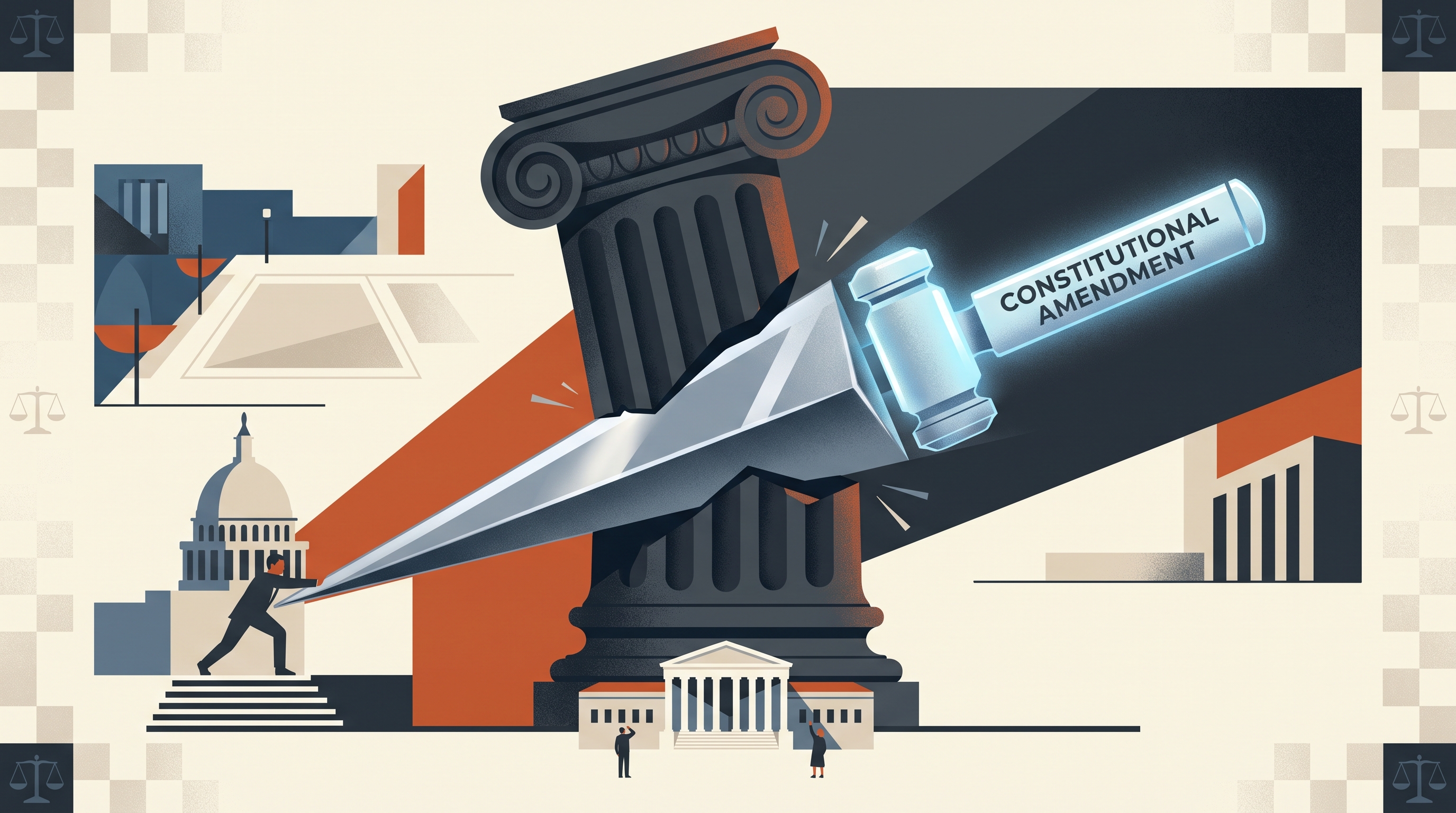
Essential Knowledge EK 2.11.A.1: The legislative and executive branches use constitutional powers—including appointments, legislation, and constitutional amendments—to limit or respond to judicial decisions.
Suggested skill: Skill 1: Concept Application.
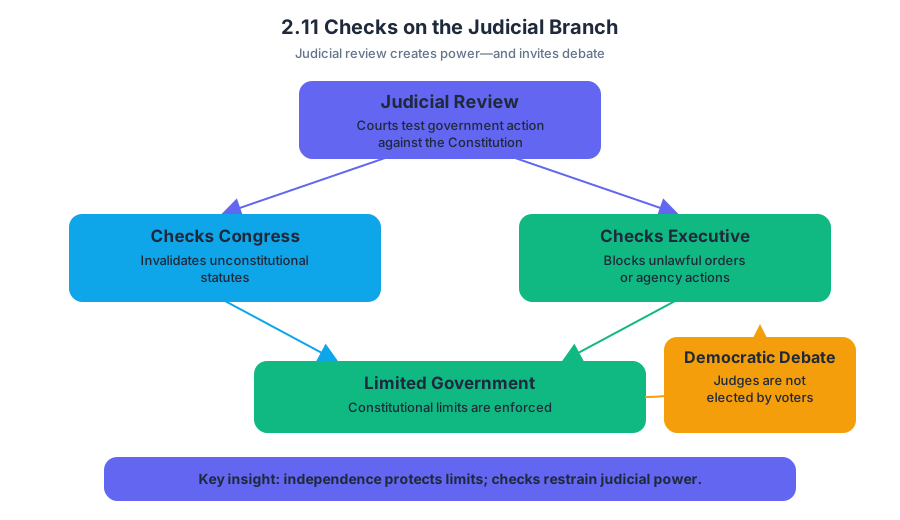
Judicial review creates power—and invites debate
Judicial review is the power of courts to determine whether a law or government action violates the Constitution. When a court invalidates an unconstitutional statute, it checks the legislative branch; when it blocks an executive order or administrative action, it checks the executive branch. This power helps enforce limited government, but it also raises a democratic problem: federal judges are not elected by voters.
Key insight: Judicial independence protects constitutional limits, while checks on the judiciary protect against unchecked judicial power.
Activism versus restraint
The debate over judicial power often uses two contrasting terms. Judicial activism asserts that judicial review permits courts to overturn laws or government actions when judges conclude that constitutional principles require intervention. Judicial restraint argues that judicial review should be constrained by current constitutional standards, established legal rules, and precedent—earlier judicial decisions that guide later cases.
These terms describe approaches to judging, not permanent labels for political parties or particular judges. A court may act assertively in one constitutional area and cautiously in another. The key comparison is how willing judges are to invalidate government action and depart from precedent.
| Approach | Main emphasis | Likely judicial behavior | Constitutional concern |
|---|---|---|---|
| Judicial activism | Active enforcement of constitutional principles | More willing to overturn laws, executive actions, or precedent | Courts may substitute judicial judgment for policymaking by elected officials |
| Judicial restraint | Deference to elected branches and established law | More likely to uphold laws unless a clear constitutional violation exists | Courts may fail to protect minority rights or prevent governmental overreach |
Named misconception check — “Activism always means liberal.” Not necessarily. “Activist” describes the willingness to use judicial review assertively; “restrained” describes reluctance to do so. Either approach can produce decisions associated with different ideological positions.
How the other branches check the courts
The judicial branch is part of a system of checks and balances, not a branch that operates without limits. Article I establishes congressional powers that matter here, while the president and Senate share authority over judicial appointments.
- Legislative overrides: Congress can respond to a judicial interpretation by passing a new statute that addresses the issue, provided the new law remains constitutional. Congress cannot simply vote to erase a constitutional ruling, but it can change the statutory basis of a case.
- The amendment process: A constitutional amendment can alter the legal rule that produced a judicial decision. The Sixteenth Amendment, which authorized a federal income tax, illustrates this mechanism after the Supreme Court had treated an income tax as unconstitutional.
- Appointment and confirmation: The president nominates federal judges, and the Senate confirms or rejects nominees. Over time, this allows elected officials to influence the judiciary’s composition and interpretive direction.
- Non-implementation or evasion: Executive officials may delay, narrow, or resist carrying out a decision, although such resistance can create a constitutional crisis and cannot lawfully nullify judicial authority.
- Jurisdiction stripping: Congress may attempt to restrict the kinds of cases federal courts can hear. Because jurisdictional limits implicate separation of powers and constitutional rights, this power is politically and legally contested.
The legislature or the independent judiciary?
The underlying disagreement is about which institution better preserves limited government. Supporters of an elected legislature argue that lawmakers are accountable to voters and can deliberate openly about public policy. Supporters of an independent judiciary argue that courts are better positioned to enforce constitutional boundaries when majorities or officials exceed their authority.
Federalist No. 78 is an assigned secondary source for analyzing this debate. Alexander Hamilton defended an independent judiciary and judicial review as safeguards against legislative violations of the Constitution. The argument is not that judges should govern generally; it is that courts must refuse to enforce laws that conflict with the higher authority of the Constitution.
A useful application is Swann v. Charlotte-Mecklenburg Board of Education (1970), which involved judicial enforcement of constitutional equality in public education. An activist interpretation sees strong judicial remedies as necessary when ordinary political institutions fail to correct constitutional violations. A restraint-oriented critique asks whether courts are exceeding their proper role by designing detailed policy solutions better left to elected institutions.
Worked concept application
Scenario: Congress proposes a constitutional amendment stating that federal courts may not hear challenges to a newly enacted federal income tax.
Reasoning: The amendment process is a check on the judiciary because it can change the constitutional rule governing a dispute. The jurisdiction restriction is a separate check because it attempts to limit the courts’ authority to hear the case. A strong answer distinguishes the two: the amendment changes what the Constitution permits, while jurisdiction stripping changes which disputes courts may decide.
Exam-ready conclusion: The example demonstrates that judicial review is powerful but embedded in a larger system of interbranch checks and balances.
Retrieval check: A Supreme Court invalidates a federal statute, and Congress responds by proposing a constitutional amendment that would authorize the statute’s policy. Which check is being used, and why is it stronger than simply passing the same statute again?
Source Materials
- AP U.S. Government and Politics Course and Exam Description
- Learn More (.pdf)
- AP U.S. Government and Politics Course Overview
- AP U.S. Government and Politics Course at a Glance
- AP United States Government and Politics Course at a Glance Poster
- AP United States Government and Politics
- AP United States Government and Politics
- United States Government and Politics Sample Syllabus 1