From the free course AP Biology on Lykke
8.7 Disruptions in Ecosystems
A disruption can change an ecosystem’s ability to provide the services on which organisms—and human societies—depend. A drought, wildfire, invasive species, pollutant, disease, or human land-use change may alter population sizes, energy flow, nutrient cycling, and the ecosystem services produced by the system.
Learning Objective 8.7.A: Explain how disruptions to ecosystems affect ecosystem services.
Essential Knowledge 8.7.A.1: Human activities can cause disruptions in ecosystems.
Essential Knowledge 8.7.A.2: Ecosystems can be disrupted by natural events.
Essential Knowledge 8.7.A.3: Ecosystem disruptions can affect biodiversity and ecosystem services.
What counts as an ecosystem disruption?
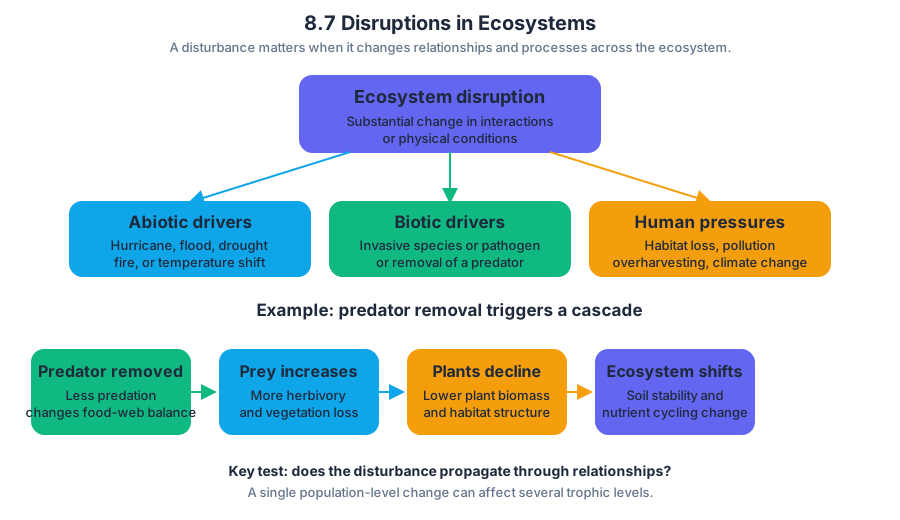
An ecosystem disruption is a change that substantially alters the interactions among organisms or between organisms and their physical environment. The disruption may be abiotic, such as a hurricane, flood, drought, fire, or temperature shift, or biotic, such as the introduction of an invasive species, the spread of a pathogen, or the removal of a major predator.
Human activities can intensify or introduce disruptions through habitat destruction, pollution, overharvesting, urbanization, and climate change. The key biological question is not simply whether one species declines; it is whether the disturbance changes relationships and processes throughout the ecosystem.
For example, removing a predator can allow its prey population to increase. The prey may then consume more vegetation, reducing plant biomass and changing soil stability, nutrient cycling, and habitat available to other organisms. One population-level change can therefore propagate through several trophic levels.
Ecosystem services: what ecosystems provide
Ecosystem services are benefits that organisms and ecosystems provide to other organisms, including humans. They depend on functioning biological interactions rather than on the presence of isolated species alone.
| Ecosystem service | Biological process supporting it | Possible disruption |
|---|---|---|
| Pollination | Animal movement transfers pollen among flowers | Decline of pollinators or habitat loss |
| Water purification | Wetlands, microbes, and plants remove or transform pollutants | Wetland drainage or chemical contamination |
| Carbon storage | Plants, soils, and aquatic systems capture and retain carbon | Deforestation, fire, or soil disturbance |
| Soil formation and retention | Decomposition, microbial activity, and plant roots build and stabilize soil | Vegetation removal or erosion |
| Fisheries | Reproduction, food webs, and habitat support fish populations | Overharvesting, warming, or habitat destruction |
A disruption can reduce a service directly or indirectly. If an insecticide lowers the abundance of bees, fewer flowers may be pollinated. Reduced pollination can lower seed and fruit production, which decreases food availability for other organisms and may reduce crop yields. The ecosystem service—pollination—has been damaged because a biological interaction was disrupted.
Worked example: wetland loss and water purification
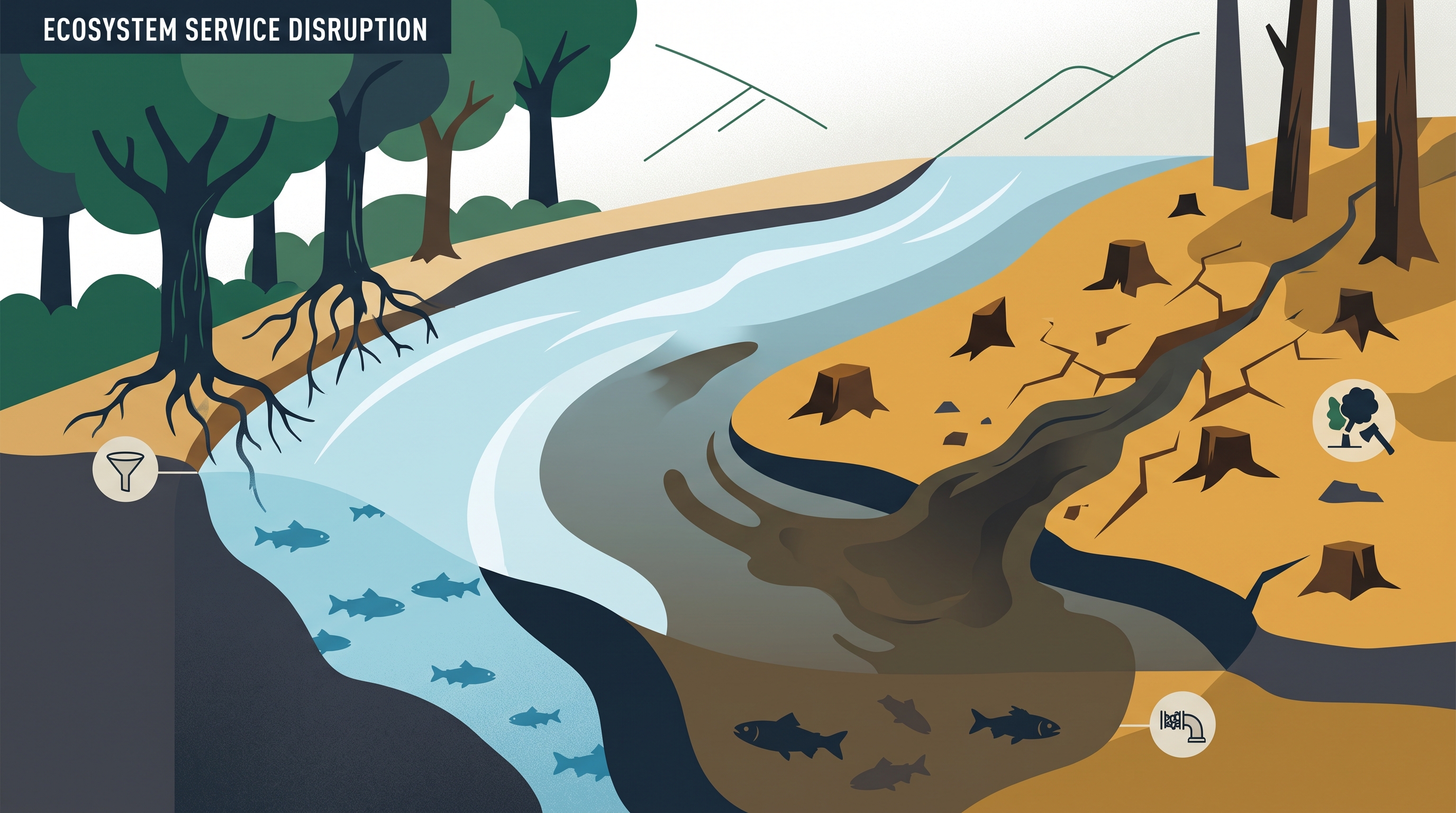
Imagine a wetland bordering a lake. Water flowing through the wetland slows down, sediments settle, plant roots absorb nutrients, and microbial communities transform or decompose some pollutants before the water reaches the lake.
Now suppose the wetland is drained for construction. The immediate change is habitat loss, but the consequences extend beyond the organisms living there:
- Less vegetation means less nutrient uptake.
- Faster water flow carries more sediment into the lake.
- Increased nutrient input can stimulate algal growth.
- Algal decomposition consumes dissolved oxygen.
- Low oxygen can stress or kill fish and aquatic invertebrates.
- Water purification and fisheries services both decline.
The claim is that wetland drainage reduces ecosystem services. The evidence would include increased nutrient or sediment concentration downstream, lower dissolved oxygen, and reduced abundance of aquatic organisms. The reasoning connects the evidence to wetland structure and function: removing plants, soils, and microbial habitats weakens nutrient removal and sediment retention.
Natural disruption does not mean “no ecological effect”
Natural disturbances such as fires, floods, storms, and droughts can also alter ecosystem services. A fire may temporarily reduce carbon storage and increase erosion, while a later recovery of vegetation may restore soil retention and carbon uptake. The effect depends on the disturbance’s intensity, duration, frequency, and the ecosystem’s ability to recover.
Misconception check — “Every disturbance permanently destroys an ecosystem.” Disturbance and recovery are not opposites. Some ecosystems are adapted to periodic disturbance, but a disturbance that is unusually intense, frequent, or combined with human pressure may prevent recovery and cause a lasting shift in ecosystem structure and services.
AP skills in this topic
This topic commonly engages Science Practice 1: Concept Explanation, when you explain how a disturbance changes populations, interactions, or services; Science Practice 2: Visual Representations, when you interpret a food web, nutrient-cycle diagram, or disturbance-response graph; Science Practice 4: Representing and Describing Data, when you graph service indicators such as dissolved oxygen or pollinator abundance; and Science Practice 6: Argumentation, when you make a claim supported by ecological evidence and reasoning.
Retrieval check: A forest is cleared beside a river, and downstream water contains more sediment while fish abundance falls. Identify one disrupted ecosystem service, name the biological process that normally supports it, and connect the two observations in a causal chain. A strong response could identify water purification or fisheries, explain that vegetation and soil normally retain sediment and support aquatic habitat, and link clearing to sedimentation and reduced fish survival.