From the free course AP Biology on Lykke
4.3 Signal Transduction Pathways
Key concepts: Signal transduction pathways · Signal reception and cellular responses · Protein modifications · Receptor proteins · G protein-coupled receptors (GPCRs) · Eukaryotic cells · Cell-surface receptors · Chemical messengers · Quorum sensing · Epinephrine stimulation
Receptor activation initiates a sequence of protein interactions and modifications that converts a chemical message into a specific cellular response. The receptor is not merely an antenna: its structure determines which intracellular pathway can begin and, therefore, which response the cell produces.
4.3 Signal Transduction Pathways
Receptor activation initiates a sequence of protein interactions and modifications that converts a chemical message into a specific cellular response. The receptor is not merely an antenna: its structure determines which intracellular pathway can begin and, therefore, which response the cell produces.
From chemical message to cellular response
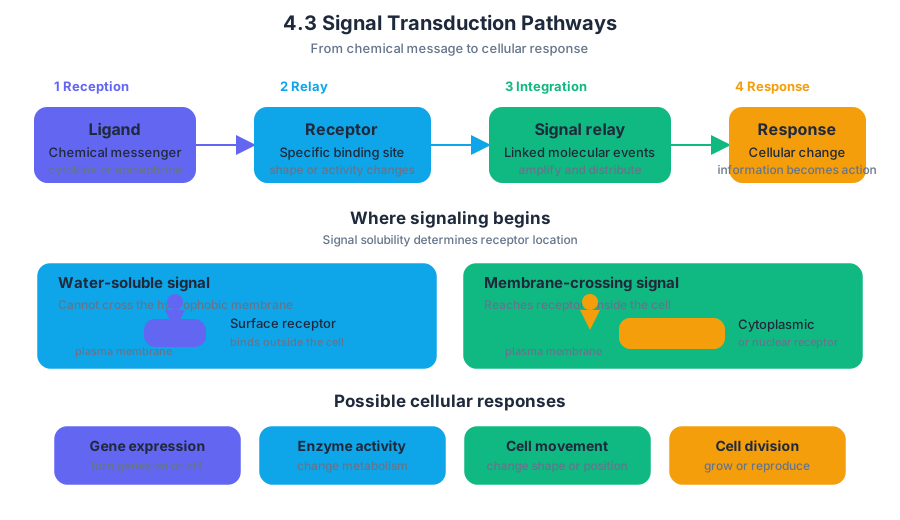
A signal transduction pathway is the linked series of molecular events that carries information from signal reception to a response inside a target cell. Signaling begins when a ligand, a chemical messenger, binds a receptor protein. A ligand may be a peptide or protein, such as a cytokine, or a small molecule, such as epinephrine.
4.3.A — Describe the different types of cellular responses elicited by a signal transduction pathway.
The ligand-binding domain of a receptor recognizes a particular chemical messenger. This specificity is comparable to a lock accepting only certain keys, but the analogy has a crucial limitation: binding does not simply “open” the receptor. It changes the receptor’s shape or activity, allowing the next component of the pathway to interact with it.
Receptors can occupy different locations in a eukaryotic cell. Receptors for water-soluble signals are often located on the cell surface because those signals cannot readily cross the hydrophobic interior of the plasma membrane. Other signaling molecules can cross the membrane and bind receptors in the cytoplasm or nucleus.
Protein modifications amplify and redirect signals
Many signal transduction pathways include protein modifications, chemical changes that alter a protein’s activity, location, stability, or interactions. One important modification is phosphorylation, the addition of a phosphate group to a protein. A kinase adds the phosphate; a phosphatase removes it. These changes can act like molecular switches, although their effects depend on the particular protein being modified.
In a phosphorylation cascade, one activated protein modifies another, which modifies another, and so on. This arrangement can amplify a small signal: one activated receptor may help activate many downstream molecules. The final response may include activating an enzyme, changing the cell’s shape, altering transport across the membrane, changing gene expression, or initiating programmed cell death called apoptosis.
Worked example — epinephrine and glycogen breakdown: Epinephrine binds a receptor on the surface of a mammalian liver cell. The activated receptor begins an intracellular pathway involving protein interactions and phosphorylation. The pathway activates proteins that promote glycogen breakdown, releasing glucose-related molecules that help the animal respond rapidly to an energy demand.
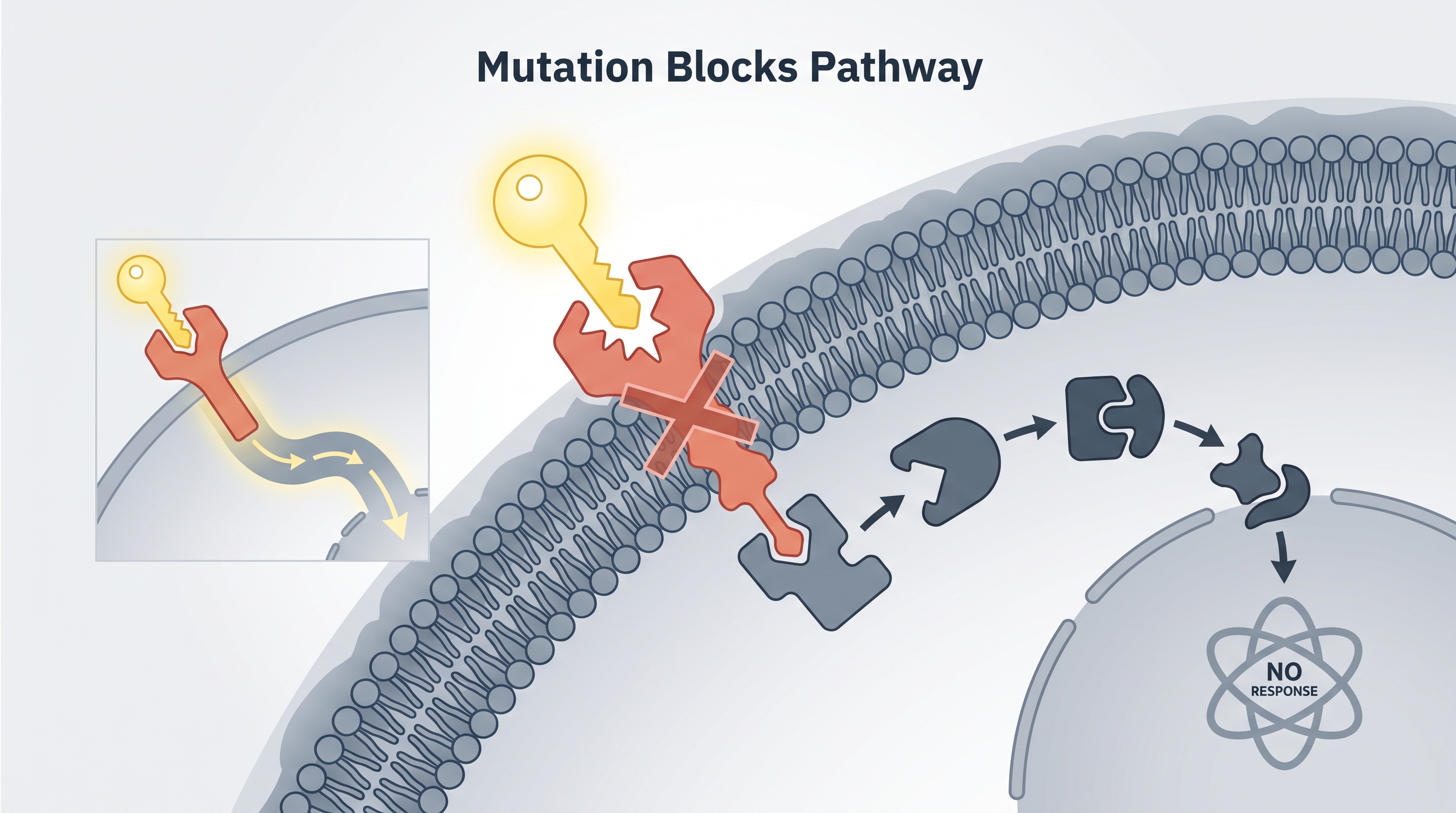
The important reasoning is causal: changing the receptor or any downstream component can change the final response. A mutation in a receptor’s ligand-binding domain may prevent epinephrine from binding. A mutation in a later protein may allow binding but block the phosphorylation cascade. The same external signal can therefore produce no response, a reduced response, or an abnormally persistent response.
Receptor proteins and pathway-specific outcomes
G protein-coupled receptors, or GPCRs, are a major example of receptor proteins in eukaryotes. When a ligand binds a GPCR, the receptor changes conformation and activates an associated G protein. The G protein then influences downstream proteins, which can modify additional targets and produce a cellular response.
A pathway’s outcome depends on the components present in the target cell. Two cell types may encounter the same chemical messenger but respond differently because they contain different receptors, G proteins, enzymes, transcription factors, or target genes. Signal transduction can therefore alter cell function and gene expression, potentially changing phenotype.
Population-level signaling
Signal transduction is not limited to animals. Microbes can release chemical messengers that nearby cells detect. In quorum sensing, the concentration of a messenger reflects population density: as more microbial cells release the signal, its concentration rises until it triggers a coordinated response, such as activating a group of genes.
EK 4.3.A.1: Signal transduction may result in changes in gene expression and cell function, which may alter phenotype or result in programmed cell death (apoptosis).
A common misconception is that a ligand directly performs the response—for example, that epinephrine itself “breaks down glycogen.” The ligand starts the pathway; receptor activation and downstream protein modifications carry out and regulate the response.
AP skill lens
This topic most directly uses Science Practice 1: Concept Explanation, when explaining how receptor activation produces a response; Science Practice 2: Visual Representations, when tracing a pathway diagram; Science Practice 3: Questions and Methods, when predicting the effect of blocking a receptor or kinase; and Science Practice 6: Argumentation, when using pathway evidence to justify how a mutation changes cellular behavior. 4.3.B — Explain how a change in the structure of any signaling molecule affects the activity of the signaling pathway. EK 4.3.B.1 emphasizes that mutations in any receptor domain or pathway component can alter downstream responses.
Retrieval check: A cell still contains its downstream enzymes, but a mutation changes the ligand-binding domain of its surface receptor. Predict the immediate effect on the pathway and explain why the final cellular response changes. A strong answer states that ligand binding is reduced or prevented, receptor activation falls, downstream protein modifications do not occur normally, and the response is reduced or absent.