From the free course AP Biology on Lykke
6.5 Regulation of Gene Expression
Key concepts: Gene expression and its regulation · Transcription · RNA processing and formation of mature mRNA · 5′ GTP cap and 3′ poly-A tail of mRNA · Alternative RNA splicing · Translation and protein assembly · Regulatory proteins binding DNA to block transcription · Differential gene expression · Viral gene expression and production of viral progeny · Changes in chromosome structure and genetic disorders
A cell can contain the same DNA as every other cell in an organism yet produce a completely different set of proteins. Gene regulation is the control of gene expression—the process by which information in DNA is used to produce RNA and, for protein-coding genes, proteins.
6.5 Regulation of Gene Expression
A cell can contain the same DNA as every other cell in an organism yet produce a completely different set of proteins. Gene regulation is the control of gene expression—the process by which information in DNA is used to produce RNA and, for protein-coding genes, proteins.
Key idea: Gene regulation results in differential gene expression, meaning that different cells or organisms express different genes, or express the same genes at different levels. These differences influence cell products, cell functions, and phenotype.
From DNA to a usable protein
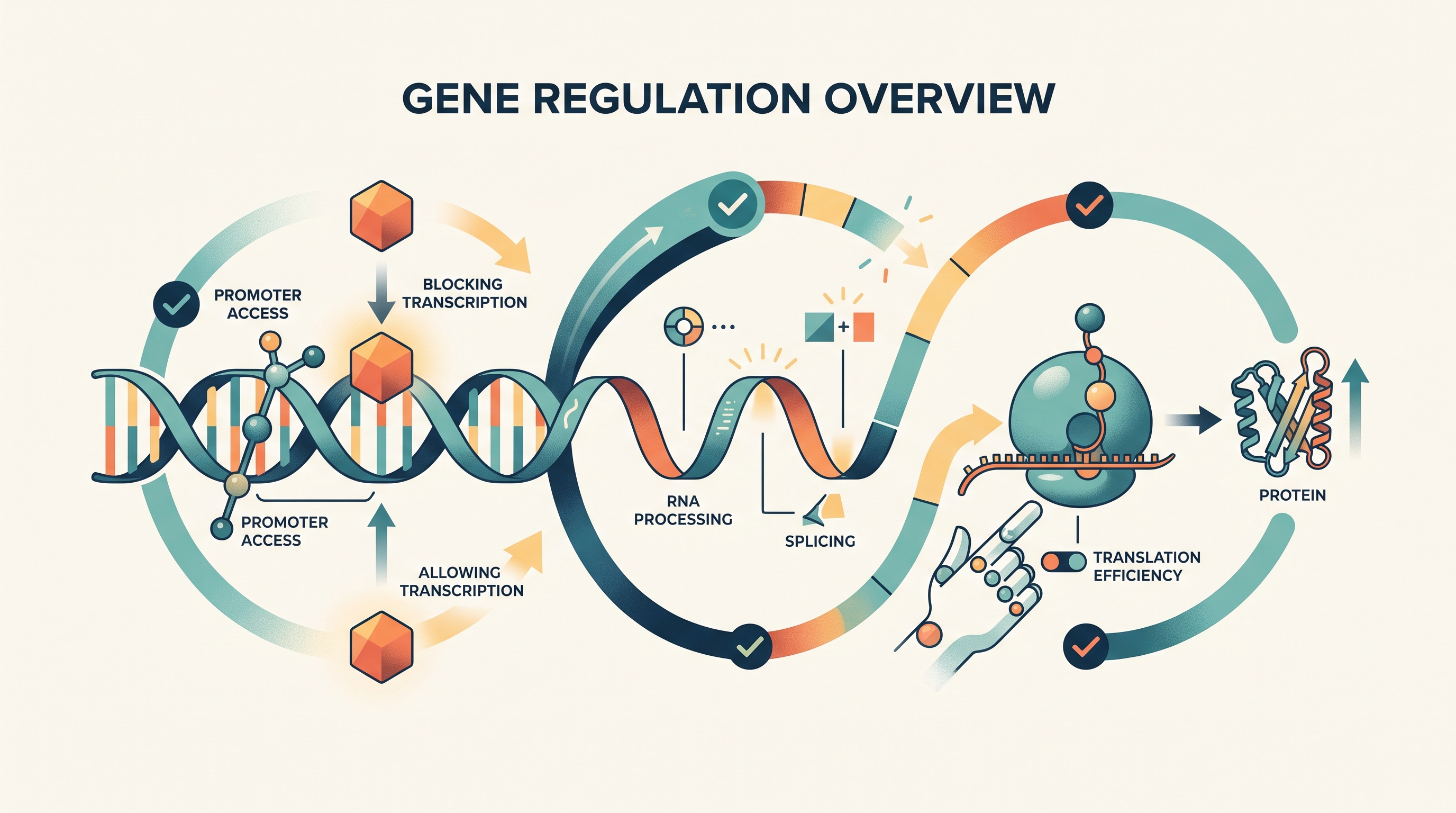
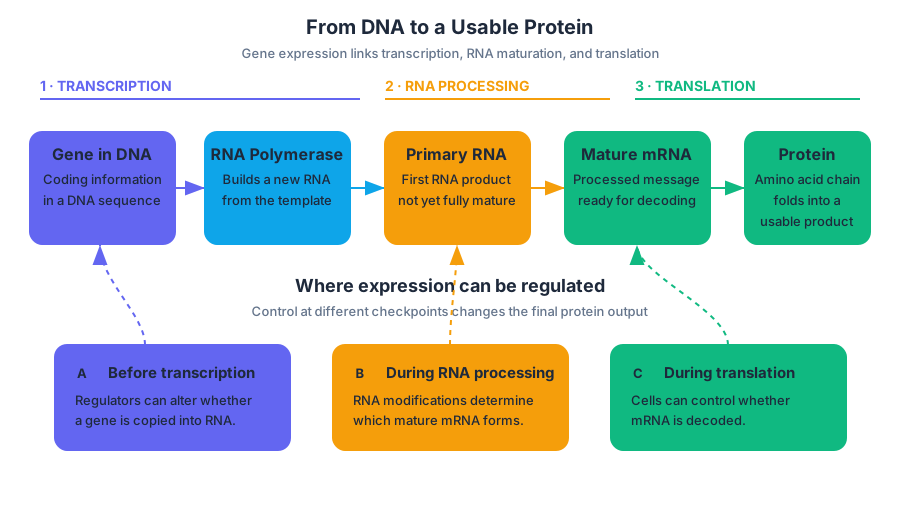
For a protein-coding gene, gene expression proceeds through two linked stages. Transcription produces a newly formed RNA molecule from DNA. Translation then uses the mature messenger RNA, or mRNA, to assemble a protein. Regulation can occur before transcription, during RNA processing, or by controlling whether the resulting mRNA is translated.
In eukaryotic cells, RNA polymerase synthesizes mRNA in the $5'$ to $3'$ direction while reading the template DNA strand in the $3'$ to $5'$ direction. The first RNA product is not yet fully mature: it undergoes enzyme-mediated modifications before it can function efficiently as an mRNA.
Maturation of eukaryotic mRNA
Two important modifications stabilize and prepare the transcript:
- A $5'$ GTP cap is added to the beginning of the RNA. It helps protect the RNA and supports recognition by the ribosome.
- A $3'$ poly-A tail is added to the opposite end. It increases mRNA stability, helping the transcript persist long enough to be used.
Alternative RNA splicing provides another layer of regulation. During processing, different combinations of RNA segments can be joined to form different mature mRNA molecules from the same initial RNA transcript. Those mRNAs can direct the assembly of different protein products.
CED traceability: 6.3.A.3 requires the directionality of RNA synthesis: RNA polymerase reads template DNA $3'$ to $5'$ and synthesizes mRNA $5'$ to $3'$. 6.3.A.4 identifies eukaryotic mRNA modifications, including the stabilizing poly-A tail and the GTP cap involved in ribosomal recognition.
Regulation at the DNA level
A gene is not automatically transcribed simply because it is present. Promoter DNA is a region where RNA polymerase and transcription factors bind to initiate transcription. Enhancer DNA can also bind regulatory proteins and influence transcription; these sequences may lie upstream or downstream of the transcription start site.
Some transcription factors promote transcription, while negative regulatory molecules inhibit gene expression by binding to DNA and blocking transcription. If the blocking protein prevents RNA polymerase from initiating transcription, little or no RNA is produced, and the downstream protein product is reduced or absent.
This mechanism explains how environmental signals or cellular conditions can change phenotype without changing the DNA sequence itself. Small RNA molecules can also regulate gene expression by affecting the stability or use of RNA transcripts.
Worked example: one transcript, different products
Imagine a eukaryotic gene whose initial RNA transcript contains coding segments $A$, $B$, and $C$.
- RNA polymerase transcribes the gene into one initial RNA molecule.
- The transcript receives a $5'$ GTP cap and a $3'$ poly-A tail.
- One cell splices the RNA as $A$–$B$–$C$.
- Another cell splices it as $A$–$C$.
- The two mature mRNAs are translated into proteins with different amino acid sequences and potentially different functions.
The DNA has not changed. The difference arises because gene expression was regulated at the RNA-processing stage. This is why “same genome” does not mean “same proteome,” the complete collection of proteins produced by a cell.
Viral expression and chromosome changes
Viral genetic material can also be expressed and translated. Once inside a host cell, viral nucleic acid can direct production of proteins and other components needed to assemble new viral progeny. The host cell’s transcriptional and translational machinery may therefore become a factory for viral replication.
Changes in chromosome structure can alter gene expression by changing gene dosage, disrupting a gene, or moving a gene near different regulatory DNA. Such changes can lead to genetic disorders. The AP scope does not require knowledge of specific disorders caused by changes in chromosome number.
Scope boundary: Detailed mechanisms involving DNA polymerase, DNA ligase, helicase, and topoisomerase are beyond the AP Exam scope for this topic. Focus instead on the regulatory logic: DNA sequence and chromosome structure influence transcription, RNA processing determines which mature mRNA exists, and translation produces the protein.
Misconception check
Misconception: “Gene regulation means the DNA is permanently changed.”
Regulation commonly changes whether a gene is transcribed, how its RNA is processed, or whether its mRNA is used. These changes can alter phenotype without altering the gene’s nucleotide sequence.
AP Science Practices in action
- Science Practice 1: Concept Explanation — Explain how promoter binding, negative regulation, RNA processing, and translation produce differential gene expression.
- Science Practice 2: Visual Representations — Trace a diagram from DNA to initial RNA to mature mRNA to protein, identifying where regulation occurs.
- Science Practice 3: Questions and Methods — Predict how blocking a promoter, removing the GTP cap, or changing splicing would affect mRNA and protein production.
- Science Practice 4: Representing and Describing Data — Use mRNA or protein abundance data to identify whether a treatment increased or decreased gene expression.
- Science Practice 6: Argumentation — Support a claim about gene regulation with evidence, such as transcription levels, mature mRNA patterns, or protein concentration.
Retrieval check: A cell produces less of a protein after a regulatory protein binds near the gene’s promoter. What is the most direct explanation? The regulatory protein acts as a negative regulator, blocks transcription initiation, reduces the amount of newly formed RNA, and consequently reduces the amount of mature mRNA available for translation.