From the free course AP Biology on Lykke
6.6 Gene Expression and Cell Specialization
Key concepts: Gene expression and its regulation · Cell specialization through differential gene expression · Gene regulation’s effects on cell products and functions · Epigenetic regulation by reversible DNA or histone modifications · Transcription factors and sequential gene expression during development · Small RNA molecules as regulators of gene expression · DNA and RNA structure and roles in gene expression · Using fluorescence markers such as GFP to measure gene expression
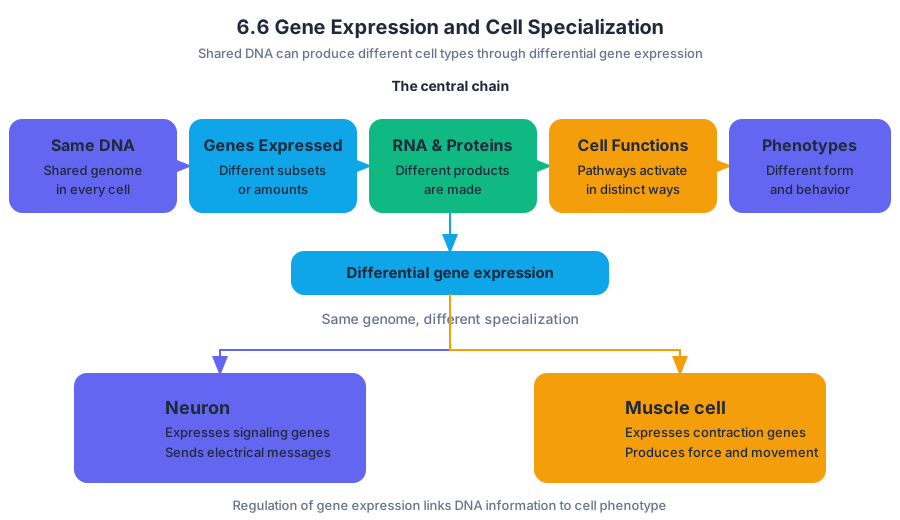
A neuron and a muscle cell can contain the same genome yet perform radically different jobs because they express different genes, make different products, and activate different cellular pathways.
6.6 Gene Expression and Cell Specialization
A neuron and a muscle cell can contain the same genome yet perform radically different jobs because they express different genes, make different products, and activate different cellular pathways. Differential gene expression means that cells use different subsets of the shared genetic information, or produce different amounts of particular gene products.
Learning Objective 6.6.B: Explain the connection between the regulation of gene expression and phenotypic differences in cells and organisms.
The central chain is:
$$ \text{same DNA} \rightarrow \text{different genes expressed} \rightarrow \text{different RNA and proteins} \rightarrow \text{different cell functions} \rightarrow \text{different phenotypes} $$
From one genome to many cell types
A cell’s phenotype is not determined simply by which genes it possesses. It depends on which genes are expressed and the levels at which they are expressed. For example, a muscle cell produces proteins that support contraction, whereas a neuron produces proteins that support electrical signaling and communication. Their differences arise because gene regulation directs each cell toward a particular set of products.
Gene regulation is the control of when, where, and how strongly genes are expressed. In this topic, the important consequence is not merely that a gene is “on” or “off”: changing expression can alter the amount of a cell product, the cell’s function, and the organism’s observable phenotype. This is 6.6.B.1: Gene regulation results in differential gene expression and influences cell products and functions.
Key distinction: Cell specialization does not usually require different DNA sequences in every cell. It requires different patterns of gene expression.
Development as a sequence of decisions
During development, one activated gene can produce a transcription factor—a protein that influences whether other genes are transcribed. That second wave of gene expression can activate additional transcription factors, producing a sequence of increasingly specialized cellular states.
$$ \text{transcription factor}_1 \rightarrow \text{gene set}_2 \rightarrow \text{transcription factor}_2 \rightarrow \text{gene set}_3 $$
This sequential process explains how a developing cell can acquire a stable function rather than switching randomly among cell types. The resulting products determine what the cell can do: a change in gene expression may alter receptors, enzymes, structural proteins, or signaling molecules. Because these products participate in pathways, an early expression change can also alter downstream signal transduction, changing how the cell responds to later signals.
Epigenetic control: adjustable access to genes
Epigenetic changes are reversible modifications of DNA or histones—the proteins associated with DNA—that influence whether genes are accessible for expression. These changes do not need to alter the DNA sequence itself. Instead, they can help maintain different expression patterns in specialized cells, allowing a liver cell and a neuron to preserve distinct identities while carrying the same genetic information.
The word reversible matters. If an epigenetic state changes, the expression of a gene may increase or decrease, which can change the cell products and functions produced from that gene. Epigenetic regulation therefore connects molecular control with phenotype without requiring a new DNA sequence.
RNA is both information and regulation
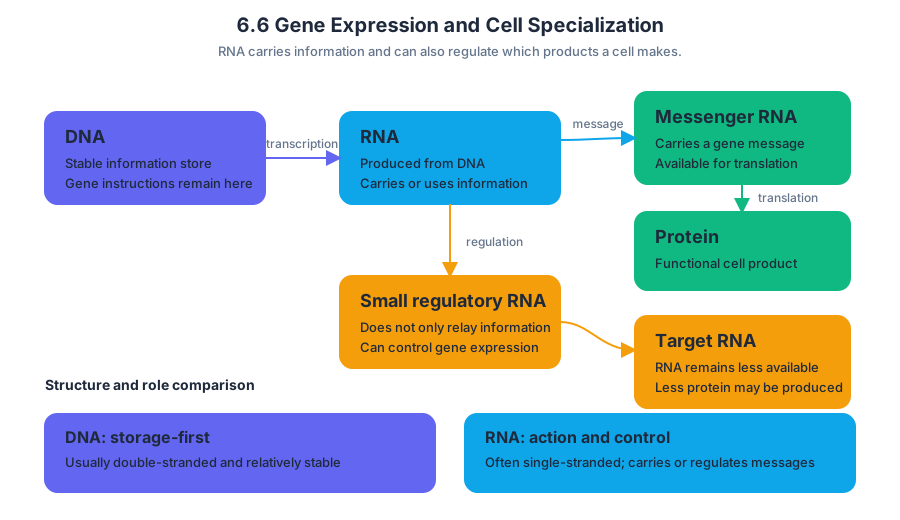
Gene expression involves both major nucleic acids. DNA is the relatively stable information-storage molecule, while RNA is produced from DNA and can carry or use that information during gene expression. Their different structures and roles make it possible for information to move from stored genetic instructions to functional products.
Not all RNA serves only as an intermediate. Certain small RNA molecules have roles in regulating gene expression, which is the required idea in 6.6.B.2. Small RNAs can influence whether particular RNA molecules remain available for producing protein, adding another layer of control over which products a cell makes.
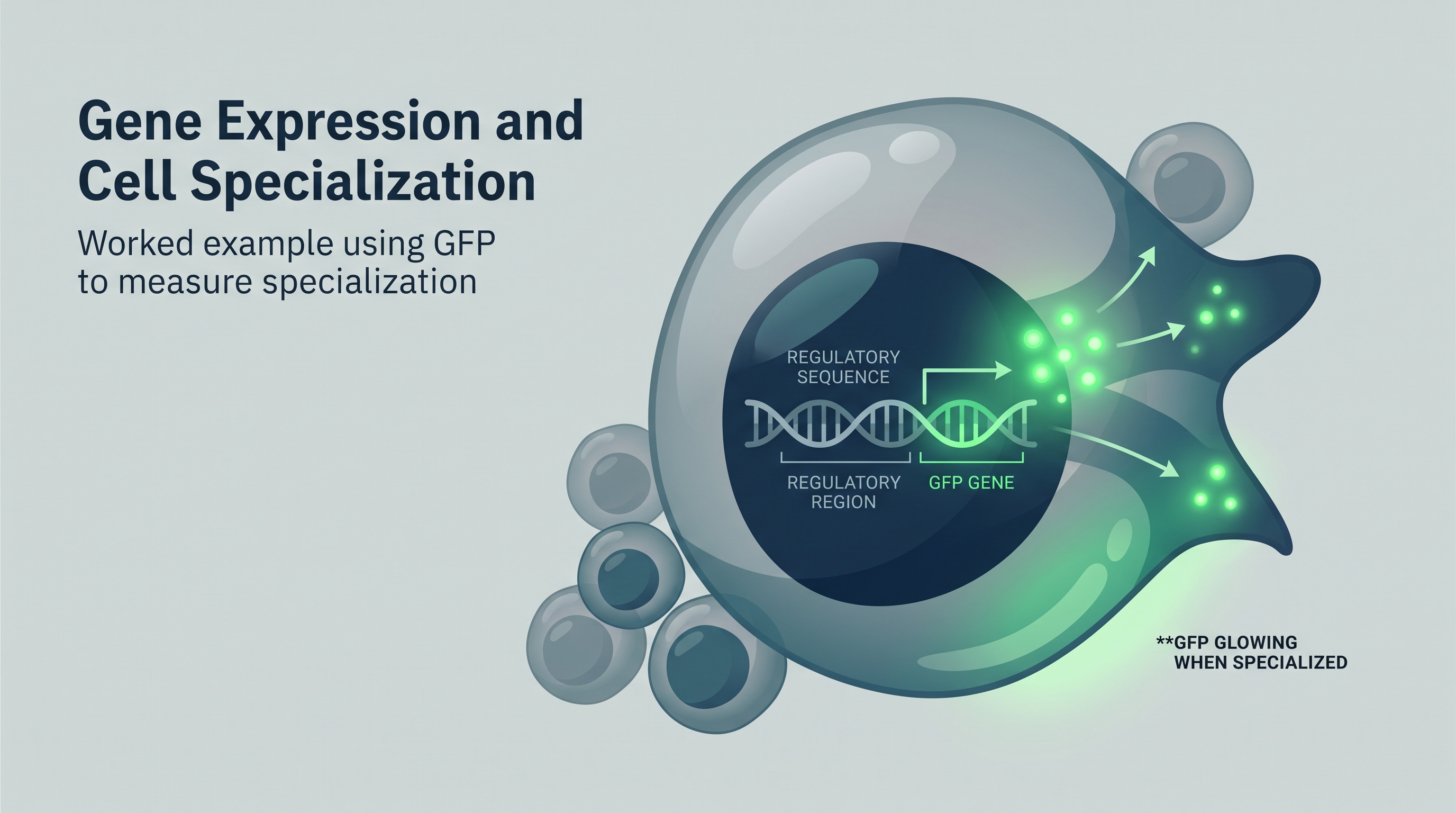
Worked example: measuring specialization with GFP
Suppose researchers attach a gene-regulatory sequence to a gene encoding green fluorescent protein, or GFP. When the regulatory sequence is active, the cell produces GFP and glows; when it is inactive, the cell remains nonfluorescent.
Reasoning: Cells with fluorescence are expressing the linked gene-regulatory sequence. If fluorescence appears only in one developing cell population, that population is using a different gene-expression pattern from the others. If fluorescence becomes brighter over time, the data support increased expression rather than merely the presence of the gene. Researchers can therefore use GFP to measure gene expression directly and connect expression patterns to cell identity or behavior.
Common misconception check
Misconception: “A specialized cell has only the genes needed for its job.” Most specialized cells retain the organism’s genome; they differ because gene regulation determines which genes are expressed and at what levels. A second misconception is that every gene-expression change immediately changes an organism’s visible appearance. The effect depends on the product involved, its amount, and its position in downstream cellular pathways.
Retrieval check
A developing cell begins producing a new transcription factor, then later produces a tissue-specific protein and gains a new function. What best explains the sequence?
Answer: The transcription factor initiated sequential gene expression. The later tissue-specific protein changed the cell’s products and function, producing specialization through differential gene expression. This reasoning applies Science Practice 6.B, Argumentation, because the claim is supported by biological evidence linking transcription factors, gene expression, cell products, and phenotype.