From the free course AP Biology on Lykke
3.1 Enzymes
Key concepts: Enzymes as biological catalysts · Lowering activation energy · Enzyme active sites and substrate specificity · Protein shape and enzyme function · Denaturation and disruption of enzymatic activity · Abiotic and biotic factors affecting enzyme activity · Temperature effects on enzymatic reactions · Enzyme concentration effects on enzymatic reactions · Peroxidase activity assays
A raw potato can turn a colorless peroxide solution visibly darker because peroxidase, an enzyme, accelerates the reaction. The enzyme does not supply energy or become the product; it provides a lower-energy route from reactants to products.
3.1 Enzymes
A raw potato can turn a colorless peroxide solution visibly darker because peroxidase, an enzyme, accelerates the reaction. The enzyme does not supply energy or become the product; it provides a lower-energy route from reactants to products.
Catalysts and activation energy
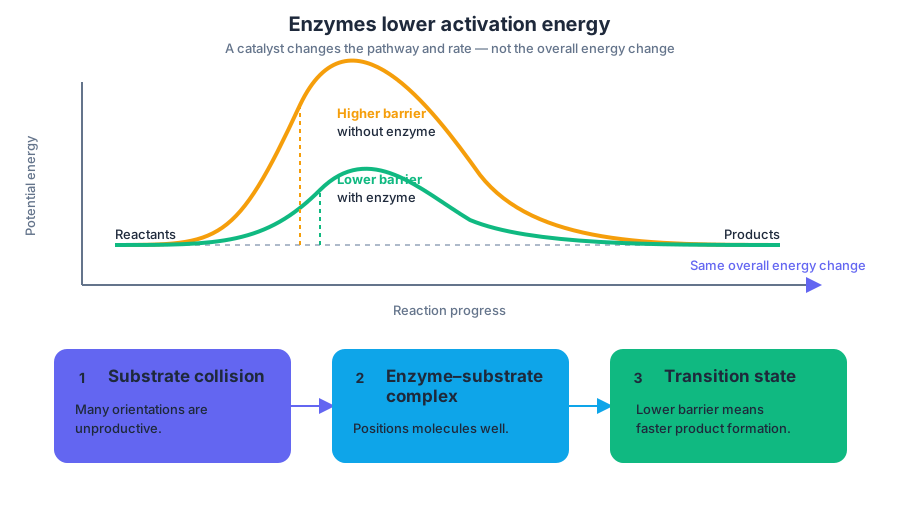
A catalyst is a substance that increases the rate of a chemical reaction without being consumed overall. Enzymes are biological catalysts. They speed reactions by lowering the activation energy, the minimum energy needed for reactant molecules to reach the unstable transitional arrangement from which products can form.
Without an enzyme, substrate molecules may collide in many unproductive orientations. An enzyme binds particular substrate molecules and forms an enzyme–substrate complex, positioning them so that the transition state is easier to reach. The enzyme changes the pathway and reaction rate, but it does not change the overall energy difference between reactants and products.
A useful analogy is a mountain pass: reactants and products are on opposite sides of the same mountain, but an enzyme creates a lower pass through the mountain. The starting and ending elevations remain the same; only the barrier between them is reduced.
Active sites and substrate specificity
An enzyme’s active site is the region where substrate molecules bind and the reaction is facilitated. Its three-dimensional shape, chemical properties, and arrangement of amino acid side chains selectively allow certain substrates to bind. This selectivity is called substrate specificity.
The active site is not merely a rigid hole into which any molecule of the right size fits. Binding depends on complementary shape and chemical interactions. Once the substrate binds, small changes in the enzyme’s shape can improve the fit and help strain or orient chemical bonds in the substrate.
Key distinction: An enzyme’s specificity determines which substrate can bind; catalytic activity determines how the bound substrate is converted into product.
Misconception check — “Enzymes make impossible reactions possible.” Enzymes accelerate reactions that are chemically possible under the conditions. They lower activation energy; they do not violate conservation of energy or guarantee that every collision produces product.
Protein shape determines function
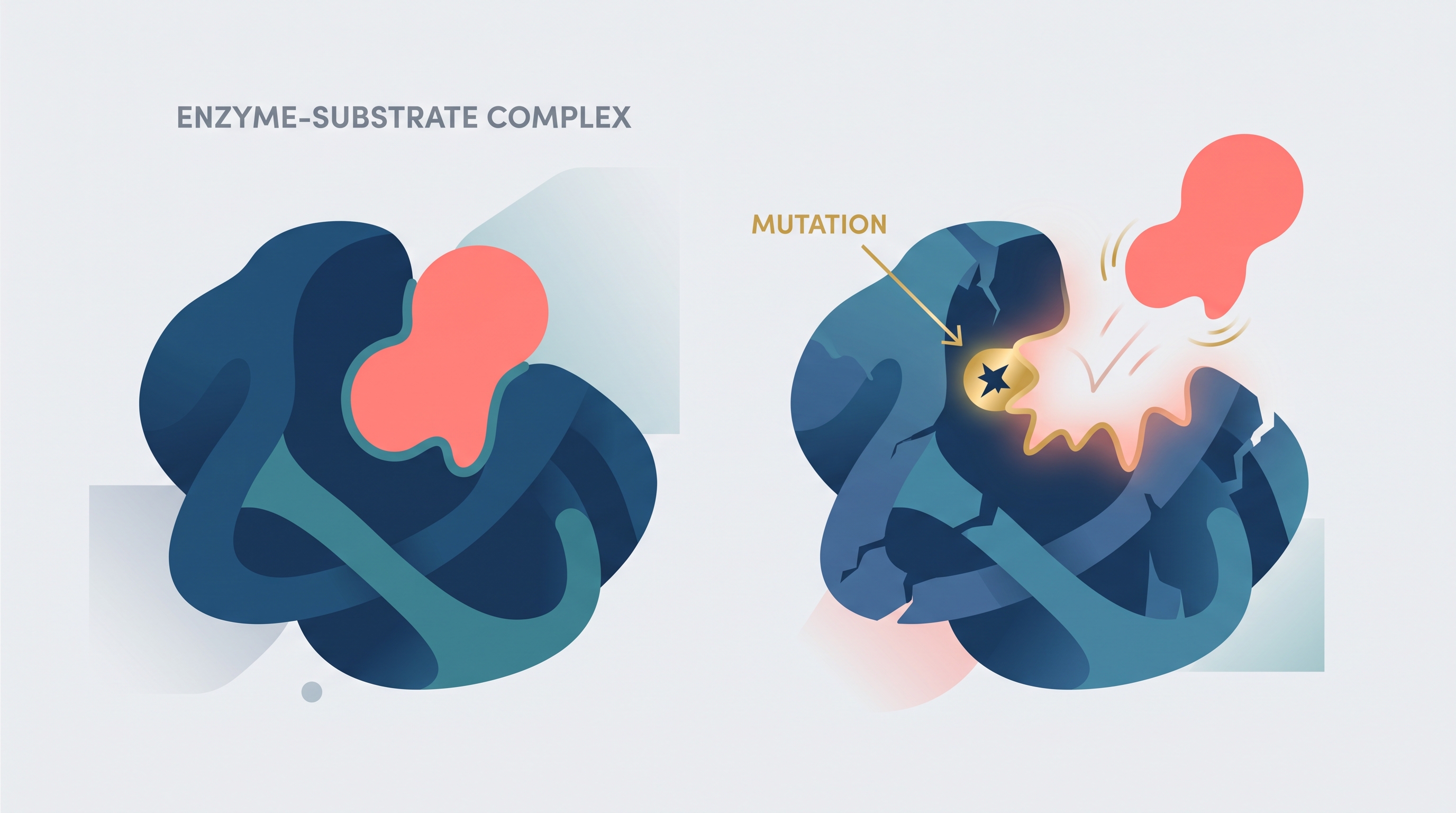
Because an enzyme is a protein, its function depends on its folded shape. If the protein’s structure changes, the active site can change as well. Denaturation is the disruption of a protein’s shape, often severe enough to destroy its function. A denatured enzyme may still contain the same amino acid sequence, but its active site may no longer bind the substrate correctly.
This explains why an enzyme can lose activity when its structure is disrupted. The immediate problem is not that the substrate disappears; it is that the enzyme–substrate complex can no longer form effectively.
Worked investigation: peroxidase activity
Suppose a student asks: How does enzyme concentration affect the rate of peroxidase activity? The student prepares identical reaction mixtures, changes only the amount of peroxidase, and observes the color produced after the same time interval.
The reasoning proceeds as follows:
- Independent variable: peroxidase concentration.
- Dependent variable: reaction rate, estimated from color intensity over a fixed time.
- Controlled variables: substrate concentration, temperature, pH, reaction volume, mixing, observation time, and light conditions.
- Prediction: with sufficient substrate, increasing enzyme concentration should increase the reaction rate because more active sites are available.
- Interpretation: darker color in the same time indicates more product formation and therefore a higher reaction rate.
A basic assay can also test temperature by keeping enzyme and substrate concentrations constant while varying temperature. A color palette can help compare peroxidase activity across treatments, but a quantitative measurement—such as color intensity recorded consistently—supports stronger comparisons than visual judgment alone.
The rate can be represented as product formed per unit time, such as $\Delta[\text{product}]/\Delta t$. Replicate trials are important because a single color difference might result from uneven mixing, inaccurate volumes, or differences in sample preparation rather than from the tested factor.
AP Biology skill connection
This investigation specifically uses Science Practice 3: Questions and Methods, especially 3.A Identify or pose a testable question, 3.B State a scientific hypothesis, and 3.C Identify experimental procedures. It also uses Science Practice 4: Representing and Describing Data—4.A Construct data representations, 4.B Describe data, and 4.C Identify patterns or relationships—to compare reaction rates. A defensible conclusion uses Science Practice 6: Argumentation, including 6.A Make a scientific claim and 6.B Support a claim with evidence.
For example: “Higher peroxidase concentration increased the reaction rate” is a claim. The evidence must identify the observed color or measured product differences, while the reasoning connects those differences to the greater number of available active sites. The conclusion should say whether the results support or contradict the hypothesis, not claim proof from one investigation.
Retrieval check
A mutation changes one amino acid in an enzyme, and the enzyme no longer converts its substrate efficiently. What is the most direct explanation? The amino acid change altered the protein’s three-dimensional shape or chemical properties, disrupting the active site and reducing formation of the enzyme–substrate complex.
Source Materials
- Ap Biology Course And Exam Description
- Ap Biology Course Overview
- Ap Biology Course At A Glance
- Ap Biology Equations And Formulas Sheet
- Chapter 3 Quantitative Skills In Ap Sciences
- Ap Biology Teacher Lab Manual Effective Fall 2019
- Updates 2025 26
- AP Biology Course-AP Central-College Board
- AP Biology-AP Students
- Biology of AP Courses-OpenStax
- AP Biology-Acellus
- AP/College Biology