From the free course AP Biology on Lykke
1.1 Structure of Water and Hydrogen Bonding
Key concepts: Water molecules are polar · Polar covalent bonds between hydrogen and oxygen · Hydrogen bonding between water molecules · Hydrogen bonding within biological molecules · Water’s properties support living systems · High specific heat capacity · Maintenance of homeostatic body temperature · High heat of vaporization
A water molecule can behave like a tiny electrical magnet: one side is slightly negative, the other slightly positive. That uneven charge distribution explains why water molecules cling to one another, why sweat cools the body, and why aquatic environments resist sudden temperature changes.
1.1 Structure of Water and Hydrogen Bonding
A water molecule can behave like a tiny electrical magnet: one side is slightly negative, the other slightly positive. That uneven charge distribution explains why water molecules cling to one another, why sweat cools the body, and why aquatic environments resist sudden temperature changes.
Learning Objective 1.1.A: Explain how the properties of water that result from its polarity and hydrogen bonding affect its biological function.
Polarity begins with polar covalent bonds
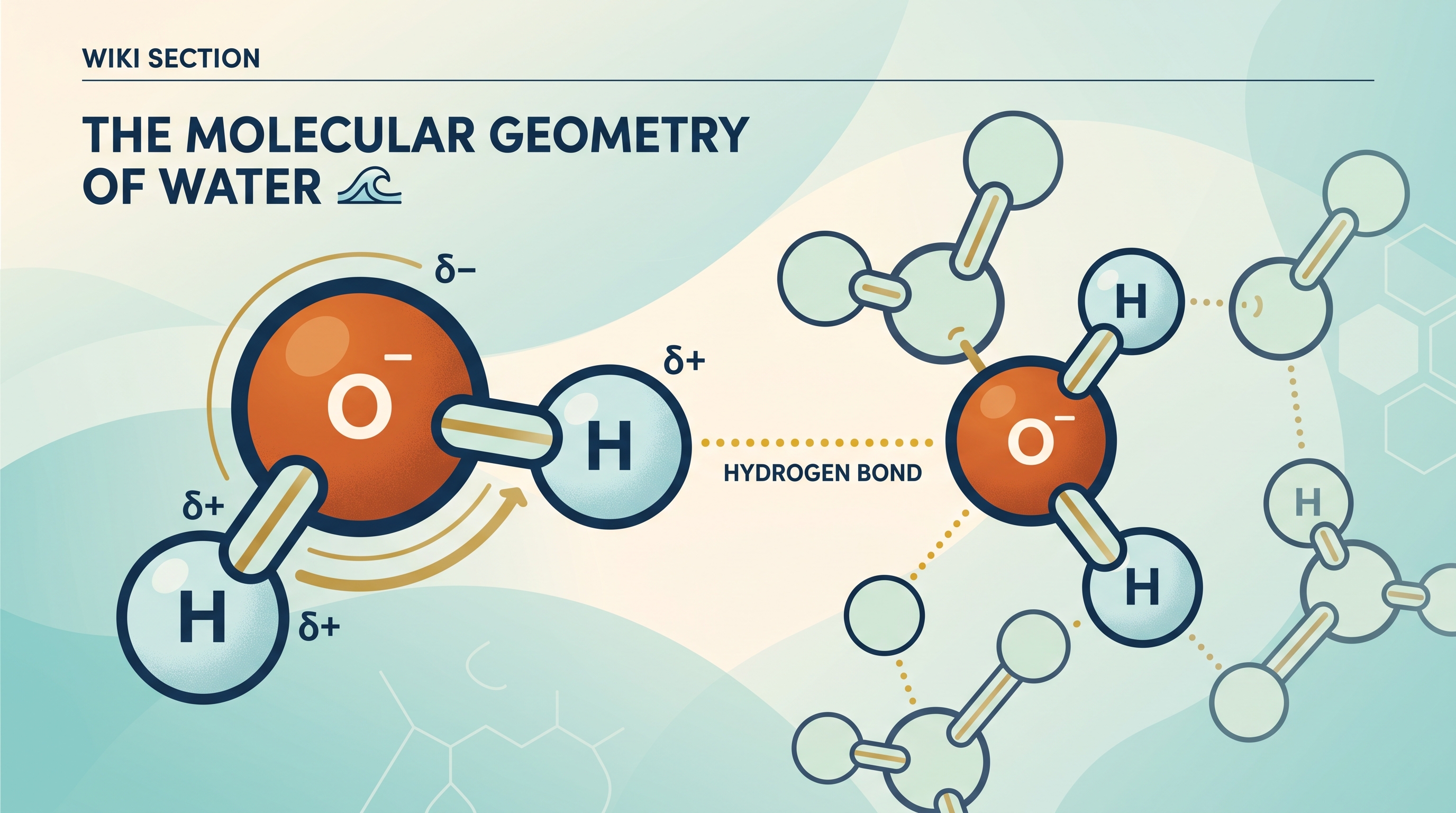
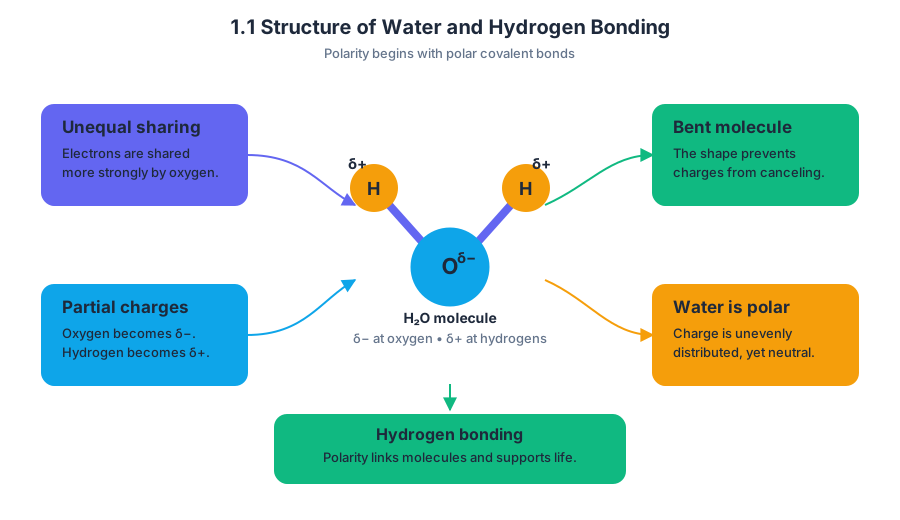
A polar covalent bond is a covalent bond in which electrons are shared unequally between atoms. In water, oxygen attracts the shared electrons more strongly than hydrogen does. Each oxygen-hydrogen bond therefore has a slight negative end near oxygen and a slight positive end near hydrogen.
The molecule’s bent shape prevents these partial charges from canceling. The oxygen end is slightly negative, written $\delta^-$, while the hydrogen ends are slightly positive, written $\delta^+$. Water is therefore polar: its charge is unevenly distributed even though the molecule as a whole is electrically neutral.
Essential Knowledge 1.1.A.1.i: Living systems depend on the properties of water to sustain life. Water has polarity because of the formation of polar covalent bonds between hydrogen and oxygen within water molecules. This polarity contributes to hydrogen bonding between and within biological molecules.
Hydrogen bonds: attraction between neighboring molecules
A hydrogen bond is a weak attraction between a partially positive hydrogen atom and a partially negative atom, commonly oxygen or nitrogen, in a nearby molecule or molecular region. The slightly positive hydrogen of one water molecule is attracted to the slightly negative oxygen of another.
A single hydrogen bond is much weaker than the covalent bonds inside a water molecule. However, enormous numbers of hydrogen bonds acting together produce important biological effects. Hydrogen bonds can also form within biological molecules, helping a molecule fold or maintain a particular shape.
These attractions produce several related properties:
- Cohesion is the attraction of water molecules to one another.
- Adhesion is the attraction of water to other polar surfaces.
- Surface tension is the resistance of the water’s surface to being broken or stretched.
Essential Knowledge 1.1.A.2: Hydrogen bonds between adjacent polar water molecules result in cohesion, adhesion, and surface tension. For example, cohesion helps maintain a continuous column of water in plant transport tissues, while adhesion helps water interact with the walls of those tissues.
Water resists rapid temperature change
Water has a high specific heat capacity, meaning that a relatively large amount of heat energy is required to raise the temperature of a given amount of water by $1^\circ\mathrm{C}$. Incoming thermal energy is absorbed partly by disrupting hydrogen bonds before the molecules’ average kinetic energy—and therefore temperature—increases substantially.
This property stabilizes biological temperature. Because cells and organisms contain substantial amounts of water, water helps buffer them against rapid environmental temperature changes. In an animal, that buffering supports homeostasis, the maintenance of relatively stable internal conditions.
Worked example: body-temperature homeostasis
On a hot day, an organism’s body receives heat from its surroundings. If its tissues contained little water, their temperature would rise rapidly. Because body water has a high specific heat capacity, much of the added energy can be absorbed with a smaller temperature increase, giving physiological mechanisms time to respond.
The organism may then use evaporation to remove heat. Water has a high heat of vaporization, meaning that considerable energy is required for liquid water molecules to escape into the gas phase. The highest-energy molecules leave first, so evaporation lowers the average kinetic energy of the remaining liquid and cools the surface.
Sweating illustrates both properties working together: water in the body resists rapid warming, and evaporation of sweat removes thermal energy from the skin. The result is evaporative cooling that helps maintain body temperature.
Essential Knowledge 1.1.A.1.ii: Water has a high specific heat capacity, which allows maintenance of homeostatic body temperature within living organisms.
Essential Knowledge 1.1.A.1.iii: Water has a high heat of vaporization, which allows evaporative cooling of the surrounding environment and helps maintain body temperature in living organisms.
Misconception check
Misconception: “Hydrogen bonds are the bonds inside a water molecule.” The oxygen-hydrogen bonds within one molecule are polar covalent bonds. Hydrogen bonds form mainly between neighboring water molecules, although hydrogen bonding can also occur between different regions of a biological molecule or between biological molecules.
Misconception: “High specific heat means water heats quickly.” The opposite is true: high specific heat means water requires substantial energy to increase its temperature. High heat of vaporization is the property involved directly when evaporation produces cooling.
AP Biology skills in action
This topic most directly develops Science Practice 1: Concept Explanation, especially 1.A Describe biological concepts and processes and 1.B Explain biological concepts and processes. A strong explanation must connect the chain: unequal electron sharing $\rightarrow$ polarity $\rightarrow$ hydrogen bonding $\rightarrow$ water properties $\rightarrow$ biological function.
It also uses Science Practice 2: Visual Representations, especially 2.A Describe characteristics of biological representations and 2.B Describe relationships among different representations, when interpreting a water-molecule diagram or a hydrogen-bond network. In an investigation comparing temperature change or evaporation, Science Practice 4: Representing and Describing Data, particularly 4.A Construct a graph and 4.B Describe data, supports evidence-based interpretation; Science Practice 6: Argumentation, especially 6.A Make a scientific claim, supports the claim that water’s properties help organisms maintain homeostasis.
Retrieval check
Why does water’s polarity lead to both cohesion and evaporative cooling? State the molecular cause first, then identify the property responsible for each biological effect. A complete response should mention polar covalent bonds, hydrogen bonding, cohesion, and high heat of vaporization.
Source Materials
- Ap Biology Course And Exam Description
- Ap Biology Course Overview
- Ap Biology Course At A Glance
- Ap Biology Equations And Formulas Sheet
- Chapter 3 Quantitative Skills In Ap Sciences
- Ap Biology Teacher Lab Manual Effective Fall 2019
- Updates 2025 26
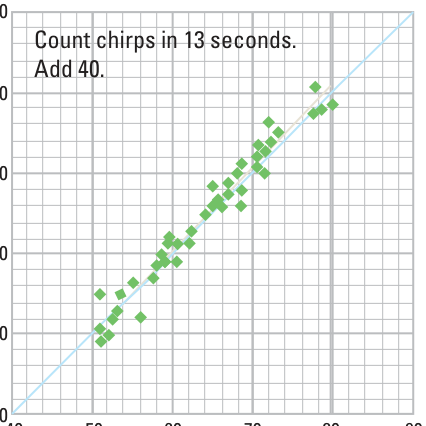
- Figure 2. Sample Scatter Plot Graph. Often we would like a straight-line relationship between our predicted value (temperature) based on actual measurements of another variable (number of chirps) and
- AP Biology Course-AP Central-College Board
- AP Biology-AP Students
- Biology of AP Courses-OpenStax
- AP Biology-Acellus