From the free course AP Biology on Lykke
8.1 Responses to the Environment
Key concepts: Responses to environmental stimuli · Physiological mechanisms · Photoperiodism in plants · Phototropism in plants · Taxis · Fight-or-flight response · Predator-warning behaviors · Plant responses to herbivory · Behavioral responses that increase survival and reproductive success · Genetic diversity and resilience to environmental change
An organism survives by detecting environmental change and adjusting its behavior or physiology before that change becomes fatal. A rabbit that freezes when it detects a hawk, a sunflower that bends toward light, and a plant that produces defensive chemicals after being eaten are all responding to environmental…
8.1 Responses to the Environment
An organism survives by detecting environmental change and adjusting its behavior or physiology before that change becomes fatal. A rabbit that freezes when it detects a hawk, a sunflower that bends toward light, and a plant that produces defensive chemicals after being eaten are all responding to environmental stimuli—signals from the internal or external environment that trigger a biological response.
Learning Objective ENE-3.D: Explain how the behavioral and physiological response of an organism is related to changes in the internal or external environment.
Environmental responses: behavior and physiology
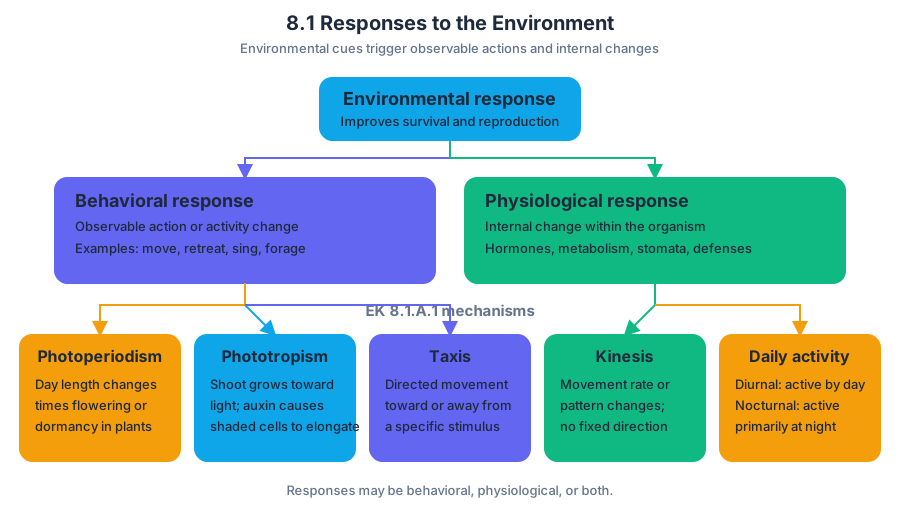
A behavioral response is an observable action, such as moving toward food, retreating from a predator, singing, or changing activity from day to night. A physiological response is an internal change, such as releasing hormones, altering metabolism, closing stomata, or producing defensive molecules. Both types of response can increase an organism’s chance of surviving long enough to reproduce.
Under EK 8.1.A.1, organisms respond through mechanisms including photoperiodism, phototropism, taxis, kinesis, and daily activity patterns. Photoperiodism is a plant response to changes in day length. Plants can use seasonal changes in the proportion of daylight and darkness to time flowering, dormancy, or other developmental processes.
Phototropism is plant growth in response to a directional light stimulus. In positive phototropism, a shoot bends toward light. Unequal distribution of the plant hormone auxin causes cells on the shaded side of the shoot to elongate more, bending the shoot toward the light source.
Animals also respond directionally. Taxis is directed movement toward or away from an environmental stimulus: movement toward light is positive phototaxis, while movement away from a harmful chemical is negative chemotaxis. Kinesis, by contrast, is a change in the rate or pattern of movement rather than movement toward a specific direction. Nocturnal and diurnal activity are additional behavioral patterns: nocturnal organisms are primarily active at night, whereas diurnal organisms are primarily active during the day.
| Response | Stimulus | What changes? | Example |
|---|---|---|---|
| Photoperiodism | Day length | Plant development or physiology | Seasonal flowering |
| Phototropism | Directional light | Direction of plant growth | Shoot bends toward light |
| Taxis | Light, chemicals, temperature, or another cue | Direction of animal movement | Movement toward food |
| Kinesis | Environmental condition | Speed or turning frequency | More movement in an unfavorable area |
| Diurnal/nocturnal activity | Light–dark cycle | Time of activity | Foraging during day or night |
Threat responses and predator warnings
Under EK 8.1.A.2, the fight-or-flight response is a physiological response to a threat. Sensory information about danger activates signaling pathways that increase readiness: heart rate and breathing rise, blood flow is redirected toward skeletal muscles, and stored energy becomes rapidly available. The organism may confront the threat or flee from it. This response is useful when immediate action matters, but maintaining it continuously consumes energy and can disrupt normal maintenance.
Predator-warning behaviors can also increase survival. An animal may freeze, flee, emit an alarm call, display warning coloration, or gather with others. A bird’s alarm call can warn nearby individuals; conspicuous coloration may cause a predator to hesitate if it associates that pattern with toxicity or danger. These responses do not guarantee survival, but they can reduce the probability of capture and increase the chance that the organism reproduces.
Plants responding to herbivory
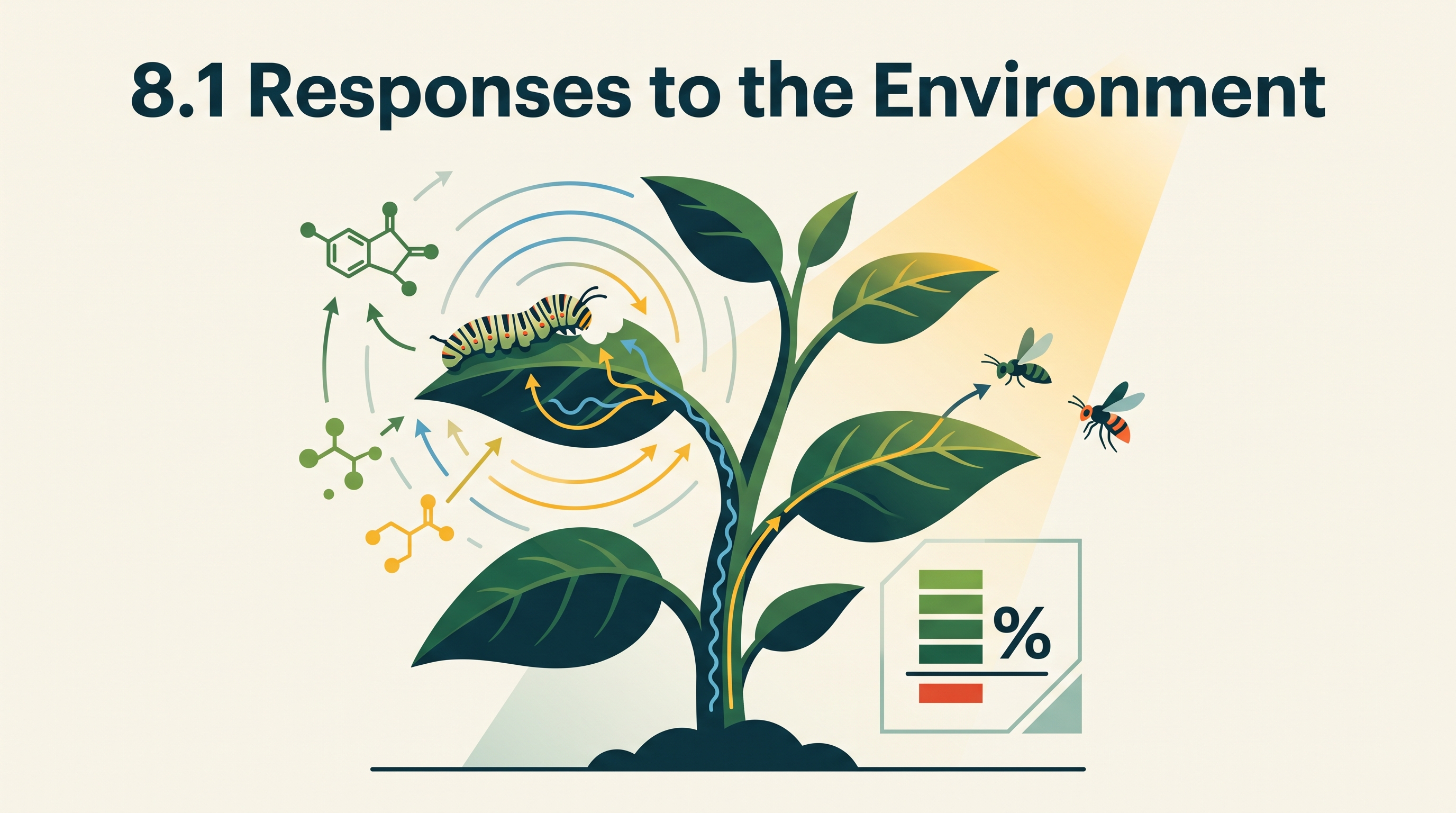
Plants cannot run from herbivores, but they can respond physiologically when tissues are damaged. Herbivory can activate internal signaling that increases production of defensive chemicals, strengthens tissues, or changes volatile compounds released into the air. Those airborne signals may attract predators or parasites of the herbivore, reducing further damage.
Worked example: A caterpillar begins chewing a tomato plant’s leaves. Damaged cells release chemical signals that activate defense pathways. The plant produces compounds that make the leaves less nutritious or more difficult to digest and releases volatile molecules that attract a caterpillar predator. The response is adaptive because it links an external stimulus—herbivore damage—to physiological changes that can reduce tissue loss and preserve future reproduction.
From individual responses to population resilience
A response affects fitness, meaning an organism’s ability to survive and produce viable offspring. Territorial marking, bird songs, pack behavior, coloration, and predator warnings are examples listed under EK 8.1.B.1 because they can improve access to resources, protect offspring, attract mates, or reduce predation. IST-5.A requires connecting these behavioral responses to overall fitness and to the success of the population.
A population’s ability to respond to environmental change also depends on its genetic diversity, the variety of alleles present among its individuals. Populations with little genetic diversity face greater risk of decline or extinction because they are less likely to contain individuals able to withstand a new environmental pressure. Genetically diverse populations are more resilient because different individuals may possess different tolerances or defenses; however, an allele advantageous in one environment may be harmful in another.
AP skill in action
For Science Practice 3, Skill 3.C: Identify experimental procedures that are aligned to the question, a valid investigation must match the procedure to the response being tested. To test whether herbivory induces plant defense, compare damaged and undamaged plants while keeping species, age, light, water, soil, and herbivore exposure time consistent. To test phototropism, measure shoot curvature after exposing plants to light from one direction and compare them with plants receiving uniform light.
For Science Practice 5, Skill 5.A: Perform mathematical calculations, calculate a response proportion such as
$$ \text{proportion responding}=\frac{\text{number of organisms showing the response}}{\text{total number observed}}. $$
A larger proportion of prey fleeing after an alarm signal supports a difference in behavior, but the conclusion must still consider replication and variation.
Retrieval check: A caterpillar begins feeding on a plant, and the plant later releases volatile chemicals that attract predators of the caterpillar. Is this a behavioral response, a physiological response, or both? Explain the stimulus, the plant’s response, and how the response could increase fitness.
Answer: It is primarily a physiological response: herbivory triggers internal defense signaling and chemical production. The response may increase fitness by reducing additional tissue damage, improving survival, and preserving the plant’s ability to reproduce.

Source Materials
- Ap Biology Course And Exam Description
- Ap Biology Course Overview
- Ap Biology Course At A Glance
- Ap Biology Equations And Formulas Sheet
- Chapter 3 Quantitative Skills In Ap Sciences
- Ap Biology Teacher Lab Manual Effective Fall 2019
- Updates 2025 26
- 11: Transpiration ENE-3.D: Explain how the behavioral and/or physiological response of an organism is related to changes in internal or external environment.
- AP Biology Course-AP Central-College Board
- AP Biology-AP Students
- Biology of AP Courses-OpenStax
- AP Biology-Acellus