From the free course AP Biology on Lykke
7.12 Origins of Life on Earth
Key concepts: Origins of Life on Earth · Natural Selection · Unit 7 · Big Idea 4 · Mutations · Biotechnology · Phylogeny · Speciation · Variations in organisms · Genes and proteins shared between different organisms
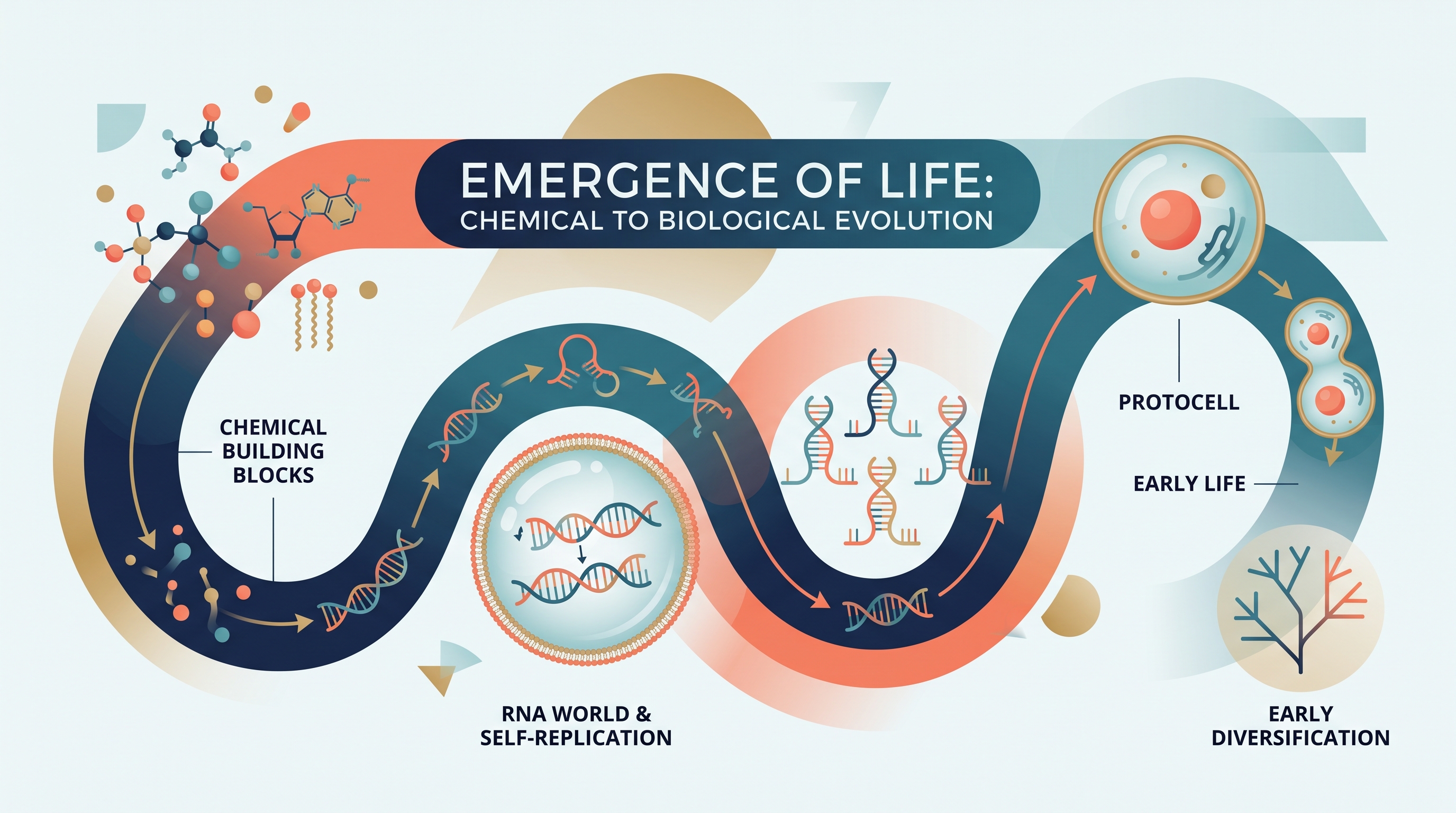
Life on Earth may have begun when nonliving chemistry became capable of storing information, copying itself, and undergoing change across generations. The scientific challenge is not to identify one proven historical sequence, but to evaluate which models of the origin of life on Earth best fit evidence from…
7.12 Origins of Life on Earth
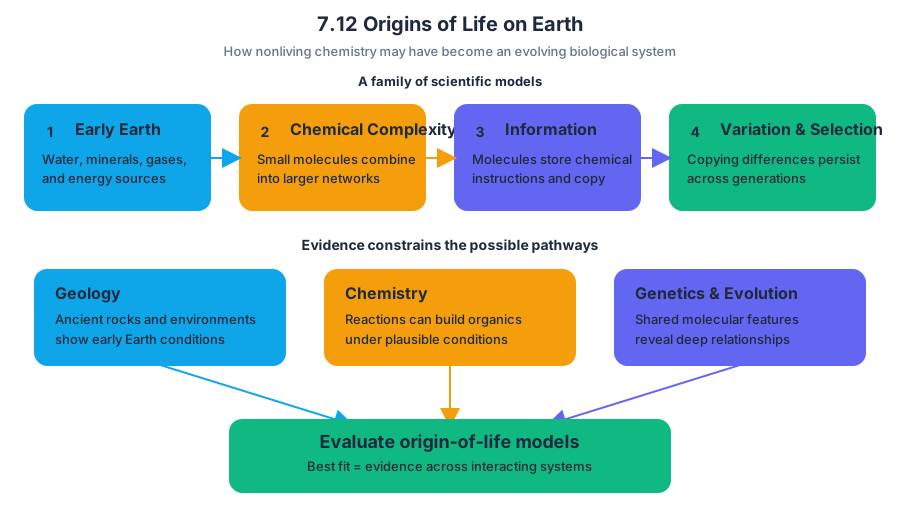
Life on Earth may have begun when nonliving chemistry became capable of storing information, copying itself, and undergoing change across generations. The scientific challenge is not to identify one proven historical sequence, but to evaluate which models of the origin of life on Earth best fit evidence from chemistry, geology, genetics, and evolutionary relationships.
Learning Objective 7.12.A: Describe the scientific evidence that supports models of the origin of life on Earth.
This topic is grounded in Big Idea 4: Systems Interactions: Biological systems interact, and these systems and their interactions exhibit complex properties. Origin-of-life models therefore connect interacting systems: early Earth environments supplied chemicals and energy; chemical reactions produced increasingly complex molecules; and information-bearing molecules made evolutionary change possible.
What counts as evidence for an origin-of-life model?
A model is scientifically useful when it makes testable predictions. For example, if an early-Earth environment could support the formation of biologically important molecules, researchers can recreate some of its chemical conditions and test whether those molecules appear. A result does not prove that exactly the same event occurred billions of years ago, but it can show that a proposed step is chemically plausible.
Scientists evaluate origin-of-life models using several kinds of evidence:
- Geological evidence: ancient rocks and minerals reveal the environments, gases, water, and energy sources that may have existed on early Earth.
- Chemical evidence: laboratory experiments test whether simple substances can form organic molecules under plausible conditions.
- Molecular evidence: shared genes, proteins, and biochemical processes can indicate inheritance from ancient common ancestors.
- Comparative evidence: DNA and protein sequences allow scientists to infer relationships among organisms and identify deeply conserved biological features.
- Experimental evidence: biotechnology can construct, detect, or modify molecules to test whether proposed chemical or genetic mechanisms work.
A key distinction is plausibility versus historical proof. Producing an organic molecule in a laboratory supports the idea that such chemistry could occur; it does not establish that the molecule formed in exactly that way on early Earth. Strong models gain support when independent lines of evidence converge.
From molecules to common ancestry
The same protein can occur in many organisms because the organisms may have inherited the gene for that protein from a common ancestor. The more similar the amino-acid sequences are, and the more similar their functions, the stronger the evidence may be that the genes share evolutionary history—although similarity must be interpreted alongside mutation, selection, and the possibility of independent evolution.
A gene is a DNA sequence containing information that can contribute to a functional product. The same gene can occur in two different kinds of organisms even when the organisms do not produce the same protein in the same way. Mutations may alter the gene’s sequence, and changes in gene regulation may prevent the gene from being expressed in a particular cell, tissue, or life stage.
This distinction matters: finding a gene is not the same as finding its protein product. A gene may be inactive, expressed only under certain conditions, translated differently, or sufficiently changed that its protein is difficult to recognize.
Phylogeny as an evidence tool
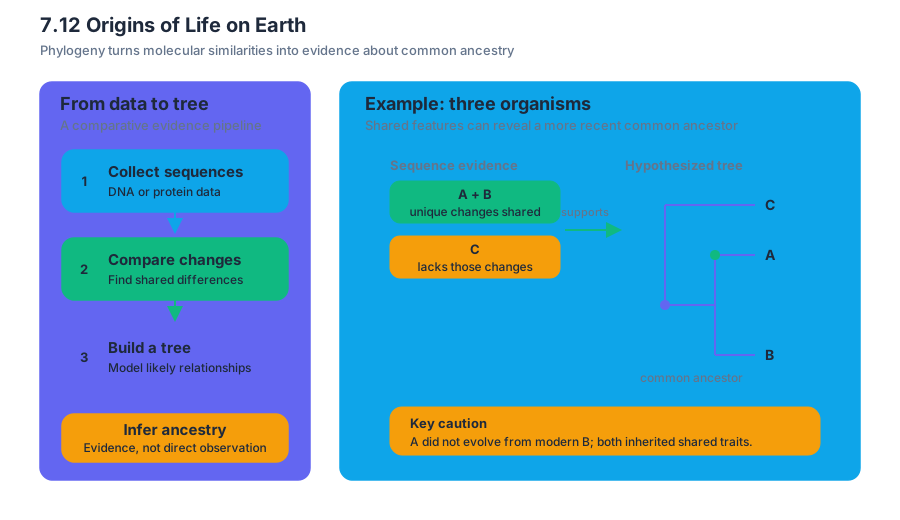
Phylogeny is the study of evolutionary relationships. Scientists compare DNA or protein sequences from different organisms and use the similarities and differences to construct a phylogenetic tree, a diagram representing hypotheses about common ancestry.
For example, if organisms A and B share many unique DNA changes that are absent from organism C, a tree may place A and B together as more closely related. The tree does not show that A evolved from modern B; instead, it suggests that A and B inherited those shared features from a more recent common ancestor.
How speciation extends the history of life
Speciation is the formation of new species through divergence of populations and the evolution of reproductive isolation. A population can accumulate mutations, experience natural selection or genetic drift, and become increasingly different from another population. If the groups can no longer successfully exchange genes, they may constitute separate species.
Speciation connects origin-of-life research to the later history of life. Once an early population of self-replicating systems existed, mutation created heritable differences, selection filtered those differences, and continued divergence could produce the branching pattern represented by phylogenies.
Biotechnology: testing ancient biological possibilities
Biotechnology uses biological molecules, cells, or organisms to investigate and solve problems. In origin-of-life research, scientists can synthesize short nucleic-acid sequences, engineer organisms to produce ancient or reconstructed proteins, compare genes across modern species, or analyze molecular systems that may preserve features of early biology.
Suppose researchers identify a highly conserved gene in organisms ranging from bacteria to animals. They can use DNA sequencing to compare versions of the gene, genetic engineering to place one version into another organism, and protein analysis to determine whether it produces a similar product. If the gene is widespread but the protein is absent in some organisms, regulation or mutation may explain the difference.
Misconception check: “If scientists can recreate one step in a laboratory, they have recreated the origin of life.”
Correction: A laboratory result supports one possible mechanism. The complete historical model must also fit geological conditions, molecular evidence, and evolutionary relationships.
Scientific-practice connection
Origin-of-life questions particularly involve Science Practice 1: Concept Explanation, when evidence is used to explain a model; Science Practice 2: Visual Representations, when phylogenetic trees or pathway diagrams are interpreted; Science Practice 3: Questions and Methods, when experiments test chemical or molecular possibilities; Science Practice 4: Representing and Describing Data, when sequence or experimental results are displayed; and Science Practice 6: Argumentation, when competing models are evaluated using evidence.
Retrieval check: A researcher finds the same gene in several organisms, but the gene is expressed in only two of them. What two conclusions are justified? The gene may have been inherited from a common ancestor, and differences in mutation or gene regulation may explain why its protein product is not detected in every organism.