From the free course AP Biology on Lykke
6.7 Mutations
A mutation is a change in the nucleotide sequence of a genome, and its biological effect can range from invisible to life-changing. The crucial question is not simply “Did the DNA change?” but rather: How could this change alter a gene product, a cellular pathway, and ultimately a phenotype?
Learning Objective 6.7.A: Explain how mutations can result in changes to the structure and function of an organism.
Essential Knowledge 6.7.A.1: Mutations are changes in the nucleotide sequence of a genome.
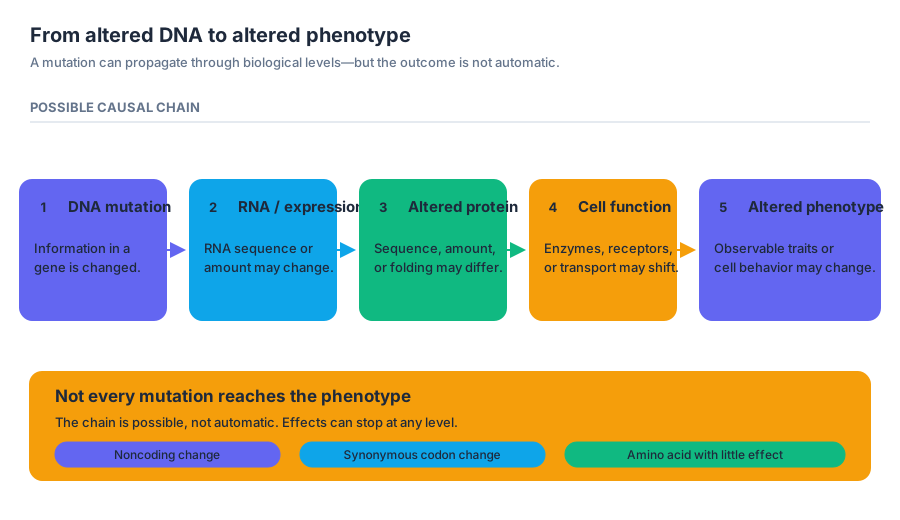
From altered DNA to altered phenotype
DNA contains information used to produce functional RNA and proteins. A mutation can change the information in a gene, which may change the sequence or amount of a protein. Because proteins act as enzymes, receptors, transporters, structural fibers, and signals, a DNA change can propagate through several biological levels:
$$ \text{DNA mutation} \rightarrow \text{altered RNA or gene expression} \rightarrow \text{altered protein} \rightarrow \text{altered cell function} \rightarrow \text{altered phenotype} $$
However, this chain is possible, not automatic. A mutation may occur in a noncoding region, change a codon without changing the amino acid, or alter an amino acid that does not affect protein function.
Mutation types: where the change occurs matters
A point mutation changes one nucleotide. If the altered codon still specifies the same amino acid, the mutation is silent. If it specifies a different amino acid, it is missense. If it changes a codon into a stop codon, it is nonsense, producing a shortened polypeptide.
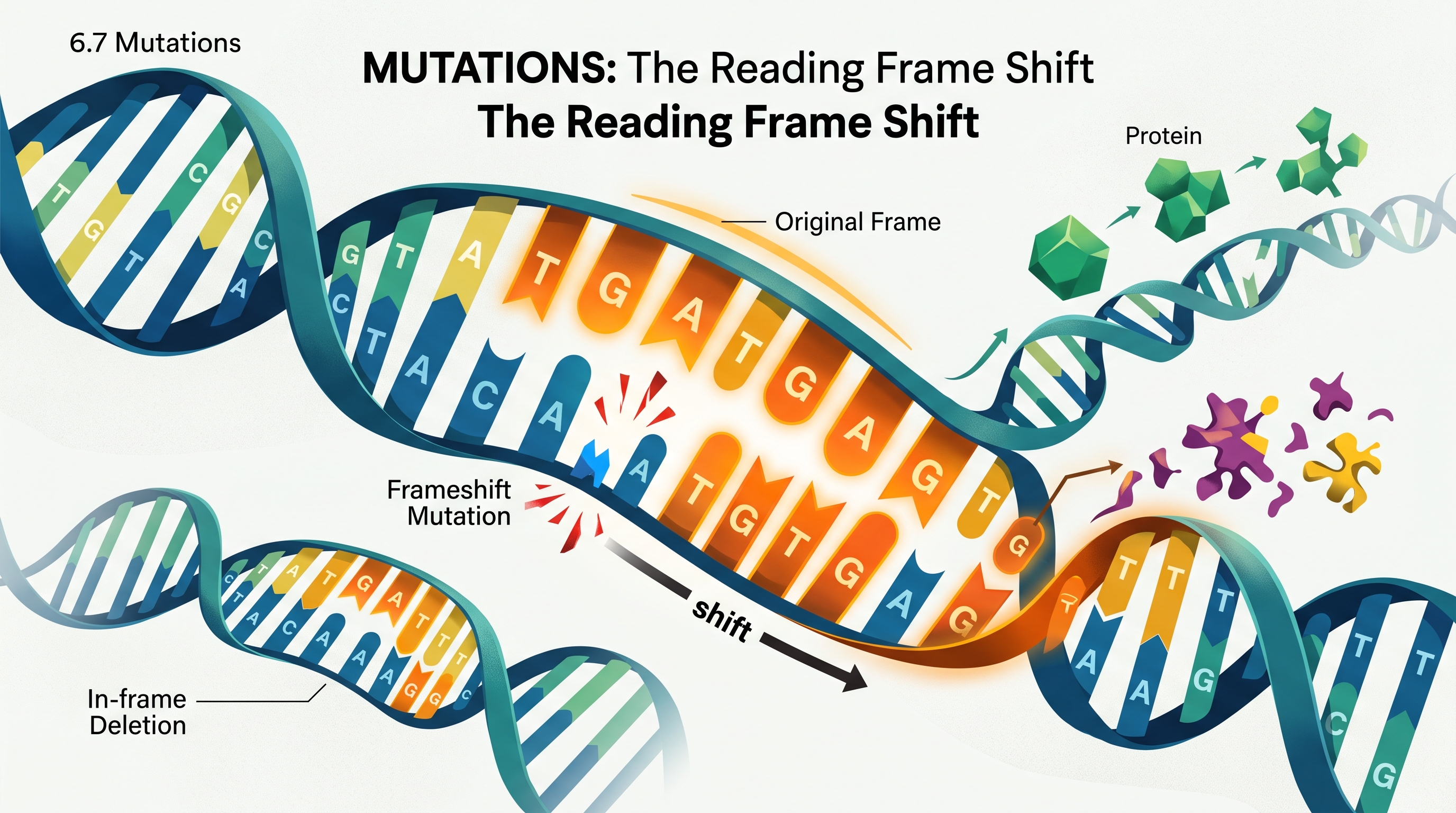
An insertion adds nucleotide(s), whereas a deletion removes nucleotide(s). If the number added or removed is not a multiple of three, the reading frame changes. This is a frameshift mutation: every codon after the mutation may be regrouped, often producing a dramatically altered or prematurely terminated protein.
| DNA change | Possible molecular result | Typical consequence |
|---|---|---|
| One nucleotide substituted | Silent, missense, or nonsense codon | No effect, altered amino acid, or shortened protein |
| One or more nucleotides inserted | Reading frame may shift | Altered downstream amino acids |
| One or more nucleotides deleted | Reading frame may shift | Altered downstream amino acids |
| Mutation in a regulatory sequence | Gene may be transcribed more or less often | Changed protein amount |
The location of a mutation is therefore essential. A substitution near an active site may disrupt an enzyme’s function, while the same substitution in a less important region may have little effect. A mutation affecting a regulatory sequence may leave the protein’s amino acid sequence unchanged but alter how much of that protein the cell produces.
Worked example: a CFTR mutation and transport
The CFTR gene provides instructions for a membrane protein involved in ion transport. Imagine a mutation that disrupts the CFTR protein’s structure. If the protein cannot fold correctly, reach the plasma membrane, or transport ions effectively, chloride movement across epithelial cells changes.
That molecular change affects water movement because dissolved ions influence the osmotic movement of water. Secretions may become unusually thick, impairing the function of tissues such as those lining the respiratory tract. The reasoning chain is:
$$ \text{CFTR nucleotide change} \rightarrow \text{altered CFTR protein} \rightarrow \text{impaired ion transport} \rightarrow \text{altered water movement} \rightarrow \text{changed tissue function and phenotype} $$
A strong biological explanation must connect each level with a mechanism. Saying only “the mutation causes disease” skips the evidence-based reasoning that explains why the phenotype appears.
Misconception check: mutations are not automatically harmful
Named misconception — “All mutations are harmful.” Mutations can be harmful, beneficial, or neutral. A mutation is neutral when it does not produce a detectable change in phenotype under the conditions being studied. A silent substitution is one possible example, but even a missense mutation may be neutral if the altered amino acid does not significantly affect folding or function.
Named misconception — “A mutation denatures a protein.” A mutation changes DNA; it does not directly denature a protein. Denaturation is the loss of a protein’s three-dimensional structure caused by factors such as extreme temperature or pH. A mutation may instead change the amino acid sequence, which can cause a protein to fold differently or become less stable.
Named misconception — “A point mutation causes a frameshift.” A point substitution changes one nucleotide but does not shift the reading frame. Frameshifts generally result from insertions or deletions that are not divisible by three.
AP skill focus: Visual Representations
Suggested Skill 2.C — Visual Representations: Explain how biological models relate to larger principles, concepts, processes, systems, or theories. For mutations, this means using a sequence, codon chart, pathway diagram, or phenotype model to connect a molecular alteration to organismal function. On an exam, do not merely identify the changed nucleotide: use the representation as evidence for the predicted protein or phenotype change.
Retrieval check: A three-nucleotide deletion removes one amino acid but does not shift the reading frame. A one-nucleotide deletion occurs near the beginning of the coding sequence. Which is more likely to alter many downstream amino acids, and why? The one-nucleotide deletion is more likely because it creates a frameshift, changing how subsequent nucleotides are grouped into codons.