From the free course AP Biology on Lykke
8.5 Community Ecology
Key concepts: Community structure · Competition · Predation · Symbioses · Positive and negative interactions between populations · Extinctions · Biomagnification · Eutrophication · Defense against herbivores · Trichome production in Brassica rapa
A community is shaped not only by which species live in the same place, but by what those populations do to one another. A plant competing for light, a spider capturing an insect, and a fungus living inside a root all change the abundance, distribution, and persistence of other populations.
8.5 Community Ecology
A community is shaped not only by which species live in the same place, but by what those populations do to one another. A plant competing for light, a spider capturing an insect, and a fungus living inside a root all change the abundance, distribution, and persistence of other populations. Community ecology examines these interactions and how they organize biological communities.
CED alignment: Learning Objective 8.5.B — Explain how interactions within and among populations influence community structure. Essential Knowledge 8.5.B.4 — Competition, predation, and symbioses, including parasitism, mutualism, and commensalism, can drive population dynamics.
Interaction signs: who benefits, who loses?
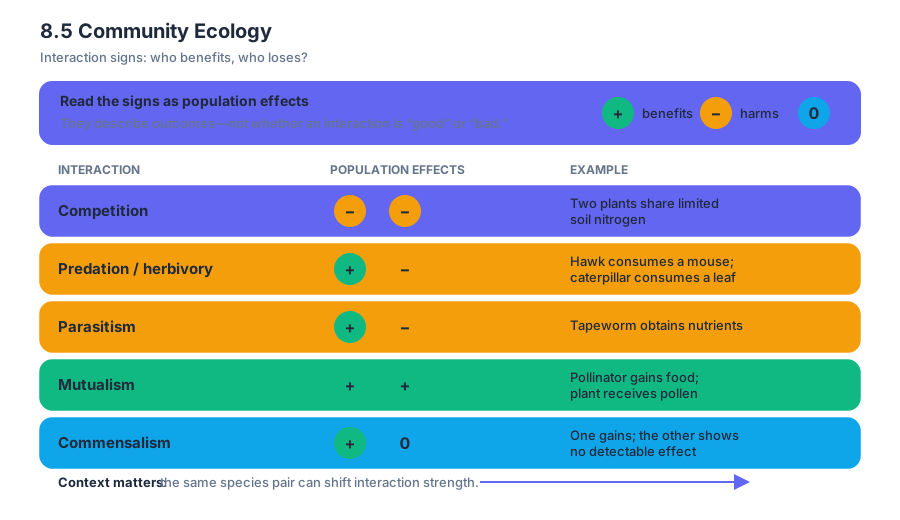
An interaction can be modeled by recording its effect on each population. A positive effect is represented by $+$, a negative effect by $-$, and no measurable effect by $0$. These signs describe the outcome for the populations, not whether the interaction is morally “good” or “bad.”
| Interaction | Effect on population 1 | Effect on population 2 | Example |
|---|---|---|---|
| Competition | $-$ | $-$ | Two plant species using the same limited soil nitrogen |
| Predation or herbivory | $+$ | $-$ | A hawk consumes a mouse; a caterpillar consumes a leaf |
| Parasitism | $+$ | $-$ | A tapeworm obtains nutrients from a host |
| Mutualism | $+$ | $+$ | A pollinator obtains food while transferring pollen |
| Commensalism | $+$ | $0$ | One population gains while the other is not detectably affected |
The same pair of species may show different interaction strengths under different conditions. For example, a plant and a fungus may have a mutualistic relationship when the fungus improves mineral uptake, but the relationship can become less beneficial if environmental conditions change the costs and benefits for either population.
Competition and niche partitioning
Competition occurs when populations use the same limited resource. Because both competitors expend energy and obtain fewer resources, the direct effect is usually $-/-$. Competition can reduce growth, survival, or reproduction and therefore alter which species are common in a community.
Niche partitioning reduces competition when populations use resources differently. Two bird species might feed in different parts of the same tree, or two plants might absorb nutrients at different soil depths. They still occupy the same community, but their resource use overlaps less, allowing both populations to persist.
Competition can also produce an indirect community effect. If one plant species grows taller and blocks light, a shorter plant may decline even though the taller species does not consume it. The interaction is still competition because both populations depend on a limited resource: light.
Predation, herbivory, and trophic cascades
Predation is an interaction in which one population captures and consumes another. The predator gains energy, while the prey loses individuals. Predation therefore changes population size directly and can change community structure indirectly by altering the abundance of organisms at other trophic levels.
A trophic cascade occurs when an effect moves through several feeding levels. If predators reduce herbivore abundance, plants may experience less grazing and increase. Removing the predator can reverse the pattern: herbivores increase, plant biomass decreases, and the community changes even though the predator never consumes plants directly.
Symbioses
Symbiosis is a close biological relationship between different species. The major forms required here are parasitism, mutualism, and commensalism. These relationships influence population dynamics by changing access to nutrients, protection, reproductive opportunities, or habitat.
- Parasitism is $+/-$: the parasite benefits while the host is harmed, although the host is not necessarily killed immediately.
- Mutualism is
$+/$+$: both populations benefit, as when one species provides food and the other provides transport, protection, or another service. - Commensalism is
$+/$0$: one population benefits while the other experiences no detectable effect.
The cost of plant defense
Plants cannot flee from herbivores, so they may defend themselves with structures or chemicals that make feeding more difficult. Trichomes—hair-like structures on plant surfaces—can discourage herbivores, but producing them requires materials and energy that could otherwise support growth, reproduction, or competition for light.
The experimental study of trichome production in Brassica rapa illustrates this trade-off. A plant that produces more trichomes may suffer less herbivory, yet defense is not free: resources invested in defense can reduce the plant’s ability to grow or compete. The correct conclusion is not “defense always lowers fitness,” but rather that defense can improve survival under herbivory while carrying a growth or resource-allocation cost when herbivory is weak.
Misconception check: A defense trait is not automatically beneficial in every environment. Natural selection favors the balance of benefits and costs under particular conditions.
Interactions, extinctions, and ecosystem change
Ecological interactions can contribute to extinction, the permanent loss of a population or species. A population may decline when competition prevents access to resources, predation becomes unusually intense, a mutualistic partner disappears, or parasites and pathogens spread through a small population. Interactions can therefore amplify an environmental disturbance rather than merely respond to it.
Biomagnification is the increasing concentration of a persistent pollutant in organisms at progressively higher trophic levels. A contaminant present at low concentration in water may accumulate in prey, become more concentrated in predators, and reach harmful levels in top consumers. Reproductive failure or death in those populations can contribute to population collapse and extinction.
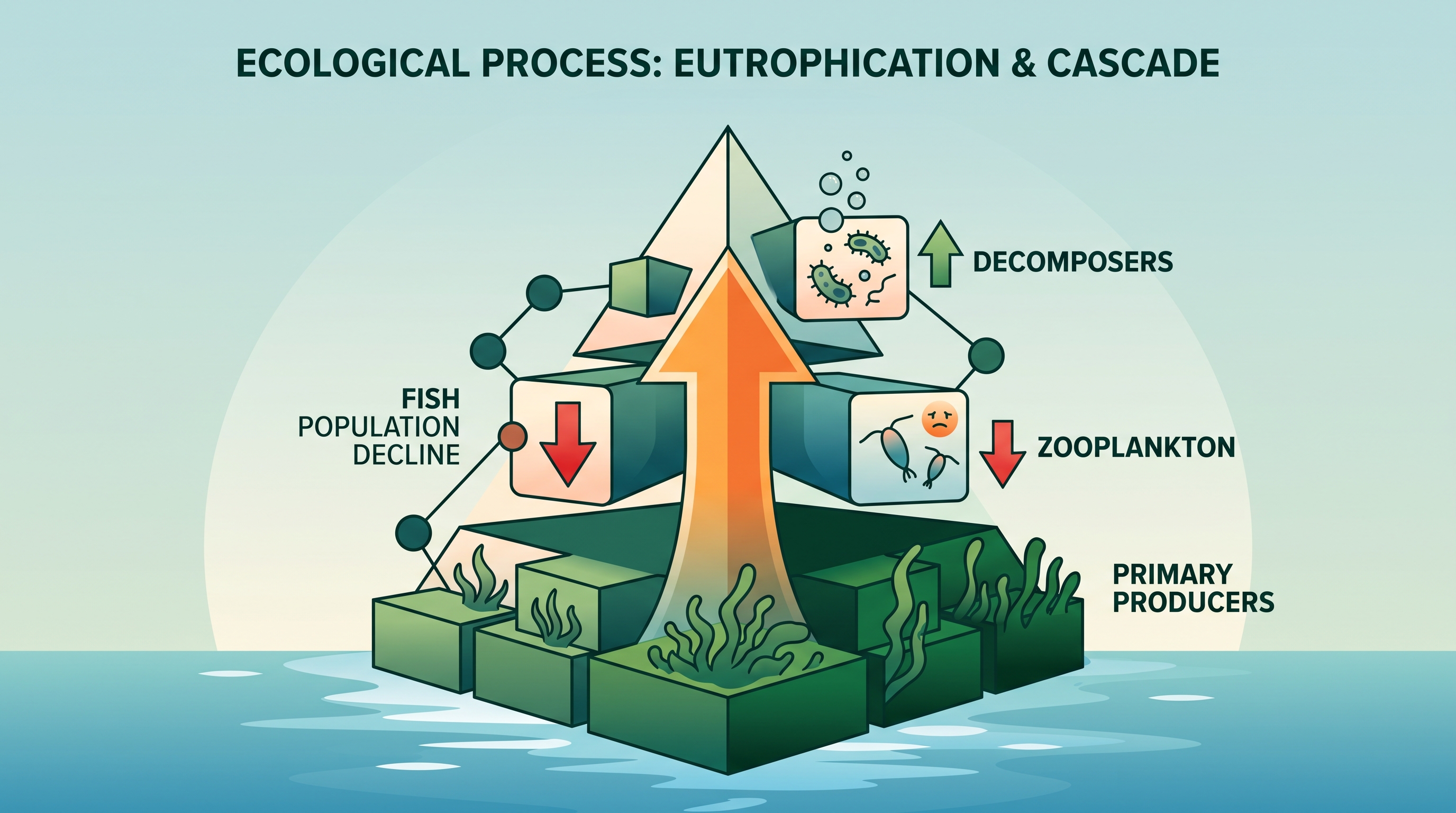
Eutrophication is nutrient enrichment of an aquatic ecosystem, often involving excess nitrogen or phosphorus. Rapid algal growth can block light; decomposition of the algae consumes dissolved oxygen; and oxygen depletion can kill fish, invertebrates, and other aquatic organisms. If these changes persist, the resulting loss of populations can contribute to extinctions.
AP reasoning in this topic
Community-ecology problems commonly assess Science Practice 1: Concept Explanation when you explain how an interaction changes population size; Science Practice 2: Visual Representations when you interpret or construct a $+/-$ interaction model or trophic cascade; Science Practice 3: Questions and Methods when you identify a testable defense-cost hypothesis; Science Practice 4: Representing and Describing Data when you graph herbivory, trichome production, or dissolved oxygen; Science Practice 5: Statistical Tests and Data Analysis when you decide whether treatment differences support a claim; and Science Practice 6: Argumentation when you connect evidence to a conclusion about community change or extinction.
Retrieval check: A lake receives excess phosphorus, algae increase, decomposition accelerates, and dissolved oxygen falls. Identify the ecological process, predict the effect on fish, and classify the fish–algae relationship only if the evidence supports a direct interaction. The process is eutrophication; fish populations are expected to decline under oxygen depletion. Do not automatically label the fish–algae relationship as predation or competition—the evidence given supports an indirect ecosystem effect, not a direct $+/-$ interaction.