From the free course AP Biology on Lykke
2.7 Tonicity and Osmoregulation
A cell placed in concentrated saltwater can lose so much water that its membrane pulls away from the cell wall. The salt does not need to enter the cell to cause this change: water moves across the selectively permeable membrane toward the side with lower water potential.
2.7 Tonicity and Osmoregulation
A cell placed in concentrated saltwater can lose so much water that its membrane pulls away from the cell wall. The salt does not need to enter the cell to cause this change: water moves across the selectively permeable membrane toward the side with lower water potential. Tonicity predicts how a solution changes cell volume, while osmoregulation is the active control of water balance and internal solute concentration.
Investigative question: Why does a plant cell become firm in fresh water but shrink in saltwater?
Water potential: the driving force for water movement
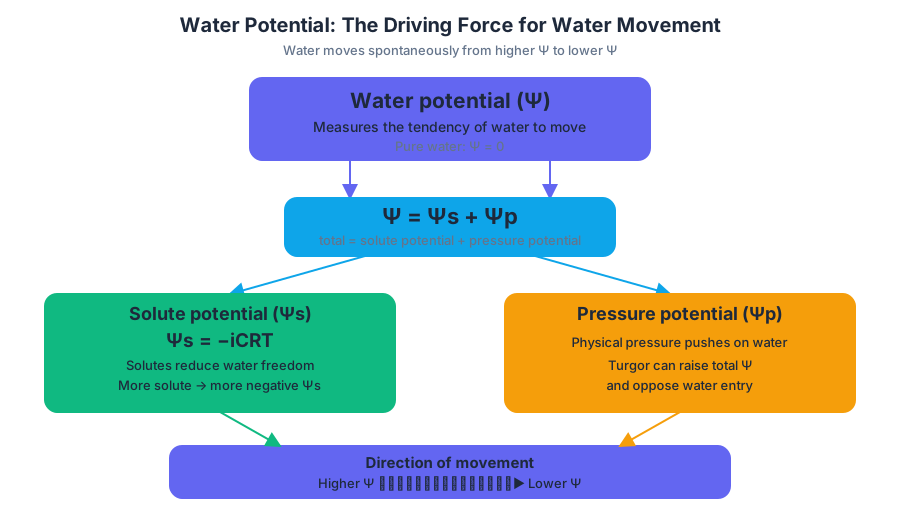
Water potential, written as $\Psi$, measures the tendency of water to move. Water moves spontaneously from higher water potential to lower water potential. Pure water under ordinary atmospheric pressure has $\Psi = 0$; adding dissolved solutes makes water potential more negative because solute particles reduce the freedom of water molecules to move.
For a solution, water potential is the sum of solute potential and pressure potential:
$$ \Psi = \Psi_s + \Psi_p $$
Solute potential is calculated as:
$$ \Psi_s = -iCRT $$
Here, $i$ is the ionization constant, $C$ is solute concentration in $\text{mol L}^{-1}$, $R$ is the pressure constant, and $T$ is absolute temperature in kelvins. The negative sign is essential: increasing solute concentration makes $\Psi_s$ more negative.
Pressure potential, $\Psi_p$, represents physical pressure pushing on water. In a plant cell, water entering the cell presses the plasma membrane against the cell wall, producing positive turgor pressure. This pressure can raise the cell’s total water potential and eventually oppose additional water entry.
Tonicity predicts cell-volume change
Tonicity compares the concentration of nonpenetrating solutes outside and inside a cell. A hypertonic solution has a higher effective solute concentration outside the cell, so water leaves and the cell shrinks. A hypotonic solution has a lower effective solute concentration outside, so water enters and the cell swells. An isotonic solution produces no net water movement and therefore no sustained change in cell volume.
The terms are always relative to the cell. A solution containing $0.3\ \text{mol L}^{-1}$ solute may be hypertonic to one cell and hypotonic to another, depending on the cell’s internal solute concentration and on whether the solute can cross the membrane.
| External solution | Net water movement | Animal cell | Plant cell |
|---|---|---|---|
| Hypotonic | Into the cell | Swells; may lyse | Becomes turgid |
| Isotonic | None overall | Maintains volume | Often flaccid |
| Hypertonic | Out of the cell | Shrivels | Plasmolyzes |
A crucial distinction is that water moves; tonicity does not. Tonicity describes the resulting effect of solute differences on water movement. Also, a freely penetrating solute may temporarily affect water movement but cannot maintain a lasting tonicity difference once it crosses the membrane.
Worked example: a plant cell in salt solution
Suppose a plant cell has a water potential of $-0.20\ \text{MPa}$, while the surrounding salt solution has a water potential of $-0.60\ \text{MPa}$. Water moves from the cell, where $\Psi=-0.20\ \text{MPa}$ is higher, into the solution, where $\Psi=-0.60\ \text{MPa}$ is lower.
As water leaves, the vacuole loses volume and the plasma membrane may pull away from the cell wall. This condition is plasmolysis. If the external solution is diluted, its water potential rises; the direction of movement can reverse, and water reenters until pressure potential and solute potential produce equilibrium.
Osmoregulation keeps internal conditions usable
Osmoregulation maintains water balance and allows organisms to control internal solute concentrations (Essential Knowledge 2.7.B.2). Cells and organisms must regulate because membranes separate environments with different solute concentrations, and uncontrolled water movement can disrupt cell shape, enzyme function, and chemical reactions.
A freshwater organism usually gains water because its body fluids are more concentrated than the surrounding water. It can release dilute urine and actively take up ions. A marine organism tends to lose water to seawater and must conserve water while controlling salt intake and excretion. Plants regulate water balance through cell walls, vacuoles, stomata, and transport of water and ions.
AP reasoning: graph, predict, argue
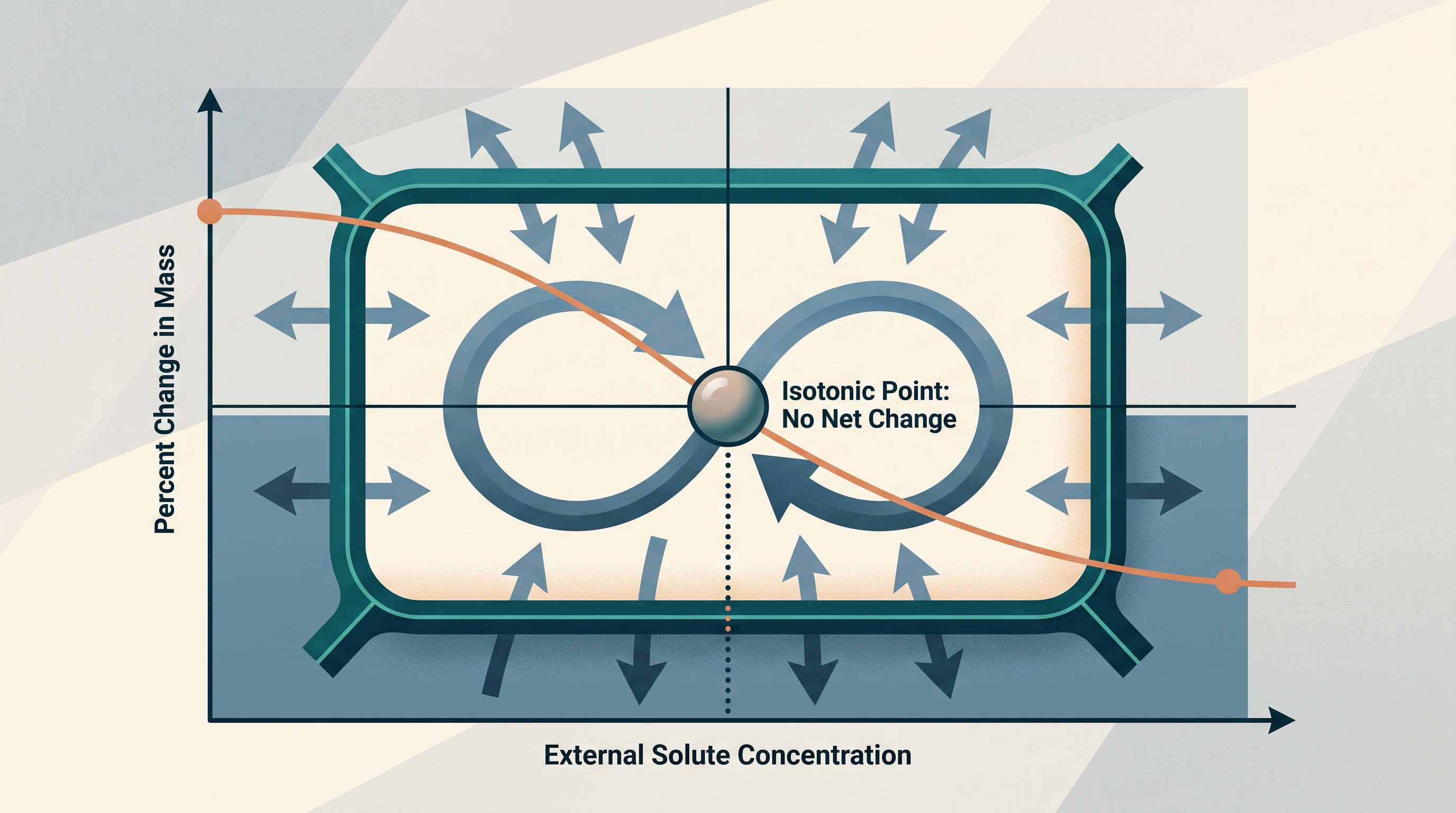
This topic directly develops Science Practice 4: Representing and Describing Data, especially 4.A Construct a graph to represent the data. In a potato-mass investigation, graph external solute concentration on the $x$-axis and percent change in mass on the $y$-axis. The concentration at which the trend crosses $0%$ change estimates the isotonic point.
It also develops Science Practice 6: Argumentation, including 6.E Predict the causes or effects of a change in, or disruption to, one or more components in a biological system. A strong prediction links evidence to mechanism: “Increasing external salt concentration will decrease tissue mass because it lowers external $\Psi$, causing net water loss.”
Misconception check: “Isotonic means water stops moving.”
No. Water molecules continue crossing in both directions; isotonic means the two directions occur at equal rates, producing no net volume change.
Retrieval check: A cell has $\Psi=-0.45\ \text{MPa}$ and is placed in a solution with $\Psi=-0.10\ \text{MPa}$. Which way does net water move, and is the solution hypertonic or hypotonic relative to the cell? Answer: Water moves into the cell because $-0.10\ \text{MPa}$ is the higher water potential; the solution is hypotonic relative to the cell.