From the free course AP Biology on Lykke
7.10 Speciation
Speciation is the evolutionary process by which one population becomes two or more distinct species, usually because gene flow between the populations has been reduced or stopped.
7.10 Speciation
Speciation is the evolutionary process by which one population becomes two or more distinct species, usually because gene flow between the populations has been reduced or stopped. The decisive question is not simply whether the populations look different; it is whether they remain able to exchange genes successfully.
Learning Objective 7.10: Explain the mechanisms of speciation.
Essential Knowledge 1.C.2: Speciation may occur when two populations become reproductively isolated from each other.
Reproductive isolation: the central mechanism
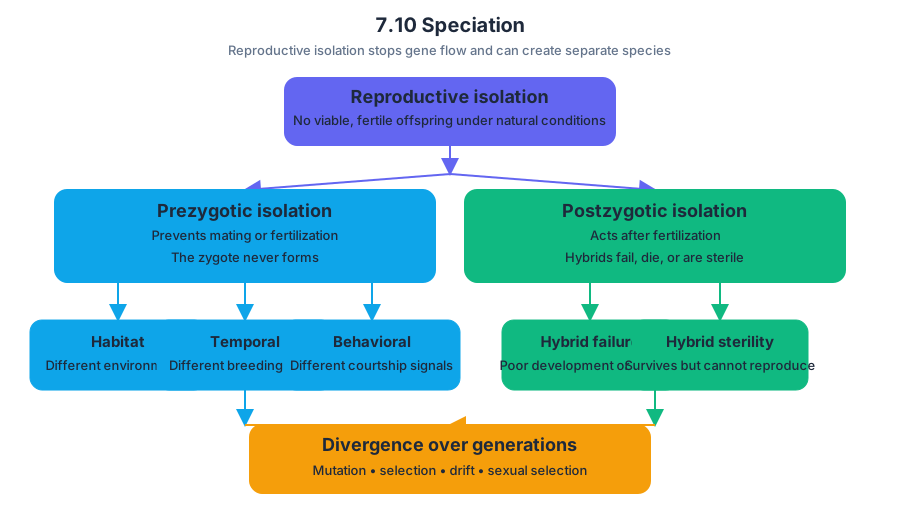
Reproductive isolation means that members of two populations cannot produce viable, fertile offspring together under natural conditions. Once gene flow stops, mutation, natural selection, genetic drift, and sexual selection can cause the populations to diverge. Over many generations, the differences may become large enough that the populations function as separate species.
Reproductive isolation can occur before fertilization or after fertilization:
| Type | What prevents gene flow? | Example |
|---|---|---|
| Prezygotic isolation | Prevents mating or fertilization | Different breeding seasons, courtship signals, habitats, or reproductive structures |
| Postzygotic isolation | Occurs after fertilization | Hybrid offspring fail to develop, survive poorly, or are sterile |
Prezygotic barriers include habitat isolation, in which populations occupy different environments; temporal isolation, in which they reproduce at different times; behavioral isolation, in which courtship signals are not recognized; and mechanical isolation, in which reproductive structures do not function together. A chemical incompatibility between gametes can also prevent fertilization.
Postzygotic barriers include reduced hybrid viability, when hybrid offspring do not survive well, and reduced hybrid fertility, when the hybrids survive but cannot produce functional gametes. A mule illustrates the latter pattern: a horse and donkey can produce a living offspring, but the mule is generally sterile. Gene flow therefore occurs between the parent species only to a very limited extent.
Allopatric speciation: isolation by geography
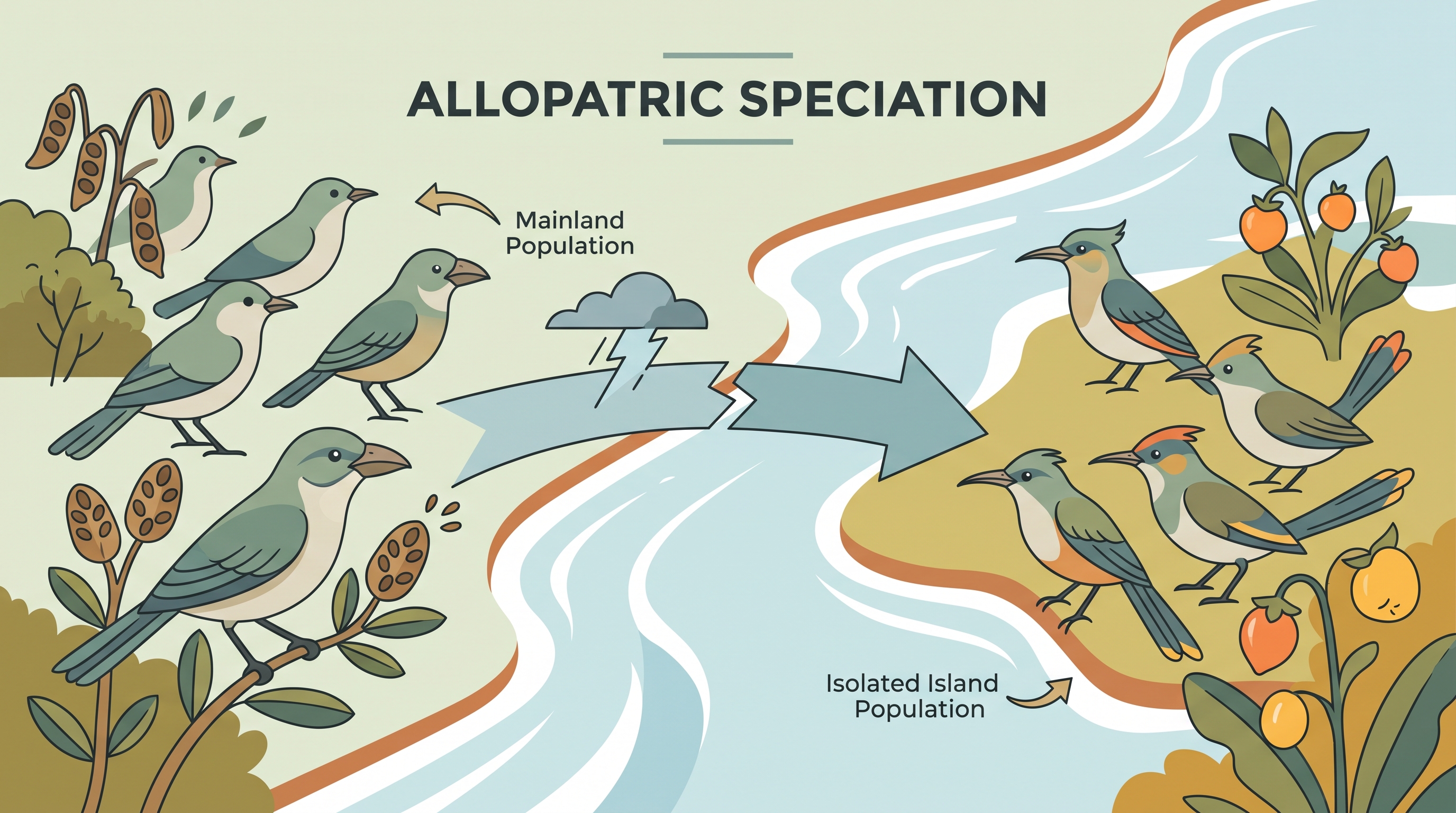
Allopatric speciation occurs when a physical barrier separates a population. A river, mountain range, glacier, or newly formed island can divide one population into two geographically isolated populations. Because individuals can no longer mate across the barrier, the two gene pools begin evolving independently.
Worked example — island populations: Imagine a bird population on a mainland. A storm carries a small group to a nearby island, where the birds encounter different food sources and predators. On the mainland, larger beaks may improve access to hard seeds; on the island, narrower beaks may be favored because soft fruits are abundant. Genetic drift may also have a stronger effect on the smaller island population. If the island and mainland populations later meet but no longer recognize one another’s courtship songs, behavioral isolation has completed an important step toward speciation.
The geographic barrier itself does not automatically create a new species. It initiates separation. Speciation requires continued divergence and, eventually, reproductive isolation. If the populations reunite while they can still mate and produce fertile offspring, they remain one species even if their average traits differ.
Sympatric speciation: isolation without a physical barrier
Sympatric speciation occurs when reproductive isolation develops while populations live in the same geographic area. Different mating behaviors, food preferences, habitats, or reproductive timing can reduce gene flow within the shared environment. In plants, changes in chromosome number can produce reproductive isolation rapidly: a chromosome-duplicated plant may be unable to produce fertile offspring with the original population.
The distinction is therefore geographical: allopatric speciation begins with physical separation, whereas sympatric speciation begins without a physical barrier. Both mechanisms require the same evolutionary outcome—reproductive isolation.
Reading speciation on a phylogenetic tree
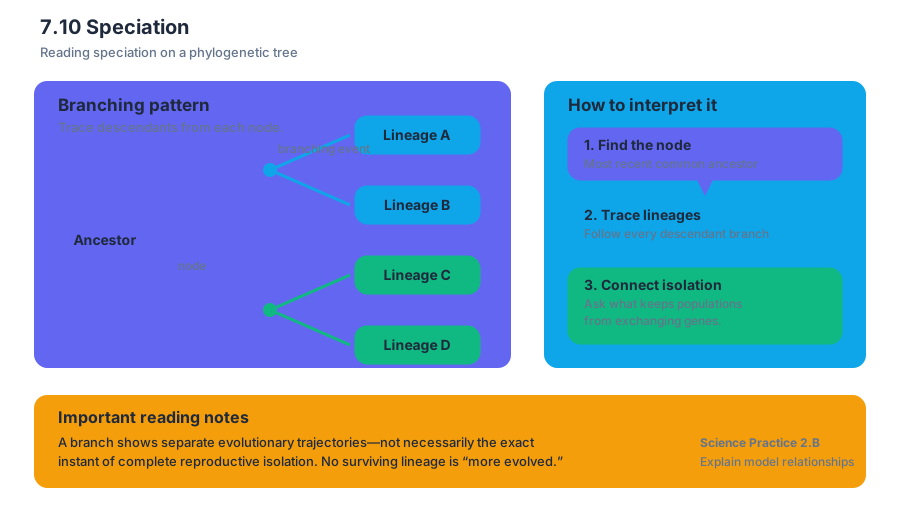
Phylogenetic trees and cladograms can illustrate speciation that has occurred. A node represents the most recent common ancestor of the lineages branching from it. A branching event represents the point at which one lineage divided into separate evolutionary trajectories; the diagram does not necessarily show the exact instant when complete reproductive isolation arose.
This is an application of Science Practice 2.B, “Explain relationships between characteristics of biological models in both theoretical and applied contexts.” To interpret a tree, identify the node, trace each descendant lineage, and connect the branching pattern to an isolation mechanism. Do not infer that a species at the end of one branch is “more evolved”; every surviving lineage has continued evolving.
Common misconception check
Misconception: “Any visible difference means two populations are different species.” Correction: differences in color, size, or behavior can appear while gene flow continues. Speciation requires reproductive isolation, not merely different appearances.
Science Practice 6.E, “Predict the causes or effects of a change in, or disruption to, one or more components in a biological system,” is tested when a prompt changes a barrier or mating pattern. For example, if a previously isolated population becomes connected by a migration route, predict increased gene flow and reduced divergence. If a new barrier prevents mating, predict that independent evolutionary change becomes more likely.
Retrieval check
A mountain range separates one population into two. After many generations, the populations come into contact, but their courtship signals differ and mating does not occur. The best explanation is allopatric speciation followed by behavioral prezygotic isolation. The geographic barrier began the separation; the failed mating behavior now maintains reproductive isolation.