From the free course AP Biology on Lykke
1.2 Elements of Life
Key concepts: Inquiry-based biological investigation · DNA mutations and cellular replication · HPV infection and cervical cancer risk · Henrietta Lacks and ethical/scientific issues · DNA plasmid stability and degradation · Selection and care of experimental organisms · Energy and biomass flow from plants to butterfly larvae · Brassica plant–butterfly larva investigation · Quantitative trait measurement in plant biology · Data organization, visualization, and analysis
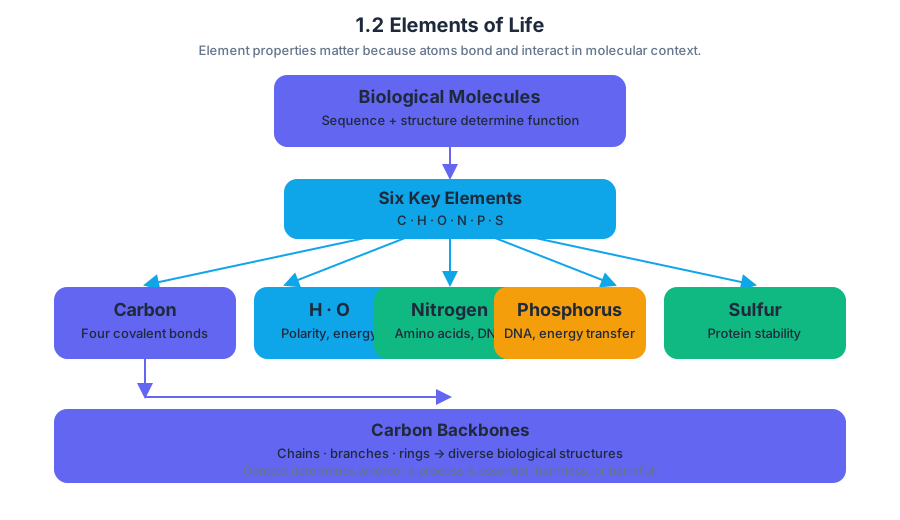
Carbon, hydrogen, oxygen, nitrogen, phosphorus, and sulfur make up most biological molecules, but their importance comes from how their atoms bond and interact, not simply from their presence.
1.2 Elements of Life
Carbon, hydrogen, oxygen, nitrogen, phosphorus, and sulfur make up most biological molecules, but their importance comes from how their atoms bond and interact, not simply from their presence. The same element can participate in harmless, essential, or harmful biological processes depending on its molecular context.
CED alignment — Topic 1.2 Elements of Life
Learning Objective 1.2.A: Describe the properties of the elements that make up biological macromolecules.
Essential Knowledge 1.A.1: The subcomponents of biological molecules and their sequence determine the properties of that molecule.
Carbon is especially versatile because each carbon atom can form four covalent bonds. This allows carbon atoms to build chains, branches, and rings that serve as biological backbones. Hydrogen and oxygen commonly contribute to polarity and energy transformations; nitrogen is central to amino acids and nucleic acids; phosphorus appears in nucleic acids and energy-transfer molecules; and sulfur helps stabilize some proteins.
From an element to a biological investigation
The most useful question is not merely “Which elements are present?” but “How can a change involving those elements alter a cell, organism, or ecosystem?” An investigation might ask whether an organism’s chemotactic response—movement toward or away from a chemical stimulus—is greater than its geotactic response to gravity or its phototactic response to light. The question becomes testable only after the responses are defined and measured, such as distance moved, percentage moving toward a stimulus, or time required to reach a target.
This illustrates inquiry-based biological investigation: begin with a biological question, identify the variables, select an organism that can be obtained and cared for responsibly, and organize observations into a form that can support an explanation. Experimental organisms should be readily available; insects may be caught or cultured, and plants may be grown on site or at home. Availability never removes the obligation to provide appropriate care, follow regulations, and respect all life. Vertebrate use may be restricted by local rules.
Worked example: a Brassica–butterfly system
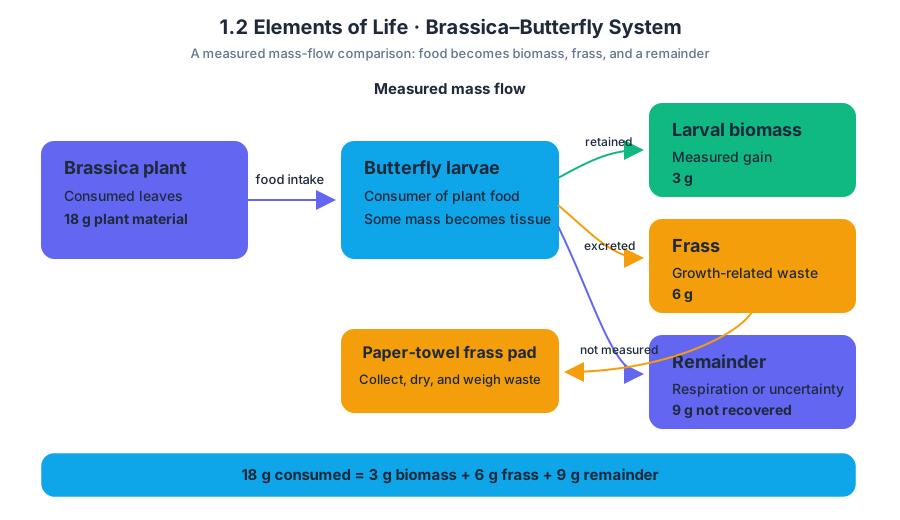
A Brassica barn can connect elemental biology to energy and biomass flow. Plants provide food for butterfly larvae, while the larvae gain some of the consumed plant biomass and lose some as growth-related waste called frass.
Suppose a group estimates that larvae consume $18\ \text{g}$ of plant material, gain $3\ \text{g}$ of biomass, and produce $6\ \text{g}$ of frass. The remaining mass represents material not recovered in those measured categories or uncertainty in the estimates. The group should not claim that all consumed biomass became larval tissue: some material is respired, and measurements may be incomplete. Converting comparable biomass measurements into energy units requires consistent units of mass, time, and energy.
A paper-towel frass pad makes waste collection visible and measurable. Students can then ask quantitative questions about plant height, stem color, or flower number and test whether those traits vary with environmental conditions or herbivore damage. The same setup can generate visual descriptions, calculations, and mathematical models rather than a single descriptive conclusion.
Mutations, HPV, and Henrietta Lacks
A mutation is a change in DNA. Normal cells can be affected when mutations alter information needed for DNA repair, cell-cycle control, or other cellular processes. If a cell with mutated DNA replicates, the altered DNA may be passed to its daughter cells; therefore, a local molecular change can become a population of cells with related abnormalities.
Human papillomavirus infection increases the risk of cervical cancer because viral effects can interfere with cellular regulation and DNA-integrity safeguards. The Henrietta Lacks case provides a concrete inquiry into what can happen when abnormal cells continue dividing and can be cultured as the HeLa cell line. It also raises scientific, legal, and racial issues: tissue removal without consent, access to medical information, the history of treatment at Johns Hopkins, and bias in research and health care.
Misconception check: HPV infection does not mean that cervical cancer is inevitable, and a mutation is not automatically harmful. The effect depends on which DNA sequence changes, how cellular regulation is altered, and whether the change is retained as cells replicate.
Plasmid stability and experimental design
Biological materials are not automatically stable simply because they are frozen. Plasmid DNA can degrade when stored in a frost-free freezer, whose repeated warming and cooling cycles can damage the sample. Before planning an experiment, investigators should check the material’s shelf life and storage requirements with the commercial vendor.
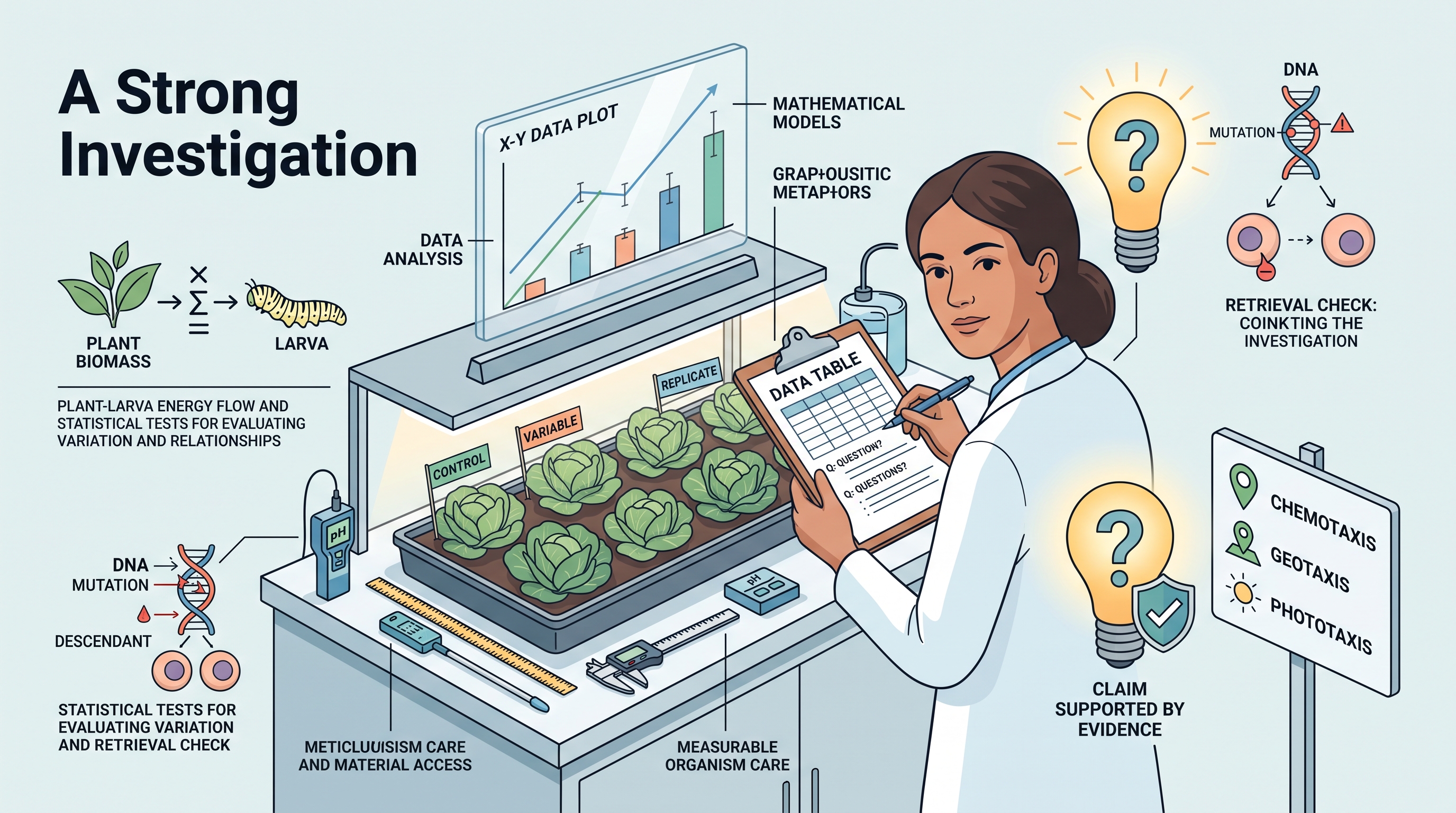
A strong investigation therefore includes organism care, material access, controls, replication, measurable variables, and a data table designed around the final question. Data should be analyzed with calculations, visual descriptions, and mathematical models, while conclusions must distinguish measured evidence from estimates.
AP Science Practices: Science Practice 1: Concept Explanation connects elemental composition to mutations, biomass, and cellular function. Science Practice 2: Visual Representations supports diagrams of DNA change and plant–larva energy flow. Science Practice 3: Questions and Methods is used to compare chemotaxis, geotaxis, and phototaxis and to design Brassica investigations. Science Practice 4: Representing and Describing Data organizes biomass, trait, and response measurements. Science Practice 5: Statistical Tests and Data Analysis evaluates variation and relationships. Science Practice 6: Argumentation requires a claim supported by evidence and biological reasoning.
Retrieval check: A plasmid sample was stored in a frost-free freezer and later produced inconsistent results. What should be checked first, and why? Then explain how a mutation in one cell could affect many descendant cells after replication.